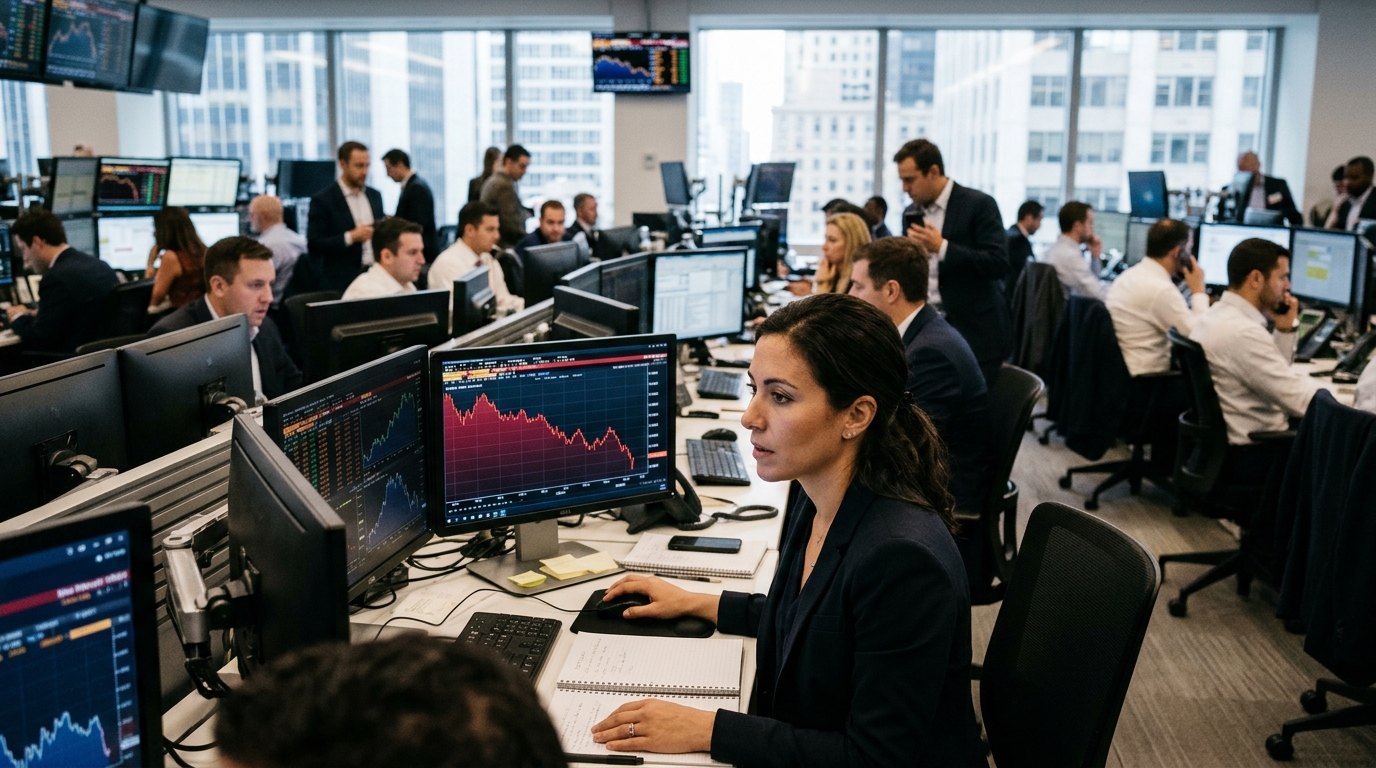
The number to hold in your head going into Friday is 48,914. That is the level, exactly 10% below the Dow’s August record close, that would officially mark a correction for the blue-chip index. The Dow closed Thursday at 49,097.06, down 1,101 points. The gap is 183 points. With Nasdaq-100 futures down and S&P 500 futures also lower in Friday’s pre-market, that threshold is live.
The S&P 500 dropped 2% for a sixth straight session, its longest losing streak in two and a half years, and now sits 8.2% off its all-time high set last month. The Nasdaq Composite is already past the correction threshold. The question is whether the index that has historically anchored retail investor confidence, the Dow, crosses the line next.
Breadth Makes This Different
Single-stock selloffs are manageable. What happened Thursday was not that. More than 90% of S&P 500 constituents finished lower, while the VIX surged to about 28.44, reflecting a sharp deterioration in investor sentiment. Selling spread across all 11 sectors. When every corner of the market falls together, it signals institutional de-risking rather than rotation. Capital is not moving from growth to value. It is leaving equities.
The AI trade is at the center of this. Nvidia fell 3.3% as the chip complex slid broadly. Those moves are on top of significant losses already accumulated this month. The broader chip sector has faced compounding pressure since the exit of Nvidia CEO Jensen Huang and persistent concerns over AI financing. The irony of Thursday is that Anthropic’s blockbuster IPO, which priced above its range and helped spark early enthusiasm, ended up serving as a sell-the-news event for every other AI name on the board.
Haven Signals Conflict
The asset mix is sending a specific message. Treasuries rallied, with the 10-year yield sitting near 5.05% after the session’s close. The dollar strengthened. The Dollar Index hit its highest level since April 2025 this week.
That combination, bonds up and the dollar up, says this is a rates-driven event as much as an AI-valuation event. Stubborn inflation has pushed markets to price in tighter policy into year-end. Traders positioned in commodities as a fear trade are getting the direction wrong.
The Global Picture
Global markets are wobbling, too. MSCI’s Asia Pacific benchmark slid sharply and is on track for its worst week since March 2020, underscoring that this is no longer a U.S.-only story.
The Trading Plan
The Dow’s 48,914 level is the session’s clearest reference point. A close below it removes any ambiguity about whether this is a correction. The S&P’s 7,100 level, flagged by multiple technicians this morning as near-term support, deserves equal attention given futures already pointing near that zone.
For chips specifically, Nvidia, Broadcom, and Micron have absorbed meaningful damage across November. The question is not whether to buy the dip but whether the macro catalyst driving the selling, a Fed that markets now expect to hike in December, has fully priced in. It has not. Avoid adding to AI-linked semiconductor positions ahead of the open.
Treasuries remain the clearest beneficiary of institutional defensive positioning. The dollar’s strength argues against commodities broadly. Any bounce attempt in equities that does not come with a VIX reversal below 25 and recovering breadth should be treated as a selling opportunity rather than a signal that the low is in.