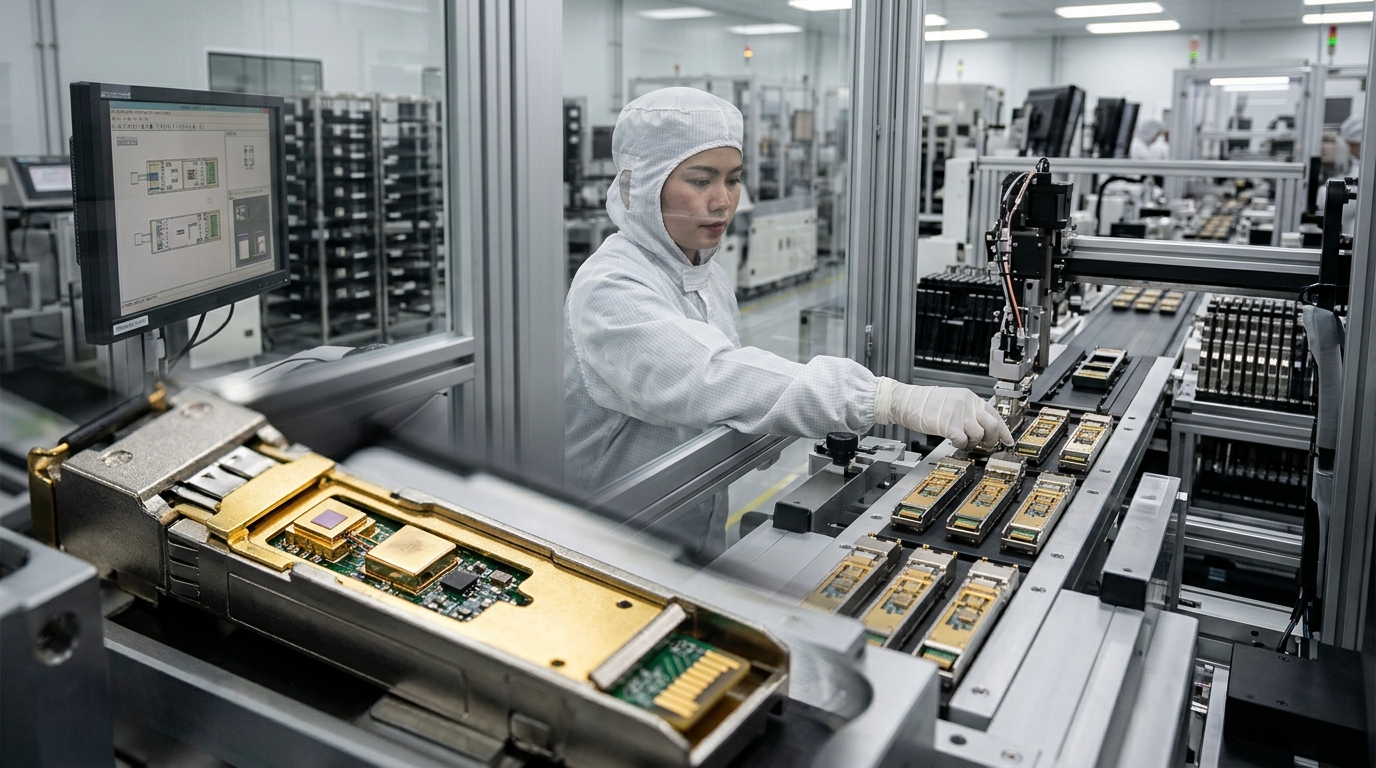
Fabrinet does not put its name on a single product it ships. It does not compete with any customer. It has no brand. And yet, after Tuesday’s close, it is now the most strategically important company in AI optical infrastructure that most investors do not own.
Why This Stock Now
On November 2, Fabrinet reported fiscal Q1 2027 results that beat on every line, then guided well above where the Street was sitting. Shares jumped roughly 15% to close at about $363.33 on November 3. That is the headline. The less-noticed development happened the same day, when Marvell announced a definitive agreement to acquire Lumentum in an all-stock deal carrying an implied enterprise value of $115 billion. Lumentum was one of Fabrinet’s own manufacturing customers. If the deal closes, the pool of independent optical suppliers will contract, and Fabrinet’s customer set will keep shifting.
The Business
Fabrinet manufactures precision optical, electro-mechanical, and electronic assemblies for the companies building AI data center infrastructure. It assembles for Cisco, Nokia, Amazon, and Coherent. Its competitive advantage is structural neutrality: because it competes with no one, it can serve everyone simultaneously.
That model produced its strongest top-line growth in a decade last quarter. Revenue reached $1.4745 billion in Q1, up 51% year over year. Data center revenue alone climbed about 78% to $777.1 million, representing 52.7% of total sales. Non-GAAP EPS hit a record $4.34, running nearly 49% above the prior-year period.
Why Wall Street Is Paying Attention
The Q2 guidance was the real accelerant. Management guided Q2 revenue to $1.60 to $1.65 billion, against a Street estimate near $1.50 billion, implying roughly 43% year-over-year growth at the midpoint. EPS guidance of $4.77 to $4.92 also cleared the consensus of $4.39 by a wide margin.
Analyst reaction was divided in degree, not direction. Needham reiterated its Buy and $500 target. Rosenblatt cut its target to $600 from $750, still implying substantial upside from current levels. The average target across the Street sits near $579.
Institutional ownership at Fabrinet runs at roughly 97% of shares outstanding, confirming this is not a retail-driven situation. Insiders, however, have been net sellers in recent months, a data point worth acknowledging.
What’s Driving the Opportunity
Two forces are compounding simultaneously. First, hyperscale-direct and merchant transceiver programs are ramping now, replacing the Nvidia-specific growth that moderated when Nvidia diversified its 800G supply chain to multiple vendors. CEO Seamus Grady said on the earnings call that he is “as optimistic as we were, if not a little bit more so than when we spoke 90 days ago,” pointing to broad demand across transceivers, data center interconnect, and high-performance computing. Near-packaged optics programs are expected to begin contributing revenue in the second half of fiscal 2027.
Second, Marvell’s acquisition of Lumentum reshapes parts of the competitive landscape. Lumentum was a customer of Fabrinet. If Lumentum is integrated into Marvell, some optical supply chains could become more vertically oriented, and that can influence how much assembly work remains outsourced versus brought in-house. Fabrinet is expanding to meet demand, targeting roughly $10 billion in revenue capacity by January 2027. It is also planning Building 11, which management said is expected to add about $3 billion of incremental revenue capacity when completed, with completion projected around the end of fiscal 2028.
What Could Go Wrong
The principal risk is customer concentration combined with the threat of insourcing. Cisco accounted for 19.9% of fiscal 2026 revenue, Nvidia 16.3%, Nokia 10.7%, and Amazon 11.5%. Together, four customers supplied over 58% of annual sales. Nvidia has already diversified away from using Fabrinet as its sole transceiver supplier for 800G products. The concern is that this dynamic repeats with the next generation of programs at Nvidia or any other hyperscaler with the capital to absorb manufacturing in-house.
Gross margins are thin at 12.1%, and operating cash flow dropped sharply in Q1, to $21.3 million from $102.6 million a year earlier, as expansion and working capital consumed cash. Longer term, the eventual migration toward co-packaged optics could structurally reduce the assembly content Fabrinet captures per unit of optical throughput.
The Bottom Line
Fabrinet’s 15% move was a reaction to the strongest quarterly results in a decade combined with guidance that cleared the bar by an unusually wide margin. The Marvell-Lumentum deal, announced the same week, could also reshape how independent optics vendors compete and how much work stays outsourced. The stock is still down substantially from its spring 2026 peak, trading around $363. That gap is partly because the Nvidia concentration fear is real and the insourcing scenario is not theoretical. But the Q1 earnings confirm that the base of demand is broadening beyond any single customer, which is exactly what the case required. For investors willing to hold concentration risk in exchange for a front-row position on the next transceiver cycle, Fabrinet is one of the clearest vehicles available today.