September 15, 2026
Bonus Content: Vertiv’s Margin Story Is Better Than Its Revenue Story
A 2,240% Gold Giant with a Neighbor Already Drilling
In mining, property lines matter to lawyers.
They matter less to geology.
One gold producer in Papua New Guinea has already turned this regional corridor into a multi-billion-dollar success story. It produces tens of thousands of gold-equivalent ounces per quarter and has become one of the top names in the world.
Now a smaller explorer is drilling nearby.
Not in a random patch of jungle.
In the same structural corridor, where surface work has already pointed to gold, copper, and silver mineralization.
The timing is interesting, too.
Across the developed mining world, many of the obvious deposits have already been drilled, mined, or picked apart. Ore grades are declining. Reserves are depleting. New discoveries are getting harder and more expensive to define.
In the South Pacific, it is different.
Rugged, remote, complicated. But still one of the few places where large undeveloped mineral systems remain on the map. Recently, the Oregon Group, a critical minerals intelligence firm, described this region as holding some of the largest undeveloped copper-rich deposits in the world.
No two projects are the same.
But the neighbor proved the district can produce.
Now the question is what sits next door.
Vertiv’s Margin Story Is Better Than Its Revenue Story
When hyperscalers scramble, they stop haggling. That dynamic is showing up in Vertiv’s (VRT) financials in a way the headline revenue numbers alone do not fully capture.
In the second quarter of 2026, Vertiv’s adjusted operating margin reached 22.6%, up 410 basis points from a year earlier, while adjusted diluted earnings per share grew 60% to $1.52. For an industrial business supplying cooling hardware, those are software-company numbers. The margin story is the real one.
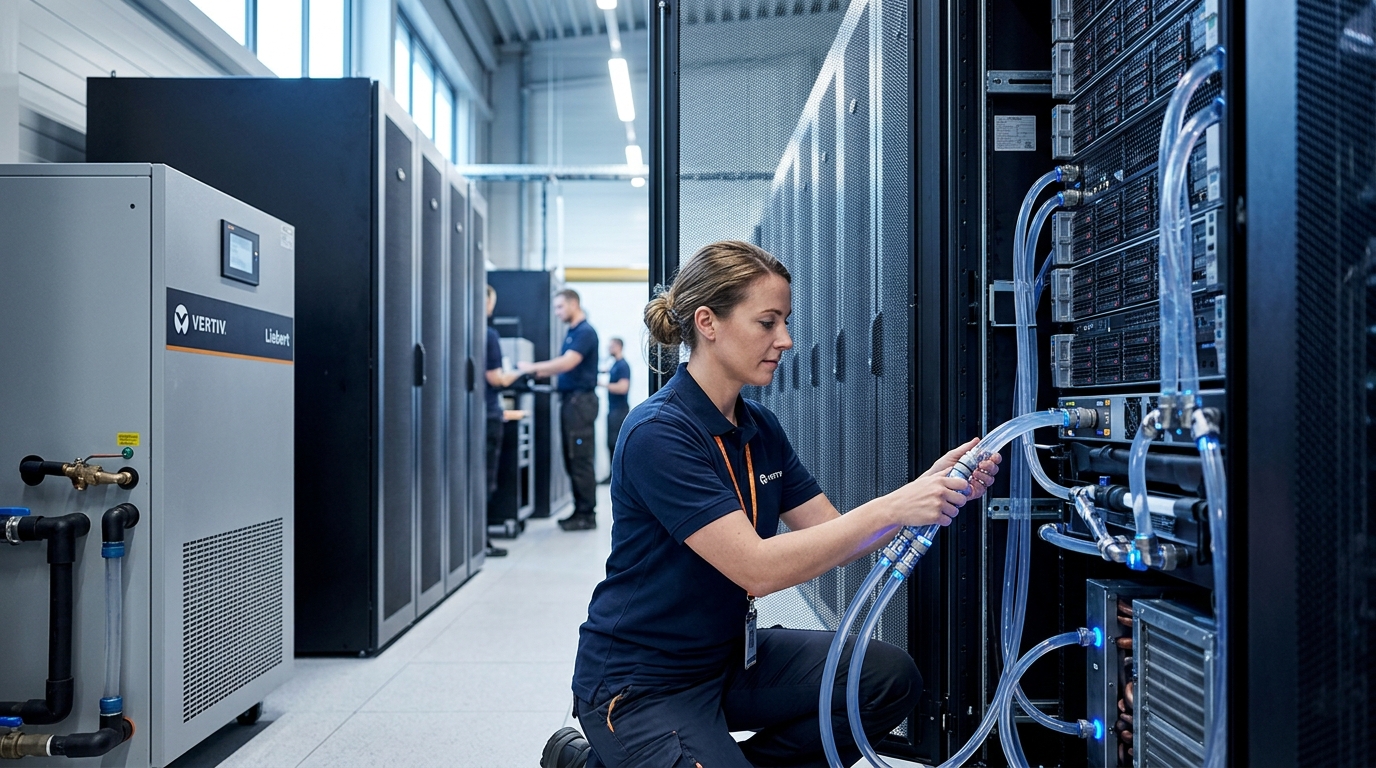
The underlying reason is structural. The shift to high-density AI racks requires advanced liquid-cooling systems that Vertiv provides. Air cooling is being pushed to its practical limits in high-density compute environments, which is why liquid cooling is moving from “nice-to-have” to “must-have” in more deployments. Every month that passes without a working liquid loop is a month of idle capital. Vertiv knows this, and its pricing reflects it.
Converting these larger, more complex projects is generating incremental margins of more than 30%, which showed up in the first quarter as adjusted operating margins expanded 430 basis points to 20.8%, underpinning the company’s raised forecast for 20% to 24% organic growth and 44% to 51% adjusted diluted EPS growth in 2026.
Management is reinforcing that position through deliberate acquisitions rather than organic engineering alone. In April, Vertiv acquired Strategic Thermal Labs, a specialist in advanced liquid-cooling technologies, extending its thermal-chain strategy by strengthening engineering capability at the interface between server-side liquid cooling and supporting infrastructure.
Then, on the Q2 earnings call, CEO Giordano Albertazzi said the company closed Thermal-Lube in April. The acquisition of Thermal-Lube added server-side liquid cooling and cold-plate expertise for high-density thermal management, together expanding Vertiv’s offering across the full thermal spectrum, from heat rejection to direct-to-chip cooling.
After raising full-year guidance again on July 29, 2026, management now expects adjusted diluted EPS of $6.70 at the midpoint, up 60% versus 2025, with the range set at $6.65 to $6.75. For context, Vertiv entered 2026 guiding to $5.97 to $6.07. Two guidance raises in six months is not coincidence; it reflects order visibility that most manufacturers cannot claim.
The $15 billion backlog establishes a reliable revenue stream for the next 12 to 18 months, and the size and quality of those orders reduces near-term cyclical risk. That cushion matters if AI capital spending softens.
The valuation is the legitimate tension. The stock trades at roughly 28 times forward earnings. A deceleration in hyperscaler capex commitments, or a single quarter of margin disappointment, would hit shares quickly.
The wealth-building lesson here is not about chasing a hot theme. It is about recognizing when a supplier holds genuine pricing leverage because its customers have no viable alternative on the timeline they need. Right now, Vertiv is that supplier. Whether it holds that position in 2028 depends on how fast competitors close the engineering gap.