September 2, 2026
Bonus Content: If Other Countries Follow Bessent’s Tariff Advice, These Portfolio Holdings Take the Hit
Below is an important message from one of our highly valued sponsors. Please read it carefully as they have some special information to share with you.
The window ahead of September 25th may be one of the more consequential positioning periods of the decade.
Because I believe Elon Musk is preparing to launch his most ambitious project to date — one that, in the years ahead, could position 1,806,000 investors for a re-rating of historic scale.
The question is whether you’ll be among them.
Hi, James Altucher here.
I’ve compiled the filings, disclosures, and market data that point to what Musk is building next.
This initiative has drawn almost no mainstream coverage — which is precisely why the asymmetric opportunity exists.
Once institutional capital finishes rotating in, that window closes.
PayPal. Tesla. SpaceX. Each redefined its sector. Based on the data I’ve reviewed, I believe what comes next is positioned to eclipse them in total economic footprint.
It represents what I consider the most significant wealth-creation setup I have analyzed in this cycle.
A select group of institutional players are already on record: a major hedge fund, the world’s largest asset manager, a global multi-strategy fund.
The 13F and Form 4 disclosures don’t lie.
After this briefing, you’ll have the same data they do.
Access the briefing here, and you’ll see the full analysis behind what Musk is developing…
You’ll understand the structural case for why this sector could see outsized upside relative to anything in his prior portfolio…
You’ll have the data showing why the September 25th window matters for positioning…
And you’ll know exactly how I’d allocate over the next 34 days to get ahead of this opportunity.
Look back at this briefing from September 25th onward.
Will it mark the moment you reviewed the analysis and acted on it?
Or the moment you passed?
The briefing is free to watch. A few minutes to review the evidence and decide whether the setup fits your thinking.
There’s also a research package valued at $1,000 included — available to a limited number of early registrants.
One note:
The September 25th catalyst date is approaching. This briefing is structured for readers ready to review the data and make a decision.
If that describes you, access the briefing here.
Looking forward to walking you through it.
James Altucher
Editor, Altucher’s Investment Network
If Other Countries Follow Bessent’s Tariff Advice, These Portfolio Holdings Take the Hit
Treasury Secretary Scott Bessent left Asheville on Tuesday with something more consequential than a press release. China was the only Group of 20 member to dissent from a joint statement declaring that non-market economies pushing out a never-ending stream of cheap exports is not sustainable. That is 19 countries aligned, one isolated, and a clear American push to turn that alignment into action investors have to price.
Bessent made his comments at the end of a two-day meeting where he urged G20 counterparts to take a page from the Trump administration’s playbook of using tariffs and other measures to crack down on trade imbalances. He was blunt about why: he had warned other nations at the beginning of Trump’s second term that a new U.S. tariff wall would mean Chinese goods flooding their markets, and said, “unfortunately, I was right.”
For investors, the critical question is not whether the G20 communiqué has teeth today. It is which parts of a diversified portfolio get damaged if even a handful of those 19 nations follow through with their own barriers over the coming months.
The China Exposure Problem
Start with the most direct line. Bessent has said China’s trade surplus, which reached a record-high nearly $1.2 trillion in 2025, is a barrier to global economic growth. The Trump administration is also eyeing an additional 7.5% tariff on Chinese imports after investigating alleged excess industrial capacity and forced-labor regulations. Owners of FXI, the iShares China Large-Cap ETF, are already sitting on an asset whose five-year track record is essentially flat. Any serious coordinated move by G20 members to wall off Chinese exports threatens the earnings base of the Chinese industrial and consumer companies that dominate that fund.
The risk inside EEM is more layered. EEM’s performance hinges on China, which represents about a fifth of the fund’s allocation. But the rest of the fund holds countries like India, Brazil, and Mexico, many of which export manufactured goods that compete directly with China. If those governments respond to Bessent’s encouragement by raising their own import barriers, they take on the friction of tariff administration and potential Chinese retaliation simultaneously. Investors should monitor geopolitical flashpoints involving China, potential tariff escalations, and currency volatility as key risks for the whole emerging-market basket.
Steel and Autos: Already Strained, Now More So
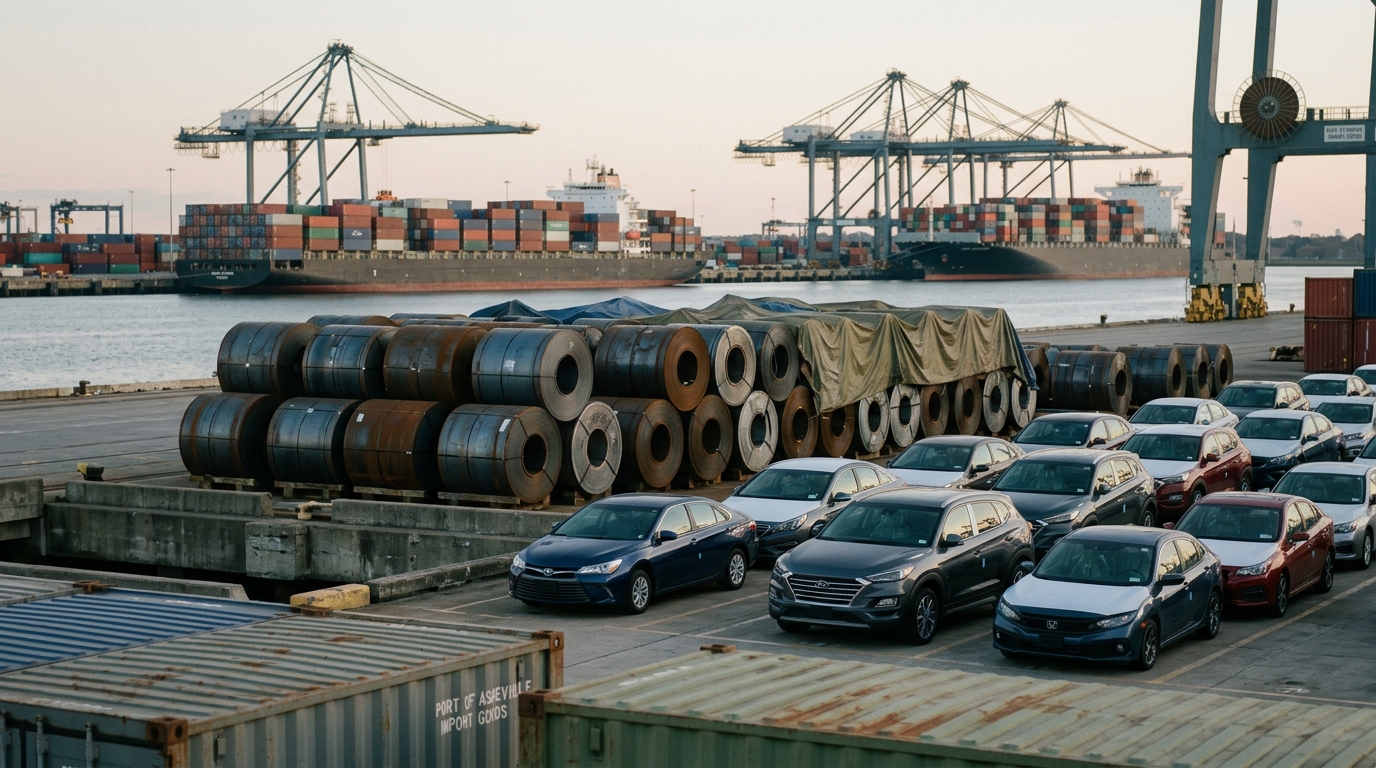
U.S. steel and aluminum already carry a 50% Section 232 duty. If European or Asian G20 members erect similar walls against Chinese steel, Chinese producers lose another outlet and may redirect volume to markets that remain open, depressing global prices and undermining the domestic-pricing advantage that U.S. steelmakers have built.
Autos face a different squeeze. Some analyses estimate vehicles can face effective tariff exposure around the low-teens in the U.S., and in July 2026 the U.S. announced and implemented additional tariff actions on imports under other statutory authority, with the impact on vehicles and parts still evolving. Automakers sourcing parts across borders carry compounding exposure if other G20 nations join the tariff cycle.
Where the Opportunity Lives
Not every portfolio position loses in this environment. Domestically focused U.S. manufacturers with limited import dependence benefit from the insulation. Companies building out U.S.-based supply chains, or those exporting to markets that are not in the crossfire of China-targeted tariffs, have structural tailwinds here.
The sharper point for long-term investors: diversification built on cheap emerging-market valuations alone is not the same as genuine diversification. Global investors spent much of 2025 adjusting to supply chain frictions introduced by U.S. trade and immigration policy, and while higher tariffs increased input costs for some EM exporters, demand for technology hardware, semiconductors, and energy-related goods allowed several EM regions to outperform expectations. That selective resilience is the template. Broad China or EM exposure without sector filtering carries real headline risk now that 19 governments have publicly agreed the current arrangement cannot stand.
Bessent’s Asheville statement may not move markets today. But a coordinated global tariff response to Chinese exports, even a partial one, rewrites the cost assumptions for steel, reshapes auto supply chains, and puts a ceiling on the China-heavy funds that rallied on the assumption that trade friction was a bilateral U.S.-China story. It is not.