Micron Technology reports fiscal fourth-quarter results on September 30, and the street is already positioning. The stock closed Monday near $959, having recovered from a summer selloff that briefly pushed shares below $740 in late July. It still sits about 26% below its 52-week high of $1,255. That gap is the question.
The revenue number almost certainly impresses. Micron guided Q4 revenue at $50.0 billion, plus or minus $1.0 billion, up from $41.5 billion in fiscal Q3 and from about $9.3 billion a year earlier. That is not a misprint. A year ago, Micron was a cyclical memory company recovering from a brutal downturn. Today it is something closer to a toll collector on every major AI build in the world.
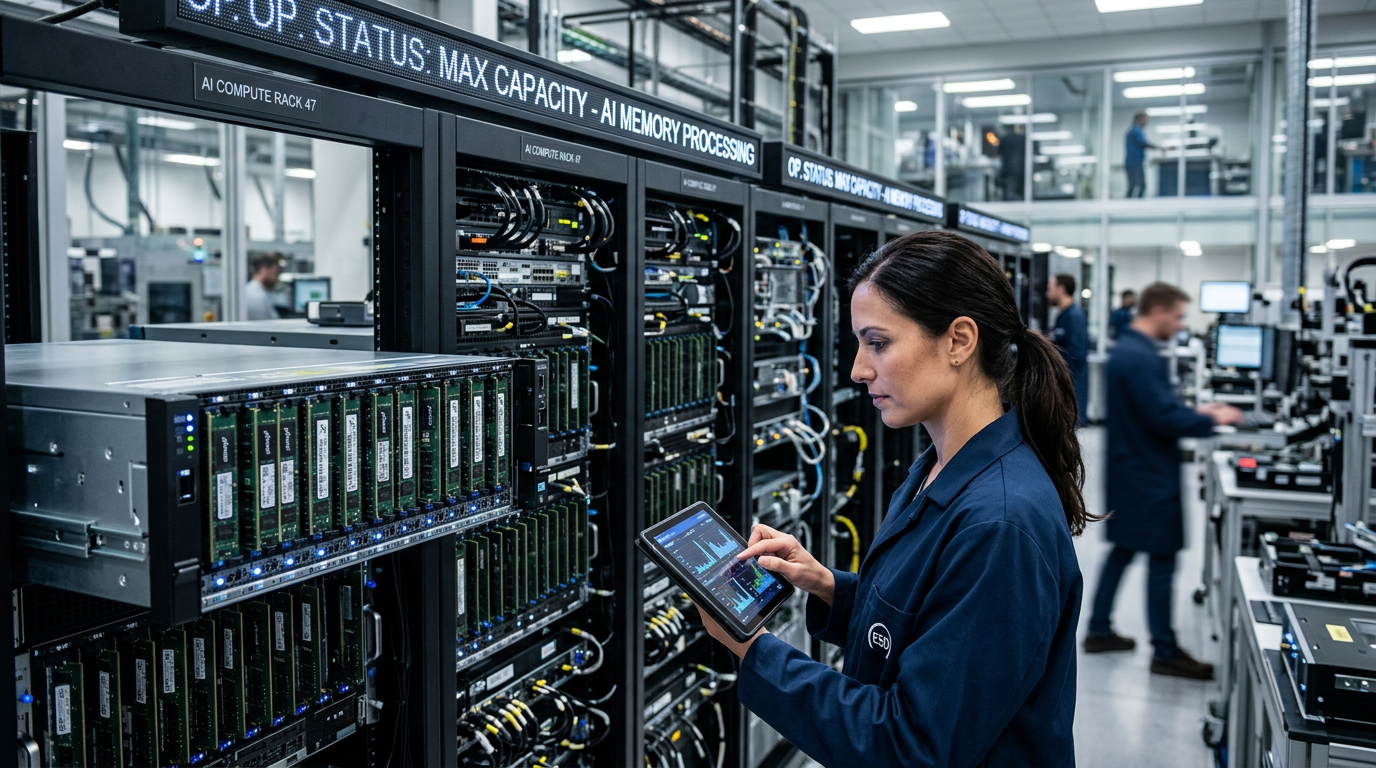
The mechanism is High Bandwidth Memory. HBM is the memory stacked directly onto Nvidia’s AI accelerators, and Micron is one of three suppliers globally. The company has secured roughly $100 billion in binding multi-year customer agreements that are structured as take-or-pay. CEO Sanjay Mehrotra said on the Q3 call that supply shortages in memory and storage will take considerable time to improve even as industry supply gradually recovers in 2028. That is a deliberate signal to hyperscalers: lock in now.
Q3 confirmed the business is delivering, not just guiding. Revenue jumped to $41.5 billion on an 85% gross margin, producing net income of $28.2 billion versus $1.9 billion a year earlier. Diluted EPS came in at $24.67, against $1.68 twelve months prior. Operating cash flow hit $25.4 billion, while Micron cut total debt from $15.5 billion to $5.7 billion in a single year. Those are not incremental improvements. That is a structural transformation of the balance sheet.
So why does the stock trade at a forward price-to-earnings ratio of roughly 6? The market is pricing in mean reversion. Memory cycles are real, and the bears cite Chinese competition from CXMT, potential algorithmic memory deflation from software efficiency gains, and the risk that HBM4 pricing softens faster than expected once Samsung and SK Hynix ramp supply. Those are legitimate concerns.
The bull case rests on two counterpoints. First, HBM4 pricing may not compress quickly. The transition from HBM3E to HBM4 is technically demanding, and Micron has said HBM4 is in high-volume shipments for its lead customer’s platform. Second, the customer agreements are take-or-pay. Hyperscalers are not walking away from memory commitments when they are simultaneously building out hundreds of billions of dollars in AI infrastructure. The deposits and commitments backing those agreements total roughly $22 billion.
What Could Go Wrong
September is historically the worst month for Micron specifically. The stock has fallen in five of the past nine Septembers, and this year the macro backdrop is complicated. The Federal Reserve meeting later this month adds uncertainty, and rate-sensitive growth stocks have been volatile all summer.
Beyond seasonality, a guide that misses $50 billion or a gross margin that disappoints versus the 85% Q3 print would rattle the thesis. The stock has recovered enough from July lows that a clean beat is partially priced in. Only an upside surprise on FY27 guidance would be a genuine catalyst for new highs.
The Bottom Line
Micron is not a speculative AI trade. It is the memory infrastructure underlying every major accelerator deployment in the world, locked into multi-year contracts, with a balance sheet that has been rebuilt in real time. A forward multiple of 6 reflects a market that has not yet decided whether this cycle is structural or temporary. September 30 is when that debate gets data. At current prices, the risk-reward favors buyers who can tolerate four weeks of volatility.