July 21, 2026
AMD’s CPU Story Just Got Bigger
EPYC is growing faster than the GPU trade. Here is why it matters now.
Frist a note from Behind the Markets
Dear Friend,
I’m going to do something unusual today: give you the name and ticker of a stock. Free.
No catch.
It’s a company almost no one knows is in a joint venture with Elon Musk, running the emergency power plant keeping his supercomputer alive right now.
Every hour those turbines spin, this company skims a toll off Musk’s panic.
Why now: that temporary power is on a federal clock, and the scramble for permanent power is just getting started.
This is the door-opener. The simplest way to get on the right side of Musk’s energy crisis today.
Click below and I’ll send you the ticker, free.
“The Buck Stops Here,”
Kelly Maguire
Behind the Markets
Most of the AMD coverage right now starts and ends with GPUs. The Instinct accelerators, the Nvidia alternative trade, the MI450 pipeline. Fair enough. That story is real. But there is a second story running alongside it that has gotten almost no attention, and it is starting to look like the bigger one.
The CPU side of AMD just doubled in addressable market size. Overnight. Based on a structural shift in how AI actually gets built.
Q1 first. AMD reported Q1 2026 non-GAAP EPS of $1.37, beating analyst consensus by roughly 7.87%, on revenue of $10.3 billion, up 38% year over year. Record free cash flow of $2.6 billion. Cash on the balance sheet of $12.3 billion. The stock moved. Coverage moved on. The GPU story dominated.
What most people glossed over was one line from Lisa Su about CPUs. That line changed the math.
Bigger than Nvidia? Louis Navellier thinks so.
In 2016, Louis Navellier recommended Nvidia at $2.51 – split-adjusted. It went up 44,000%. He also called Apple before a 36,000% rise and Microsoft before a 60,800% climb. Now he says a new AI device coming online in Tennessee is the setup for the biggest call of his career.
He’s agreed to reveal the stock at the center of it – down to the ticker – for free.
The Number That Doubled
On the Q1 call, Su raised AMD’s server CPU total addressable market forecast from roughly $60 billion growing at 18% annually to over $120 billion growing at greater than 35% annually by 2030. The reason is agentic AI, and it is worth understanding what that actually means for compute architecture.
Old AI workloads, the chatbot kind, ran on a standard ratio: one CPU head node for every four to eight GPUs. The CPU handled scheduling and I/O. The GPUs did the math. Agentic AI is different. Multiple models acting autonomously, calling tools, executing workflows, handing off tasks in real time. That workload requires far more CPU compute per unit of GPU capacity. The ratio is collapsing toward 1:1 in some deployments.
CFO Jean Hu said it plainly: agentic AI is not about answering questions anymore. It is about orchestration, database access, and tool execution. All of those require significant CPU performance.
Slight tangent, but it matters: AMD posted its fourth consecutive quarter of record server CPU revenue in Q1. Sales rose more than 50% year over year, with both cloud and enterprise end markets up over 50%. AMD now expects server CPU revenue to grow more than 70% year over year in Q2 alone.
Venice Launches This Week
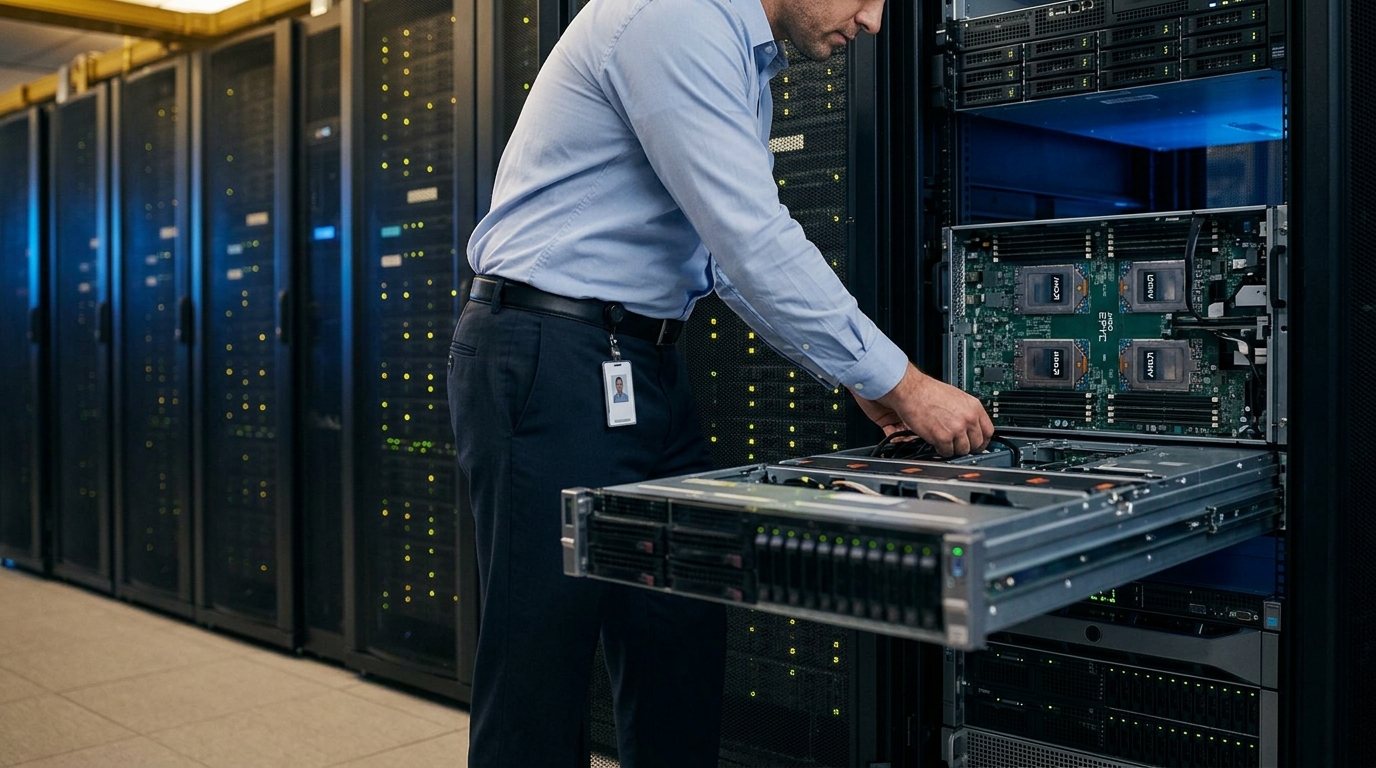
AMD EPYC Venice, the company’s next-generation Zen 6 server CPU, is being officially introduced at AMD’s Advancing AI 2026 conference on July 22 and 23 at the Moscone Center in San Francisco. This marks the commercial debut of the first x86 server CPU in production on TSMC’s 2nm process node.
Venice lands with a 33% core count increase over its predecessor, a claimed 70% performance advantage, and a fundamental redesign of the chip’s internal architecture. The platform moves to a new SP7 socket supporting 16 memory channels and up to 1.6 TB/s of bandwidth, with PCIe Gen 6 support that doubles per-lane bandwidth compared to PCIe 5. The process-node lead over Intel’s next P-core Xeon, Diamond Rapids, is expected to last at least through the end of 2027.
Lisa Su’s keynote is July 23 at 9:30 AM PT. The event features over 100 sessions, with confirmed partners on stage including Meta, OpenAI, xAI, Oracle, Microsoft, Cohere, HUMAIN, and Red Hat.
Venice is also the host CPU inside the Helios rack-scale platform. Helios integrates 72 MI455X accelerators at rack scale, with AMD marketing the rack at up to 2.9 exaflops of FP4 compute performance and 31 TB of HBM4 memory. AMD expects the first Venice-based systems to ship in Q3 2026. Microsoft has announced it will deploy Helios on Azure for production-scale AI inference.
The competitive position is worth noting. AMD already held a record 46.2% of x86 server CPU revenue in Q1 2026, at only 33.2% unit share. That means AMD generates nearly half of all x86 server CPU spending while shipping roughly one-third of the units. Venice is designed to extend that premium.
The Business Numbers
Data Center segment revenue climbed 57% to $5.8 billion in Q1, driven by EPYC processors and Instinct GPUs. Client and Gaming revenue rose 23% to $3.6 billion. Embedded grew 6% to $873 million. Non-GAAP gross margin came in at 55%, up 170 basis points year over year.
AMD’s Q2 2026 outlook calls for revenue of about $11.2 billion, plus or minus $300 million, implying roughly 46% year-over-year growth at the midpoint, with non-GAAP gross margin around 56%. Q2 earnings are confirmed for August 4.
One more number worth anchoring: more than 1,600 public EPYC cloud instances are now available globally, up approximately 50% year over year. The CPU story is not theoretical. It is already in production at scale.
What Wall Street Is Saying
The analyst community has been catching up fast. Goldman Sachs raised its 12-month price target to $640 on July 5, maintaining a Buy rating. Wells Fargo raised its target to $615 from $505 on an Overweight rating, and increased its AMD server CPU revenue estimate to $16.0 billion for 2026.
Cantor Fitzgerald analyst C.J. Muse raised his target to $700 from $500, the highest on Wall Street, calling AMD his top pick in computing above both Nvidia and Broadcom. UBS increased its target to $670, with analyst Timothy Arcuri citing AMD’s competitive edge in standalone CPU racks and continued server CPU market share gains.
The consensus forming across the Street: AMD’s most important growth driver over the next two years may not be the Instinct GPU. It may be the EPYC server CPU.
Where the Risk Lives
Nvidia’s CUDA software ecosystem remains a genuine competitive moat. AMD’s ROCm stack is improving, but it does not yet match CUDA’s breadth across AI and HPC workloads. Developer inertia does not reverse quickly, and that gap is real.
Intel’s Clearwater Forest is now available, targeting high-density scale-out workloads. Diamond Rapids, Intel’s P-core Xeon response, is confirmed for 2027. That gives AMD a clear window, but enterprises making long-term infrastructure decisions know the competition is coming.
China remains an overhang. AMD’s filings discuss inventory and related charges tied to U.S. export controls on Instinct data center GPU products. Further restrictions could weigh on addressable revenue. And the stock is not cheap. A Helios ramp delay, a pause in hyperscaler AI capex, or tighter export controls would pressure 2026 and 2027 estimates, on which the current valuation depends.
Three Dates Worth Watching
- July 22-23: AMD’s Advancing AI 2026 conference, Moscone Center, San Francisco. Lisa Su keynote July 23 at 9:30 AM PT. Watch for full Venice SKU details, Helios customer disclosures, and any roadmap updates beyond H2 2026.
- August 4: Q2 2026 earnings. The most important data point will be Q3 Data Center AI guidance. Sequential acceleration from Q2 would confirm that contracted demand with Meta and OpenAI is converting to recognized revenue. A flat or declining Q3 guide is the warning sign to watch.
- H2 2026 Helios execution: AMD confirmed the MI450 is now sampling, with the Helios rack-scale system launching in H2 2026. AMD has said a number of customers already have full Helios racks in their own data centers running production workloads.
Bottom Line
The GPU trade at AMD is real. The Meta 6-gigawatt commitment, the MI450 pipeline, the Helios rack delivering 2.9 exaflops per unit. That story earned its place in the conversation.
But the part that still does not get enough credit is this: AMD expects server CPU revenue growth above 70% year over year in Q2, with robust growth continuing through the second half of 2026 and into 2027. The company has doubled its server CPU total addressable market estimate, with Lisa Su now projecting it will reach over $120 billion by 2030 at a 35% CAGR. While AMD previously outlined a server CPU market growing at roughly 18% annually, that number is now more than double.
The Advancing AI event this week and August 4 earnings will either deepen the conviction behind that call or start testing it. If Venice benchmarks land close to AMD’s projections and Q3 guidance reflects Helios ramp momentum, the CPU story goes from underappreciated to the main event. If either slips, the valuation leaves little room. Either way, the CPU angle is worth understanding before the results land.