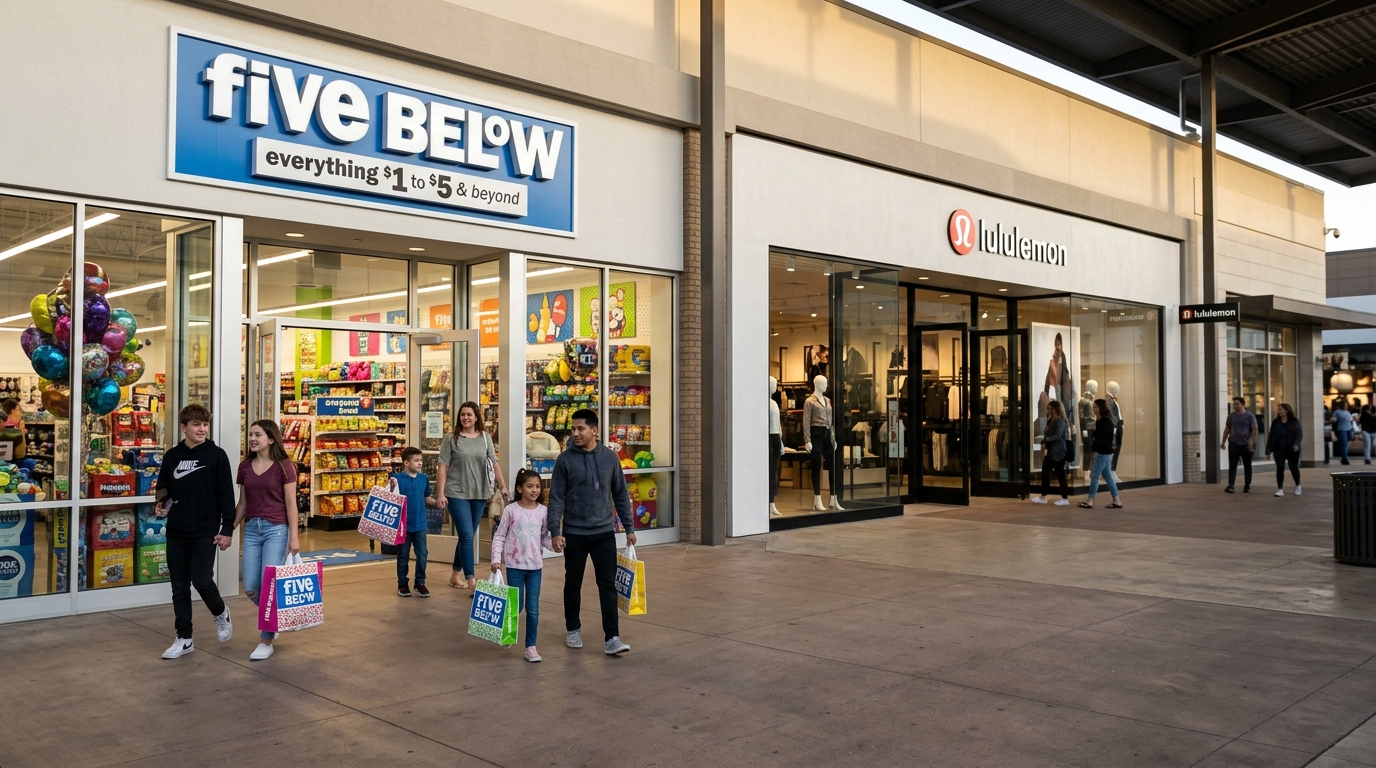
Discretionary retail split apart Wednesday night. Lululemon plunged about 15% in after-hours trading Thursday after reporting a 4% revenue decline and a 9% comparable sales drop, the kind of result that confirms a structural deterioration, not a rough patch. The company cut its full-year forecasts again, underscoring the challenges ahead for incoming CEO Heidi O’Neill as she walks into a business with no obvious floor. Meanwhile, Five Below (NASDAQ: FIVE) did the opposite of everything investors feared.
Why This Stock Now
The stock rose 5.3% in after-hours trading to $255.96 after comparable sales rose 14.1%, and that number is not a one-quarter fluke. The second quarter marked Five Below’s fifth straight quarter of double-digit comparable sales growth, with two-year stacked sales up 26.5%. When a retailer laps a double-digit comp with another double-digit comp, the word “momentum” stops being a placeholder and starts being a fact.
The Business
Five Below sells trend-driven merchandise, tech accessories, party supplies, snacks, toys, fashion basics, at a price point that holds in almost every economic environment. Comparable sales growth was driven mainly by higher transactions, and management said traffic was strong, with better engagement from both new and returning customers. The model does not depend on a single category or a single demographic holding up. When a consumer is being squeezed, Five Below is often where they go.
The company opened 52 net new stores and ended the quarter with 2,022 stores in 46 states, and it entered Idaho, its 47th state, in August, with plans to enter Puerto Rico in the second half of 2027. The white space is real. At a store base this size, new unit returns still rank among the most attractive capital deployments in the business.
Why Wall Street Is Paying Attention
Five Below reported adjusted earnings of $1.68 per share on revenue of $1.26 billion, beating Wall Street estimates of $1.33 per share and $1.21 billion in sales. The bottom line surged 107.4% from 81 cents in the year-ago quarter. That kind of earnings leverage, more than doubling EPS while growing the store base by nearly 9%, is what gets institutions to move.
They moved. Analysts raised their price targets following the earnings beat, with Mizuho to $295 and Telsey to $305, while others also moved targets higher in the days after the report. The upgrades are broad and the conviction behind them is visible in the numbers.
The board paired the earnings release with a separate statement: on August 29, directors approved a new share repurchase program authorizing the buyback of up to $600 million of common stock. For a company trading near $257, that is a meaningful commitment and a direct signal that management views the current price as below fair value.
What’s Driving the Opportunity
Management raised its full-year sales outlook to $5.63 billion to $5.71 billion from $5.40 billion to $5.48 billion, with comparable sales now expected to grow 10% to 12% compared to the prior forecast of 6% to 8%. The full-year adjusted earnings forecast moved to $9.83 to $10.31 per share from $8.65 to $9.05. Both the sales and earnings revisions cleared Street expectations by a wide margin. The guidance raise is not conservative math, it reflects real trend acceleration in the first half.
Gross margin improved to 35.6%, while adjusted operating margin widened to 9%. Margin expansion alongside unit growth and comp acceleration is the combination that drives multiple expansion, and Five Below is currently delivering all three.
What Could Go Wrong
The stock is approaching its 52-week high, which means it is not cheap in absolute terms. Any deceleration in comparable sales from the 14% pace, even to the 8-10% range management guided for Q3, could disappoint investors who have re-rated the stock on the strength of recent results. Adjusted gross margin expansion in Q3 is expected to be partly offset by higher outbound transportation fuel costs and an unfavorable shrink comparison. Execution on the store redesign program and new state expansions adds operating complexity. A broad consumer slowdown would pressure traffic even at value-oriented retailers.
The Bottom Line
Five Below earned the right to be today’s featured stock by doing the exact opposite of what the rest of discretionary retail did this week. It grew traffic, expanded margins, opened stores at pace, raised the year, and authorized a $600 million buyback, all in the same report. Mizuho analyst David Bellinger said the beat and raised guidance demonstrates a model fully aligned with its core customer base. That alignment is not accidental. It is the product of a strategic reset now clearly working. The Lululemon collapse across the street makes Five Below’s momentum look sharper by contrast. This is where discretionary dollars are going right now.