July 2, 2026
AMD Pulled Back. Aug 4 Is Still the Real Test.
The CPU story has been hiding in plain sight all year.
AMD closed June 30 at $580.91, hit a 52-week high of $584.73 the same day, and the market cap briefly touched $950 billion. Then Wednesday happened. The stock dropped more than 4% — trading around $531 by midday July 2 — as investors locked in gains after one of the biggest single-quarter chip rallies in recent memory. The stock is still up roughly 152% year-to-date. But the pullback is a reminder that at these multiples, the margin for error heading into August 4 is basically zero.
Here’s what I keep coming back to, though.
Everyone is watching the GPU story. The MI450 ramp, the Meta deployment, the AI accelerator TAM. And yes, all of that matters. But there’s a case to be made — and Wells Fargo made it explicitly on June 30 when they raised their AMD target to $615 — that the server CPU opportunity is the part of this story that the market hasn’t fully digested yet.
Bitcoin Got the Idea Right. It Got the Backing Wrong.
Bitcoin proved millions want money no government can print. But it’s backed by nothing but belief.
What happens when you keep everything it got right — and back it with real, verified gold? You find out July 8.
Wells Fargo kept their Data Center GPU estimates unchanged at $15.6 billion for 2026 and $40.6 billion for 2027. The thing is, they raised the target anyway. The revision was driven entirely by CPU estimates. That’s the tell. If the GPU numbers already reflect the AI acceleration theme, then the incremental upside — the part not yet in the price — lives in server CPUs. AMD guided server CPU revenue to grow more than 70% year-over-year in Q2. More than 70%. That’s not a GPU number. That’s an EPYC number.
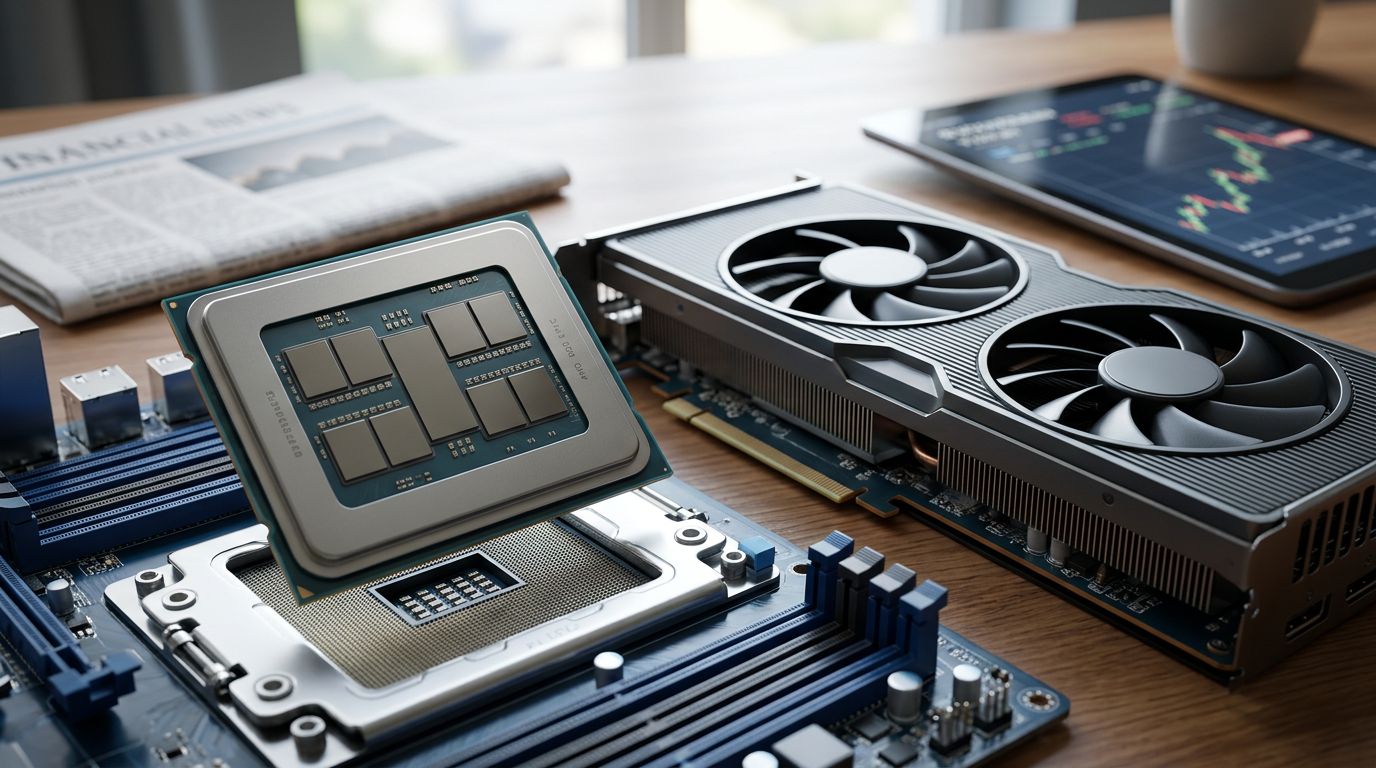
Quick tangent worth noting: AMD’s 6th Generation EPYC “Venice” chips, built on TSMC’s 2nm process, entered production ramp in May, and AMD said it has more customers validating and ramping Venice than any prior EPYC generation. Meta is also a lead Venice customer, on top of the MI450 GPU commitment. AWS, Google Cloud, Microsoft Azure, and Tencent have all expanded EPYC-powered instances. The CPU footprint is widening fast, and it’s widening at exactly the moment AMD is about to report Q2 numbers.
On the Q1 call — reported May 5, with revenue of $10.25 billion (up 38% year-over-year) and non-GAAP EPS of $1.37 against a $1.29 consensus — Lisa Su said customer forecasts around the MI450 Series and Helios were exceeding initial expectations. Data Center came in at $5.8 billion, up 57%. Management guided Q2 to $11.2 billion, plus or minus $300 million. The Street is currently sitting at roughly $11.25 billion in Q2 revenue consensus, with EPS expectations around $1.60. Both are fractionally above the guidance midpoints, which means AMD needs clean execution, not heroics.
The 7 Things I Wish I’d Known Sooner
I’ve been trading for over 50 years. In that time, I’ve made every mistake an options trader can make – and watched plenty of other people make them too.
Here’s what I learned: the losses you regret most almost never come from a lack of knowledge. They come from skipping a step you already knew to take.
So, I wrote down the 7 steps that matter most. On one page. Run it before any options trade.
It’s called the Smart Trade Options Checklist. Normally $29.97. Free today.
The options picture is interesting right now. Call volume was heavy in the final days of June as AMD broke to new highs. The implied move into August 4 will likely underprice what the stock is capable of — AMD jumped roughly 15% in after-hours after the Q1 report — but that’s how the options market works. It anchors to recent realized vol, not to tail outcomes. The traders buying out-of-the-money calls in late June were betting on that gap.
The bear case is worth taking seriously, not dismissing. AMD’s trailing P/E sits somewhere north of 170x depending on whose numbers you use. The $800 million inventory charge from Q2 FY2025 tied to U.S. export controls on the MI308 — that’s behind them, but China policy risk hasn’t gone away. NVIDIA still owns AI training in a way that AMD hasn’t cracked yet. And insiders have been net sellers over the past 90 days, though the bulk of that looks like pre-scheduled 10b5-1 activity rather than conviction selling. Still. At 170x trailing earnings, you’re pricing in a long runway of perfect execution.
Cantor Fitzgerald raised to $700 on June 29. UBS is at $670. Wells Fargo moved to $615 on June 30. Goldman Sachs upgraded to Buy at $450, grounding their thesis in agentic AI infrastructure demand. The range from $450 to $700 tells you something: analysts aren’t disagreeing about whether AMD wins, they’re disagreeing about how much of the win is already in the stock.
The July 22-23 Advancing AI 2026 event at Moscone Center in San Francisco is the part most people aren’t fully accounting for. Lisa Su is presenting. There could be MI450 and Venice details that shift the implied volatility picture going into August 4. That event is less than three weeks away — which means anyone positioned for the earnings report should be watching July 22 just as closely.
Miss These 10 Stocks… Miss the Rally
What are the “Double Engine” stocks for the rest of 2026? Instead of settling for income or growth, these are stocks that deliver both. Our Top 10 Best Stocks to Own in the Second Half of 2026 report includes companies that are the perfect combination of steady payouts and explosive capital appreciation potential – all in one portfolio-ready list. This is how you position ahead of a market tailwind.
August 4 is confirmed, after the close. Q2 EPS consensus is around $1.60. The CPU growth story either shows up in that report or it doesn’t. The GPU numbers will get the headlines either way. But the CPU line is where the real read on AMD’s 2027 trajectory lives — and that’s the number worth watching when the release drops.