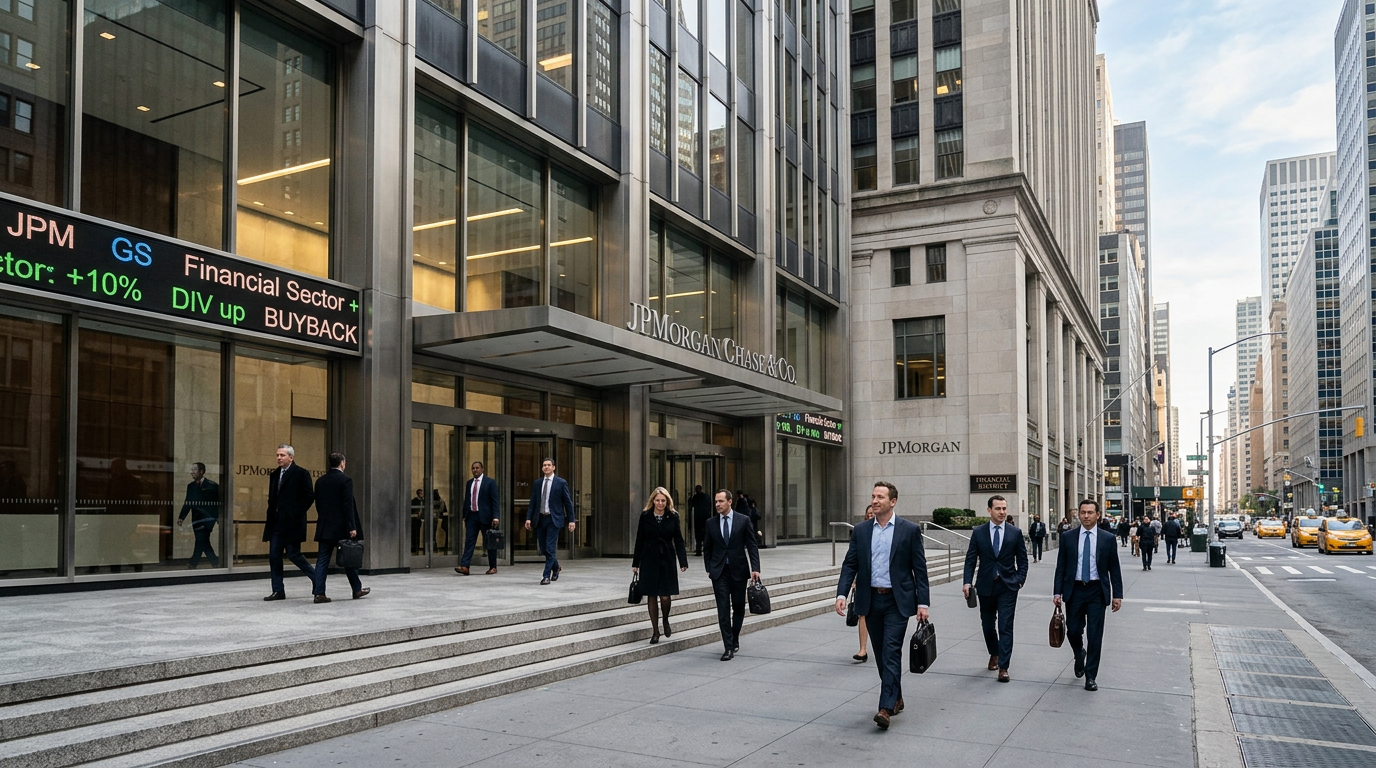
Let’s start with the number that actually matters: $50 billion.
That’s JPMorgan’s new share repurchase authorization, effective July 1. The largest U.S. bank by assets also raised its quarterly dividend 10% to $1.65 per share. That alone would have been a headline week. But JPMorgan wasn’t alone.
Goldman Sachs lifted its quarterly dividend 11% to $5.00 per share from $4.50 — a 25% increase versus the prior year. Morgan Stanley raised its payout 15% to $1.15 per share and reauthorized a $20 billion multi-year buyback program. Wells Fargo lifted its dividend 11% to 50 cents per share. Citigroup is moving to 67 cents from 60 cents, pending board approval. Bank of America CEO Brian Moynihan said an announcement is coming next month.
All of this followed the Federal Reserve’s release of 2026 stress test results showing that all 32 large banks tested remained above their minimum capital requirements — even after absorbing more than $708 billion in projected losses under a hypothetical scenario that included a 39% decline in commercial real estate prices, a 30% drop in housing prices, and unemployment peaking at 10%.
Why This Moment Is Different
In most years, passing the stress test is table stakes. Banks pass, they raise dividends modestly, the press releases go out, and the sector moves on. This year has a different texture to it.
The Fed decided in February 2026 to freeze the stress capital buffer requirements until 2027. What that means practically: no new capital constraints are being imposed. Banks are not being asked to hold more capital against losses before returning money to shareholders. The frozen buffer is a structural tailwind for capital returns that runs through the end of next year.
That decision combined with the nation’s six biggest banks having already paid out more than $140 billion in dividends and buybacks last year — a record that surpassed 2019 — suggests the capital return cycle is accelerating, not plateauing.
The firms collectively posted their largest annual profit since 2021 on record trading revenue. Passing the stress test just removed the last formal constraint on where that profit goes.
The Numbers Behind the Headline
JPMorgan raised its dividend from $1.50 to $1.65 per share and authorized a new $50 billion buyback. Its stress capital buffer requirement stays at 2.5% through September 30, 2027, and its CET1 ratio requirement remains at 11.4%. Goldman Sachs lifted its dividend to $5.00 from $4.50, with its stress capital buffer steady at 3.4% through the same date and CET1 at 11.4%. Morgan Stanley moved its payout to $1.15 from $1.00 and reauthorized $20 billion in buybacks, with its aggregate CET1 at 11.8%. Wells Fargo raised to $0.50, an 11% increase. Citigroup moves toward $0.67 pending approval.
To put the stress scenario in context: the Fed modeled a severe global recession where equity markets decline 58%, housing falls 30%, commercial real estate drops 39%, unemployment climbs from 5.5% to 10%, and the U.S. economy contracts 4.6%. Despite that hypothetical, aggregate CET1 capital ratios across all 32 banks declined just 1.6 percentage points — and every single one stayed above the regulatory floor.
Slight tangent, but it matters:
The regulatory environment for banks is softening in ways that go beyond the stress test freeze. The Fed has been revising the tests to be more bank-friendly, and banking groups have been pushing for greater transparency in how the rules are adopted. Some of the biggest bank-capital rule changes since post-2008 are being debated. If those finalize in the direction most analysts expect, the structural floor for dividend growth and buyback capacity gets even more favorable heading into 2027.
Where the Capital Goes
Buybacks at current price levels are worth watching closely. JPMorgan is trading near $333 — a P/E of roughly 16x on trailing earnings, elevated versus its five-year median of 11.3x but not stretched by historical standards for a capital-return cycle. Goldman is at a similar premium relative to its own history. Morgan Stanley’s $20 billion reauthorization, combined with its 15% dividend increase, signals management confidence in earnings durability.
Bank of America is the name to watch in this group. With nearly $23 billion remaining under its existing share repurchase authorization and a dividend announcement expected after its July board meeting, the setup is straightforward. The stock has underperformed its peers in the first half of the year. A dividend increase could be the catalyst that closes that gap.
Technical and Positioning Framework
The KBW Bank Index has been rangebound in Q2 2026, partly held down by rising rate-hike expectations under Fed Chair Kevin Warsh. BofA and Deutsche Bank both now expect the Fed to raise rates 25 basis points in September, October, and December 2026. That’s a complicated backdrop for bank stocks — higher rates can expand net interest margins, but they also compress valuations and raise credit risk concerns in a late-cycle environment.
What the stress test results do is separate the credit quality question from the capital return question. The Fed has essentially certified that these institutions can absorb a near-catastrophic economic scenario and still pay dividends and buy back stock. That’s a powerful message for income-focused institutional investors who had been underweight financials.
Scenario Framework
Bull case: Deregulation accelerates, net interest margins expand in a higher-rate environment, and banks use their capital flexibility to generate buyback-driven EPS growth that outpaces the broader market. JPM, GS, and MS approach 2025 highs over the next 12 months.
Base case: Capital return announcements provide a near-term catalyst but rate-hike uncertainty keeps valuations range-bound. Banks trade modestly higher in the second half of 2026 as dividend yields attract income investors who rotate out of fixed income at current yield levels.
Bear case: The Fed’s hypothetical stress scenario becomes less hypothetical. Commercial real estate losses in particular — which contributed around $75 billion in projected losses to the stress test — begin showing up in actual earnings. Higher rates pressure loan demand and credit quality deteriorates faster than the models assumed.
The Part Most Investors Are Missing
The consensus view on banks in 2026 has been that rising rate-hike risk is a net negative. That’s probably the wrong frame. Higher rates are a headwind for valuations but a tailwind for net interest income — and the banks that passed this week’s stress test have already demonstrated their balance sheets can absorb the downside scenario. The dividend wave that just started is a direct transfer of earnings to shareholders that doesn’t require the macro to cooperate.
The frozen stress capital buffer through 2027 is the structural point most investors haven’t priced. It removes an overhang that has historically constrained how aggressively these firms can return capital. For the next 15 months, that constraint is gone. The dividend announcements this week are the opening move, not the whole trade.
For informational and educational purposes only. Not investment advice. Trading involves risk, including loss of principal.