May 29, 2026
SpaceX + Tesla: The Merger Nobody Can Quite Price
Featured: SpaceX + Tesla: The Merger Nobody Can Quite Price
SpaceX + Tesla: The Merger Nobody Can Quite Price
Two numbers are sitting next to each other right now and they don’t reconcile. Wedbush’s Dan Ives has merger odds between SpaceX and Tesla at 80–90% by early 2027. Kalshi prediction markets have the same event at 33%. Both are looking at the same S-1, the same equity stakes, the same shared personnel. One of them is very wrong.
That gap is what I keep coming back to.
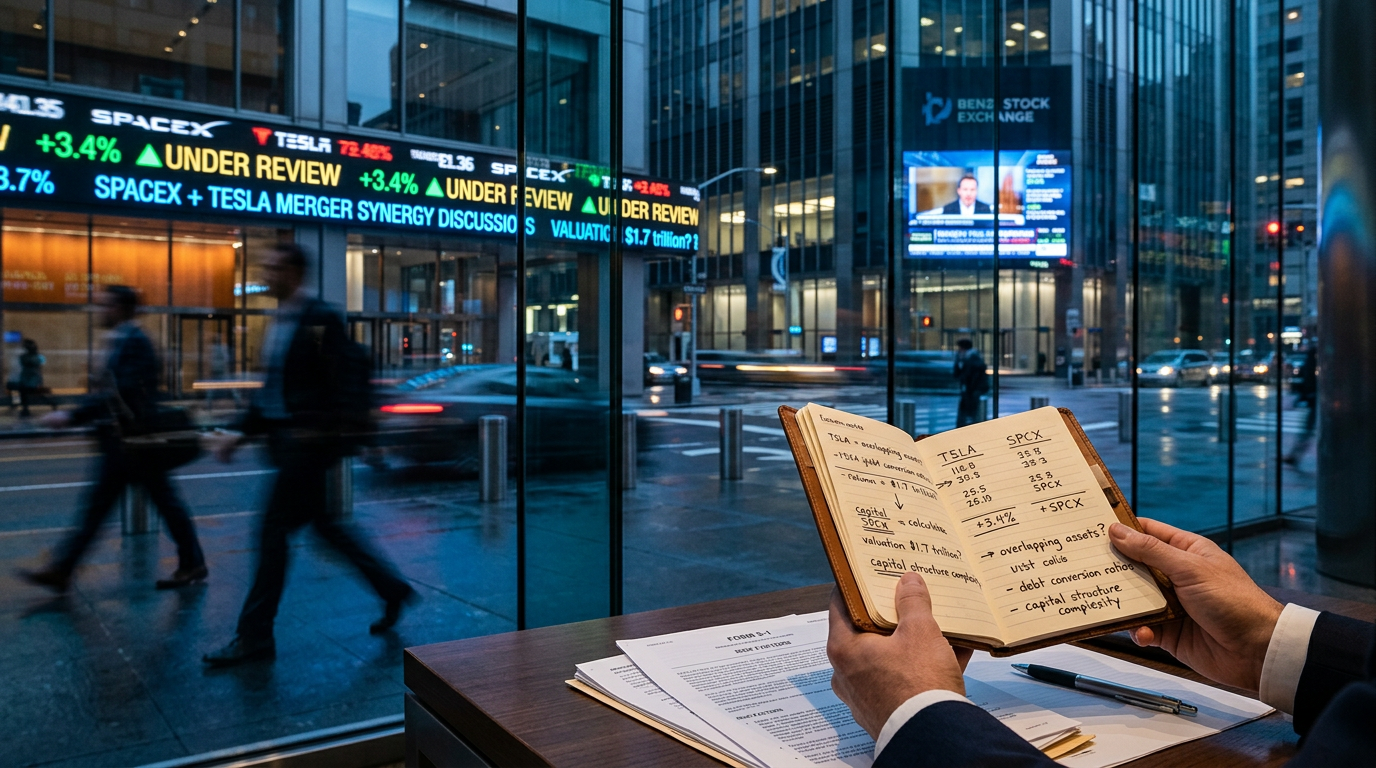
SpaceX filed its S-1 on May 20 and is targeting a Nasdaq debut under SPCX around June 12 – $1.75 trillion valuation, $75 billion raise, largest IPO ever attempted. Tesla’s market cap is hovering near $1.6 trillion. Combined, you’re looking at something north of $3 trillion on paper. The moment that S-1 dropped, the merger conversation stopped being speculative chatter and started showing up in serious analyst notes. Which is fair. But the speed of that shift tells you something. Markets moved on vibes before the actual structure of a deal existed. That matters.
Here’s where it gets complicated. The “merger” framing assumes these are two separate companies that might combine. That framing is already questionable. SpaceX spent $697 million on Tesla Megapack storage systems in 2024 and 2025, wiring xAI’s Colossus data center cluster in Memphis. Another $131 million went toward Tesla Cybertrucks in 2025. Tesla is sitting on a $2 billion SpaceX equity stake converted from xAI preferred stock, after SpaceX absorbed xAI in a $250 billion all-stock deal. One VP of materials science is actively serving both companies at the same time. Musk is on both boards. And in East Texas, there’s Terafab – a joint chip fab projected to run up to $119 billion, building AI silicon for both entities simultaneously. At some point “two companies” is just a filing convention.
The operational entanglement is almost beside the point now. It’s the balance sheet where this gets genuinely hard.
You may only have until June 9 to act on SpaceX
CNBC called it a potential “biggest IPO ever.”
At first glance that sounds exaggerated. Then you look at what Musk already built – reusable rockets, Starlink, Tesla – and the scale starts to make more sense.
The June 9 window is what caught my attention.
SpaceX’s S-1 disclosed $102.1 billion in assets, $60.5 billion in liabilities, and a net loss of $4.94 billion on $18.67 billion in 2025 revenue. Starlink carried most of that revenue – estimated $10.4 billion of the $15 billion operating segment. Tesla is free-cash-flow positive. SpaceX is not, at the net level. So a merger doesn’t add a profitable aerospace engine to Tesla’s books. What it adds is a long-duration capital infrastructure bet, with a satellite internet business funding the whole thing and an AI compute division spending aggressively against future returns. That’s not a bad bet necessarily. It’s just a very different one than the synergy narrative implies.
Slight tangent – Tesla’s standalone 2026 capex is already projected above $25 billion, roughly triple prior-year levels, most of it aimed at autonomy, robotics, and chip infrastructure. That plan exists regardless of any deal. So the question isn’t really whether these companies should be building similar infrastructure. They already are. The question is whether a combined legal structure makes that capital more efficient or just harder to unwind.
And then governance. Which almost nobody is writing about seriously.
Musk holds 85.1% of SpaceX’s voting power through super-voting shares. He holds roughly 20% of Tesla’s equity. Any formal merger negotiation is Musk sitting across from Musk. Tesla shareholders are already in active litigation over the $2 billion xAI investment. A full merger would make that lawsuit look like a footnote. The structural conflict-of-interest problem here isn’t just optics – it’s the kind of thing that creates years of legal overhang even if the deal itself is sound. That’s the variable I’d be watching more closely than the exchange ratio.
One Shark Missed Billions… Another Saw This Coming
Imagine turning down Uber at a valuation of $10 million, only to watch it go public at over $80 billion.
That’s exactly what happened to Mark Cuban… a 799,900% return, gone.
But original Shark Tank investor Kevin Harrington built his career doing the opposite: spotting asymmetric opportunities before they go mainstream.
Like Uber turned vehicles into income-generating assets, Mode Mobile is turning smartphones into income streams.
They were named the #1 fastest-growing software company by Deloitte and have already helped their users earn and save over $1B.
Kevin Harrington invested early.
And at just $0.50/share, you can still get in before their potential IPO. But this window will not stay open for long.
PRICE ALERT: share price moves today at 5 PM ET. Details here.
Please read the offering circular at invest.modemobile.com. This is a paid advertisement for Mode Mobile’s Regulation A Offering.
SPCX’s first week of trading on June 12 is the near-term read. If it opens above $1.75T and holds institutional support through the first five sessions, the merger currency argument gets real traction. If it prices and fades, the whole conversation resets. Tesla Q2 guidance will add another layer – specifically any commentary on SpaceX cross-investment or capex framing. That’s where Musk typically signals what’s actually happening before any formal announcement.
Whether this becomes one ticker or stays two deeply entangled entities with shared infrastructure and overlapping personnel – I don’t think anyone knows yet. Including, possibly, Musk.