
May 14, 2026
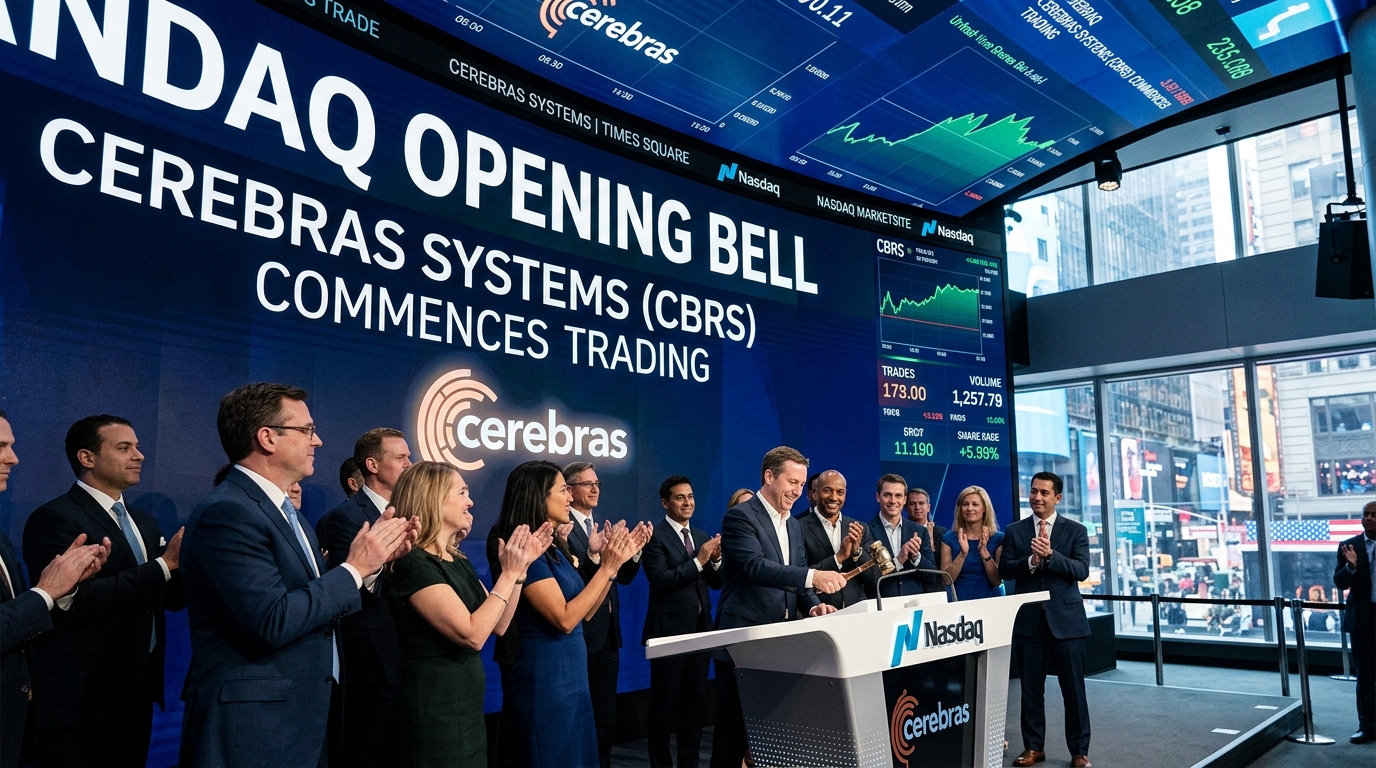
Cerebras Systems (CBRS) Is Live. Here’s the Full Picture.
Priced at $185. $5.55B raised. $24.6B in backlog. And an operating loss nobody’s leading with.
Quick Summary
- Cerebras (CBRS) began trading on Nasdaq today, May 14, priced at $185/share
- IPO raised $5.55B on 30M Class A shares — fully diluted valuation ~$56.4B
- 2025 revenue: $510M, up 76% YoY — but 86% came from two UAE entities
- GAAP net income of $237.8M was driven by a $363M one-time accounting gain, not operations
- Actual operating loss in 2025: $145.9M. Non-GAAP net loss: $75.7M
- US domestic revenue shrank 34% in 2025 — all headline growth was international
- OpenAI deal: $20B+ Master Relationship Agreement, 750MW of compute, $1B loan + warrants
- AWS deal: CS-3 chips being deployed inside Amazon data centers, accessible via Amazon Bedrock
- Total disclosed backlog: $24.6 billion — mostly not yet in the revenue base
- Valuation at IPO: approximately 111x trailing 2025 revenue
- Lock-up expiry: approximately November 2026
Trump Drops a Triple Bombshell
According to one ex-Wall Street insider, President Trump is preparing to unleash a stunning, triple-bombshell on Washington.
It’ll send shockwaves across America, the moment it goes live – triggering a $7.5 trillion chain reaction in the markets.
With one little-known corner of stocks erupting by up to 1,000% in 12-24 months.
This isn’t being covered on CNBC.
Let’s start with the noise, because there was a lot of it going into this morning.
Cerebras priced at $185 per share on the evening of May 13 — above a $150–$160 revised range, which had itself already jumped from an original $115–$125 band. The offering was 20x oversubscribed before they ever touched the range. Thirty million Class A shares hit the market. $5.55 billion raised. A fully diluted market cap north of $56 billion before anyone even looked at a chart.
That’s a signal about institutional positioning in AI infrastructure, not necessarily a signal about value.
Worth noting before we go further: Arm Holdings and SoftBank reportedly tried to acquire Cerebras in the weeks before this IPO. That bid was turned away. Two of the most strategically placed players in the global semiconductor supply chain wanted this company badly enough to make a move — and couldn’t get it done. That context matters more than the day-one price action.
The Technology, Plainly
Cerebras doesn’t build a faster GPU. It builds something structurally different: the Wafer-Scale Engine, a processor that uses an entire silicon wafer as a single chip rather than dicing it into hundreds of smaller dies and then networking them together. The current flagship — the WSE-3 — is 58 times the die size of a leading GPU and claims inference speeds up to 15x faster on major open-source models.
The catch is yield. Wafer-scale manufacturing is notoriously hard — any defect on the wafer becomes a potential failure point across the whole chip. Cerebras addresses this with redundant cores and memory cells baked in at the design level. It works, but it’s not a solved problem at higher production volumes. That’s a supply-side constraint worth keeping in mind as the OpenAI and AWS ramps get underway.
Revenue flows through hardware (the CS-3 system), cloud-based AI services, and large multi-year compute arrangements. In 2025: roughly $358M from hardware, $152M from cloud and services. The cloud mix is growing — that matters because cloud revenue carries better margins and more predictability than lump hardware orders.
The Profit Headline Is Wrong — Or at Least Incomplete
You’ll see 47% net margin and $237.8M in GAAP net income floating around today. Here’s what’s underneath it.
Back in 2024, Cerebras entered a deal with Abu Dhabi’s G42 involving the sale of preferred shares — a transaction that created a $401 million loss on the books that year. The US government raised national security concerns about the arrangement, and it was eventually restructured. When that liability came off the balance sheet, Cerebras recorded a $363 million paper gain — which flowed directly into 2025 net income. Take that out, along with stock-based compensation, and you’re left with a $75.7 million non-GAAP net loss. The company’s actual GAAP operating loss for 2025 was $145.9 million.
None of that makes Cerebras a bad business. It makes it an early-stage business at a very late-stage valuation. Gross margins are genuinely improving — 12% in 2022, 39% in 2025 — and R&D ran $243 million last year, which is where you’d expect a company building next-generation silicon to be spending. The margin trajectory is real. But at 111x trailing revenue with an operating loss underneath, the story requires a lot of future to be true.
Giving “2022 pre-ChatGPT” vibes (but 10x bigger)
Do you remember when ChatGPT launched, Nvidia soared 1,800% in 3 years, and 500,000 regular Americans became millionaires?
According to Nvidia’s CEO, July 22nd could trigger an even BIGGER explosion of wealth…
Because Tesla is set to unveil a revolutionary technology that could shock the markets…
And be “10x bigger than the largest product in history” according to Elon Musk.
OpenAI, AWS, and the Gap Between Backlog and Revenue
The OpenAI deal is the center of gravity here. In January, OpenAI signed a binding Master Relationship Agreement with Cerebras for 750 megawatts of low-latency AI compute — expandable to nearly 3 gigawatts by 2030. Total contract value: over $20 billion. OpenAI also extended Cerebras a $1 billion loan secured by warrants for more than 33 million near-free shares. That means OpenAI is simultaneously Cerebras’ most important customer, a creditor on the cap table, and a future equity holder with warrants worth roughly $5 billion at the IPO price.
That’s a lot of surface area in one relationship. The warrants alone — per Financial Times reporting — represent approximately half the gross profit Cerebras is projected to earn on the contract. It’s a good deal. It’s also a complicated one.
The AWS deal is structurally different and arguably more important for long-term diversification. Amazon announced plans to deploy Cerebras CS-3 systems inside its own data centers, integrated alongside Trainium chips, and accessible to developers through Amazon Bedrock. That’s a channel relationship — AWS is embedding Cerebras into its AI services stack, not just signing a bilateral purchase agreement. A third major hyperscaler at that level would change the customer concentration picture meaningfully.
The S-1 discloses $24.6 billion in total backlog. Most of it is not yet revenue. The S-1 projects roughly 15% recognized in the first 24 months. That’s the gap investors are underwriting at $56 billion today.
The Risk Nobody Led With This Week
Customer concentration is still the dominant risk. Mohamed bin Zayed University of Artificial Intelligence in Abu Dhabi accounted for 62% of 2025 revenue. G42 was another 24%. That’s 86% of revenue from two UAE-affiliated entities — both geopolitically exposed, both project-based and lumpy.
Here’s the number that got buried in roadshow coverage: Cerebras’ US domestic revenue fell 34% in 2025, from $282.7 million to $187.6 million. Every single dollar of the 76% headline growth came from Abu Dhabi. OpenAI and AWS haven’t moved the revenue needle yet — they’re in the backlog, not the income statement. The question isn’t whether those deals are real. It’s how fast they convert, and whether the UAE revenue holds long enough for the domestic ramp to take over.
If that timing is off by two or three quarters, the model gets exposed at this multiple.
Bull, Base, Bear
Bull: OpenAI draws down its 750MW commitment on pace. AWS Bedrock drives a wave of enterprise developers onto Cerebras infrastructure. A third major hyperscaler signs before Q3. Cloud services revenue grows as a mix percentage, pushing gross margins through 50%. The $24.6B backlog converts faster than the S-1 projects. Cerebras becomes the inference layer the way Nvidia owns training — and 111x trailing revenue looks like the entry point.
Base: The ramp is real but slow. UAE revenue fades at roughly the pace that OpenAI revenue builds — the gap never blows out, but it never fully closes either. The stock trades sideways to modestly higher while institutional holders wait for the first public quarterly print to give them something to underwrite. Earnings visibility is the unlock.
Bear: OpenAI hits its own capital constraints and slows deployment timelines. UAE revenue steps down faster than expected. Nvidia’s CUDA moat — built over 12+ years of developer tooling — proves stickier than Cerebras’ inference speed advantage for most real-world workloads. TSMC capacity constrains WSE-3 production just as demand would otherwise ramp. Lock-up expires around November 2026 and early holders reduce. At 111x revenue with an operating loss underneath, the multiple compression is severe.
The variable that matters most across all three scenarios is the same: is OpenAI actually deploying that 750 megawatts, or just contracted for it? That answer shows up in the first earnings call — not today.
The 10 AM Trade Pulling Triple-Digit Winners
Stop chasing complicated systems and expensive software. A top trader discovered one repeatable setup that fires almost every morning and has delivered gains of 113% on GOOGL, 240% on META, and more. The Opening Bell Trade Guide breaks it all down and it’s free right now. Don’t wait. We won’t keep it free forever.
What to Watch From Here
- Q1 2026 earnings (first public print): Does UAE revenue hold? Is OpenAI showing up in actual recognized revenue, not just backlog?
- US domestic revenue trajectory: Needs to reverse the 34% decline. Watch for AWS Bedrock-driven enterprise bookings.
- Gross margin trend: 39% in 2025 needs to move toward 50%+ for the valuation to make sense. Cloud mix is the lever.
- OpenAI megawatt deployment pace: 750MW contracted, 15% of backlog projected in first 24 months. Any acceleration is a bull signal.
- Third hyperscaler: A Google or Microsoft deal would structurally re-rate the stock.
- OpenAI warrant dilution: Monitor cap table changes and any renegotiation of the $1B loan terms.
- November 2026 lock-up expiry: Supply event. Early investors and employees gain liquidity. Worth positioning around.
- WSE-4 timeline: Next-gen chip development pace vs. Nvidia’s Blackwell roadmap matters for competitive positioning beyond 2026.
At $56 billion fully diluted on $510 million of revenue — with an operating loss, a one-time accounting gain inflating the profit line, and 86% of that revenue concentrated in Abu Dhabi — there is no margin of safety in the conventional sense. The technology is real. The OpenAI and AWS relationships are real. The backlog is real.
What you’re buying today is the ramp, not the track record. That’s a different kind of bet.
The approach here: watch the open, let the day-one volatility settle, and wait for the first quarterly print before sizing anything. If OpenAI revenue starts flowing and domestic bookings reverse — that’s the entry signal. If Q1 shows the UAE cliff arriving before the ramp catches it, the stock will give you a better price.
The bell rang this morning. The real story takes another 90 days to start making itself clear.