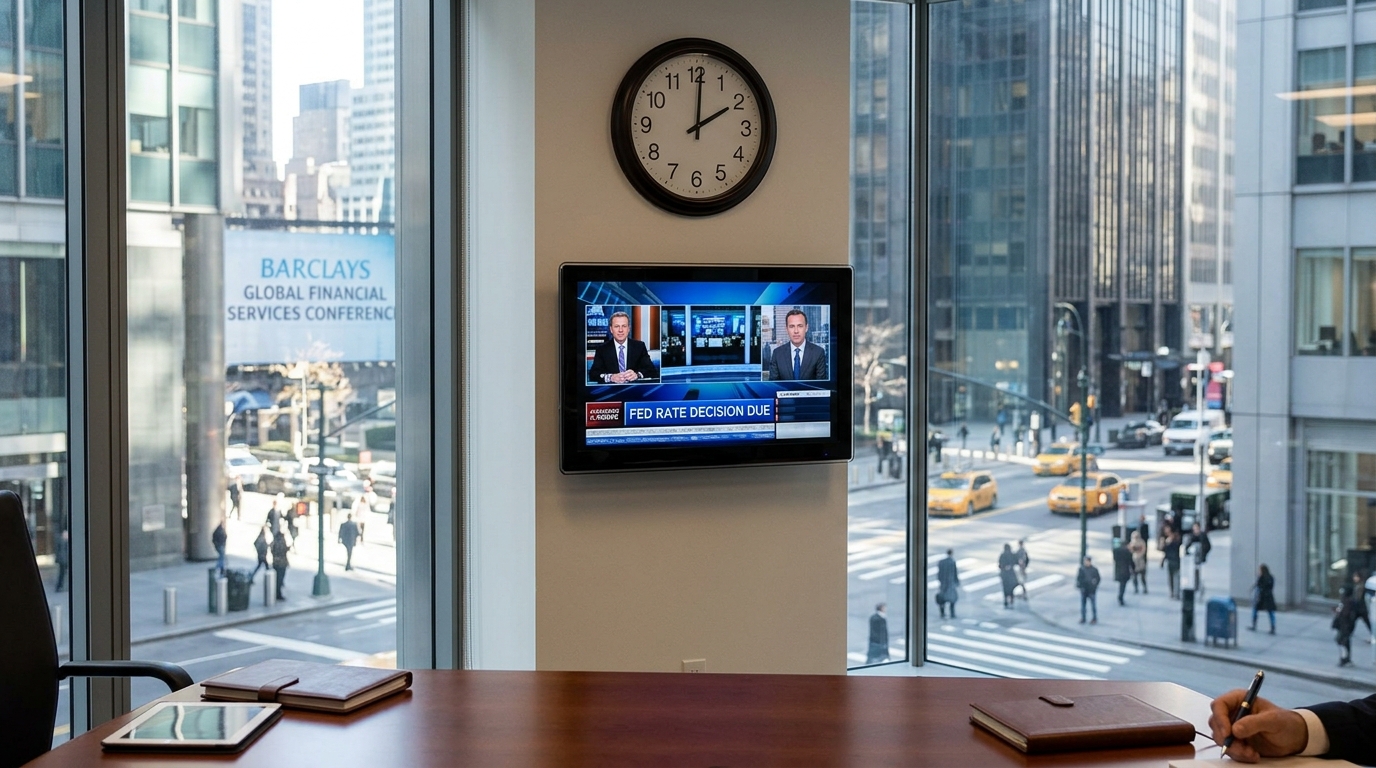
At 2:00 pm ET today, two things happen simultaneously: the Federal Reserve releases its September policy decision, and Goldman Sachs CEO David Solomon opens at the Barclays 24th Annual Global Financial Services Conference. For traders in bank stocks, both matter. The question is which one drowns out the other.
The Fee Picture Walking In
The context Solomon inherits is bruising. Brian Moynihan told the same Barclays conference on Monday that Bank of America’s Q3 investment banking fees would land between $1.6 billion and $1.8 billion, more than 10% below the prior year, against analyst expectations closer to $2 billion. Moynihan attributed the shortfall partly to BofA’s positioning, saying the broader IB market is down roughly 10% based on Dealogic data. BofA shares fell roughly 5% on the day, and Goldman, Citigroup, and JPMorgan were dragged lower too.
That selloff is the backdrop Solomon walks into. Goldman is structurally different from BofA in capital markets, but that distinction has to be made out loud today or the market will assume the same damage applies.
Why Goldman Is the Critical Data Point
Goldman has advised on more than $1 trillion of announced M&A so far in 2026, the fastest any investment bank has reached that milestone this year, according to Dealogic. First-half investment banking fees jumped 52% year over year to $6.24 billion. That is the bull case. The bear case, courtesy of Moynihan, is that Q3 saw the momentum stall.
Goldman’s third-quarter 2026 earnings are scheduled for October 13, 2026. That means today is the final scheduled public appearance by Solomon before the Q3 numbers land. There is no preannouncement, no investor day, no other conference on the calendar between now and then. What he says at 2:00 pm is it.
Investors should watch the closing rate of announced transactions, specifically how many clear regulatory hurdles, along with management commentary on the M&A pipeline and deal timelines, to assess whether the strong first half carries through year-end.
The Fed Complication
The Fed interest rate decision is announced Wednesday, September 16 at 2:00 pm ET, alongside the Summary of Economic Projections and the dot plot. Futures traders are pricing in about a 93% chance the FOMC raises the federal funds rate by 25 basis points, to a target range of 3.75% to 4.00%. Fed Chair Kevin Warsh’s late-August Jackson Hole speech warned that inflation remains well above the Fed’s 2% target.
A 25-basis-point hike is consensus. What is not priced is the dot plot’s implied path through December and into 2027. If Warsh signals additional tightening is live, that resets the terminal rate and compresses deal valuations immediately. That is exactly the environment in which backlogged M&A slips to the right.
How to Trade This
GS is the most capital-markets-levered name in the large-bank group. Its first-half fee surge was built on the same deal wave that Moynihan says cooled in Q3. Solomon’s comments on whether that pipeline accelerated or softened are worth more today than any single analyst estimate.
Watch for two divergence signals. First, if Solomon characterizes Q3 deal activity as stronger than the industry average, GS separates from BAC and JPM to the upside. Second, if the Fed’s dot plot projects rates above 4.25% by year-end, the entire group faces renewed pressure regardless of what Solomon says, because higher financing costs delay the closings that convert announced M&A into recognized fees.
Deal completions and IPO activity are sensitive to market volatility, economic conditions, and financing availability. Goldman’s strong market position and elevated backlog suggest IB momentum is likely to remain healthy, though the magnitude depends on how quickly the pipeline translates into completed transactions. That conditional is what the next 90 minutes will begin to answer.