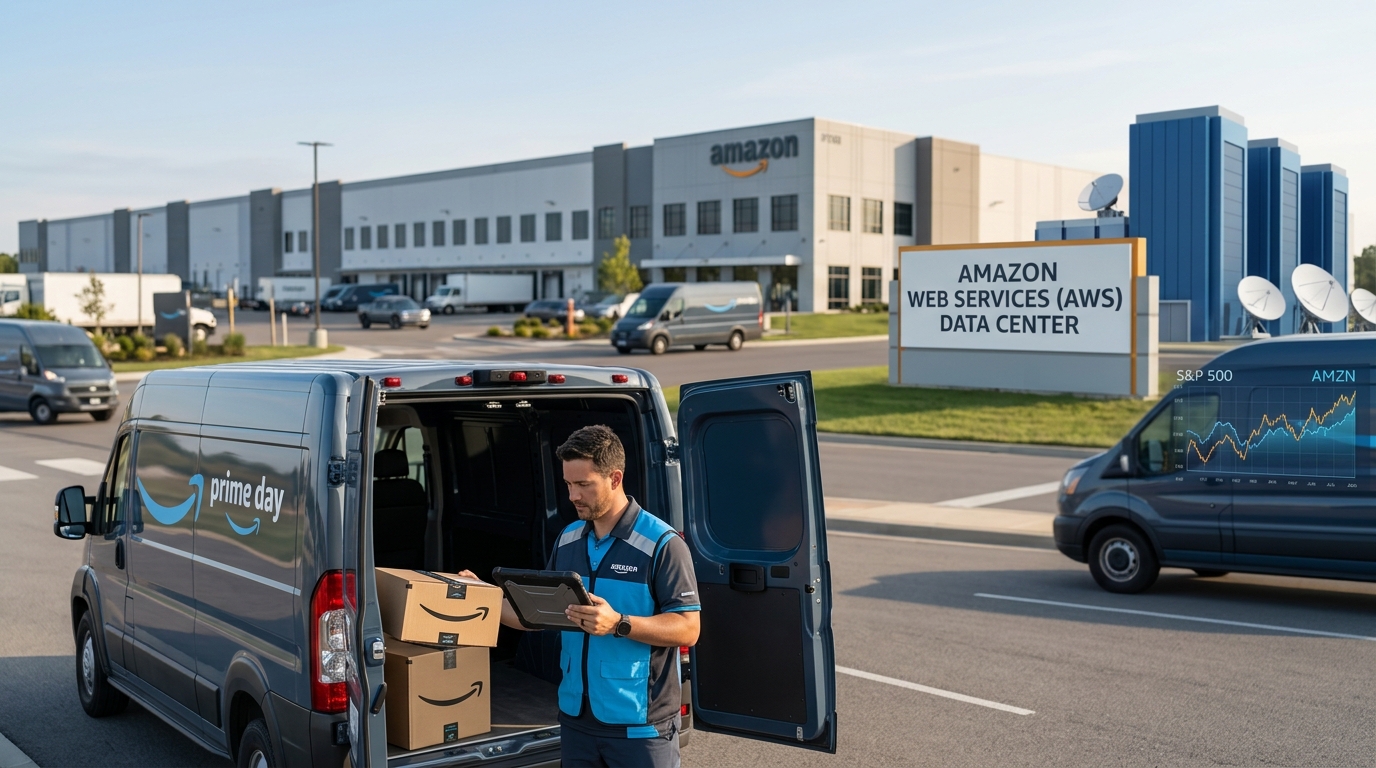
AMZN is up roughly 6% year-to-date. The S&P 500 is up more. For a company running AWS at $150 billion in annualized revenue and advertising at $70 billion trailing, that’s a gap worth examining.
This week matters. Prime Day 2026 kicks off June 23 and runs through June 26 — the first time in five years Amazon has moved the event out of July. Four days, 35+ product categories, AI-powered deal discovery through Alexa for Shopping, and a retailer that has spent the last decade turning a members-only sales event into the de facto mid-year commerce season.
But here’s the thing. Prime Day is almost certainly not the most important thing happening at Amazon right now. It might not even be in the top three.
What the Numbers Actually Say
Q1 2026 results came in well ahead of expectations on every major metric. Net sales hit $181.5 billion, up 17% year over year. AWS grew 28% to $37.6 billion — its fastest pace in 15 quarters — putting the cloud unit on an annualized run rate above $150 billion. Operating income climbed to $23.9 billion from $18.4 billion a year earlier. And advertising revenue hit $17.24 billion for the quarter alone, with trailing twelve-month revenue now exceeding $70 billion.
That advertising figure doesn’t get enough attention. At $70 billion in trailing revenue, Amazon’s ad business is now larger than the entire AWS business was in 2018. And most of that revenue carries software-like incremental margins. Every point of ad growth matters more for earnings than equivalent retail growth, which is why the advertising segment has quietly become the swing factor for quarterly earnings beats.
Wall Street consensus is Strong Buy: 45 buy ratings, one hold, with an average price target of $319 — implying roughly 31% upside from current levels. Bank of America has a $310 target. BMO Capital, after attending the AWS Summit, set a $355 target and called AMZN a Top Pick.
Prime Day Is the Distraction. Alexa for Shopping Is the Story.
Emarketer expects Amazon’s U.S. Prime Day sales to rise 7.1% this year to $15.68 billion, giving Amazon a 60.3% share of total U.S. ecommerce during the four-day period — its highest since 2019. More than half of U.S. consumers plan to shop this Prime Day, up from 45% who participated last year. Two-thirds expect to spend the same or more.
One analyst at Bank of America is watching something more specific: Alexa for Shopping. He sees the AI assistant as a deal-discovery and purchase-tracking tool with the potential to generate more than $200 billion in incremental GMV by 2035 and $20 billion in incremental retail profit. That’s not a Prime Day story. That’s a decade-long flywheel story with AI at the center, and most investors are treating it as a footnote.
The earlier June timing also creates a subtle math problem. Q2 numbers will be flattered by Prime Day GMV. Q3 comparisons get harder. Investors focused purely on near-term quarterly beats may miss the more durable structural picture.
The Real Debate Is About Capital and Time
CEO Andy Jassy has said Amazon’s custom chip business — Graviton, Trainium, Nitro — is now above a $20 billion annualized revenue run rate and growing at triple-digit percentages year over year. Amazon has committed roughly $200 billion in 2026 capital expenditure, mostly tied to AI infrastructure, which is the central tension on the stock.
That capex level is enormous. Free cash flow timing is a legitimate concern. Investors will want proof that spending converts into durable AWS revenue acceleration, not just capacity that sits idle waiting for demand to arrive. That proof is coming in quarterly increments. The Q1 acceleration to 28% growth was a meaningful data point. It wasn’t definitive.
Separately — and this deserves attention — the FTC and multiple state attorneys general are preparing a potential lawsuit over alleged deceptive practices in Amazon’s advertising business. The investigation involves disclosure of advertising terms, fees, and reserve pricing. This is a real regulatory risk in a segment that has become one of the most important margin drivers in the entire business.
Scenarios
- Bull: AWS accelerates further into Q3 on AI enterprise demand. Advertising compounds at 20%+. Alexa for Shopping begins showing measurable GMV impact. Prime Day beats GMV estimates. The stock re-rates toward analyst consensus near $319.
- Base: Prime Day delivers in line with the $15.68 billion estimate. AWS holds 26–28% growth. Advertising maintains high-teens growth. Stock grinds toward $270–280 as execution is steady but capex spend creates near-term FCF drag.
- Bear: FTC lawsuit advances into a serious structural probe. Capex fails to translate into AWS acceleration. Macroeconomic pressure weighs on retail spending heading into H2. Stock gives back recent gains and retests April lows near $204.
What investors may be underestimating: Amazon’s three businesses — retail, cloud, advertising — are increasingly interdependent. Retail generates the consumer data that makes advertising more effective. Advertising margin funds the AI capex. AWS wins enterprise deals partly because of Amazon’s existing data infrastructure advantages. The sum-of-parts analysis most analysts run actually understates the compounding effects of that integration.
The stock is underperforming the market this year. The business isn’t. That gap tends to close — one way or the other.
For informational purposes only.