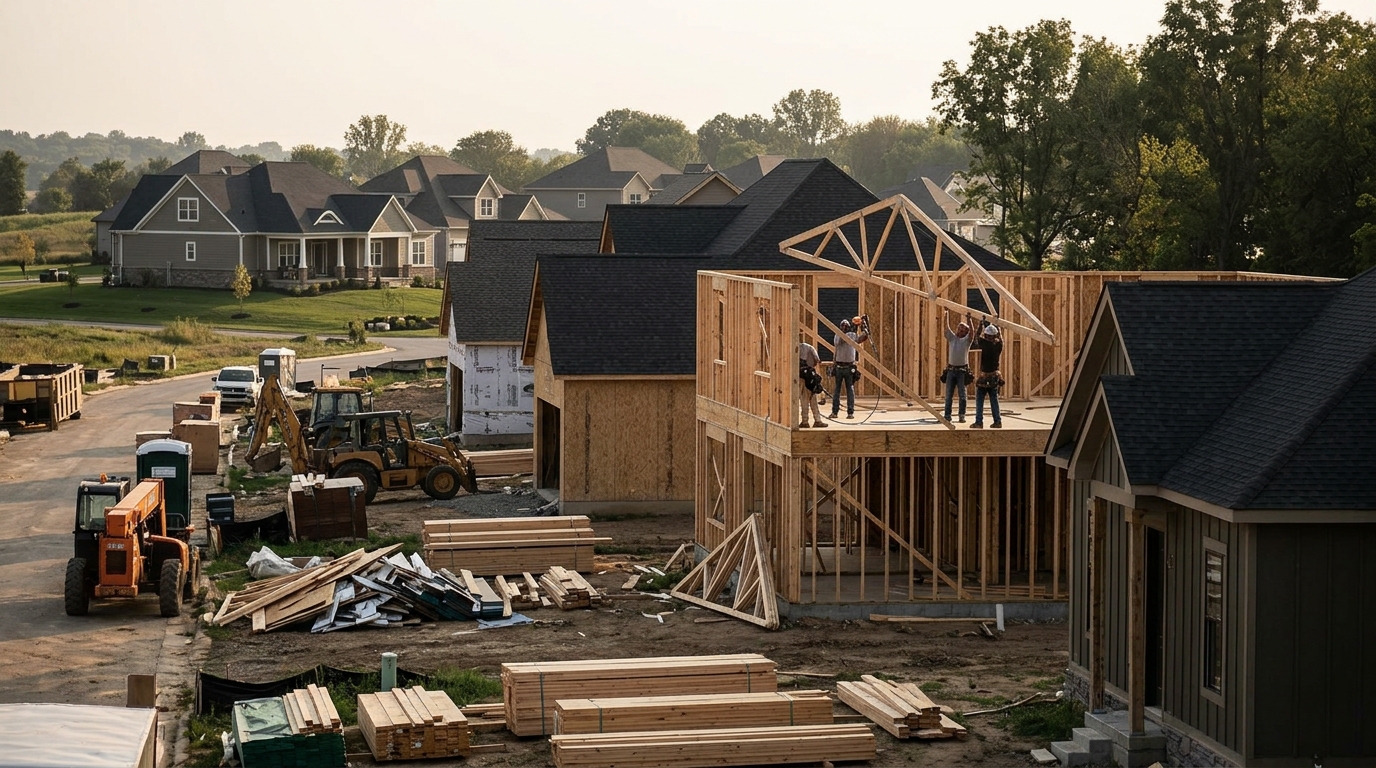
Wednesday’s October construction report gave the housing sector a headline it did not earn. Overall housing starts rebounded 9.9% to a pace of 1.309 million units. Financial media ran with it. Homebuilder investors probably should not.
Starts for housing projects with five units or more soared 25.5% to a rate of 433,000 units in October. That is the apartment-and-condo business, not the single-family market that drives revenue at D.R. Horton, Lennar, PulteGroup, and NVR. Strip out the multifamily surge and the actual story looks considerably worse. Single-family housing starts came in at a rate of 864,000, just 4.0% above the revised September figure of 831,000. That 4% move carries a margin of error of plus or minus 9 percentage points, meaning it is not even statistically significant at the Census Bureau’s standard confidence level.
The Number That Actually Matters
Investors who own homebuilder shares should focus on permits, not starts. Permits are the pipeline. Single-family permits fell 8.7% to 772,000 from September and were 12.9% below a year earlier. That is the weakest reading since January 2023, now nearly four years ago. It represents the volume of single-family homes that builders expect to break ground on in the coming months. A permit filed today typically becomes a 2027 delivery.
The permit number does not exist in a vacuum. A National Association of Home Builders survey released in October showed sentiment among single-family homebuilders slumped to its lowest level since 2012. The NAHB said stepped-up immigration enforcement was keeping legal workers off construction sites, deepening labor shortages and driving up costs, while developers faced growing cost pressures from high energy and material prices.
Context from the Demand Side
The supply side is not the only problem. Sales of previously owned U.S. homes fell sharply in October to their lowest level in more than 16 years, as rising mortgage rates squeezed buyers already struggling with high prices. Existing-home sales dropped 5.5% from September to a seasonally adjusted annual rate of 3.75 million, according to the National Association of Realtors. The housing market looks increasingly grim as discouraged buyers grapple with mortgage rates above 7% and stubbornly high prices.
Treasury yields are the transmission mechanism behind all of it. Pending home sales fell across all 50 major metro areas as the median monthly payment hit its second-highest level on record.
An overhang of unsold new homes on the market is also constraining single-family homebuilding, while residential investment has contracted in six of the last seven quarters. Builders are not building speculatively into that environment. The permit collapse confirms they are pulling back.
What This Means for the Stocks
For DHI, LEN, and PHM, closing revenue in 2027 depends heavily on what gets permitted now. The NAHB Housing Market Index fell to 29 from 32 in October, which the NAHB called a 14-year low and the weakest reading since 2012. Rising Treasury yields and mortgage rates near 7% are pressuring homebuilder stocks despite analysts citing strong structural housing demand of roughly five million units.
Builders FirstSource (BLDR) faces a sharper exposure than most investors appreciate. Builders FirstSource supplies, manufactures, and installs products for professional residential builders and also serves repair and remodel work, making BLDR a more direct housing-cycle read than a general home-improvement retailer. Management projected single-family starts in its geographies down mid- to high-single digits. A 772,000 permit rate validates that caution rather than contradicting it. Home Depot and Lowe’s carry more insulation through their repair-and-remodel business, but neither is immune to a prolonged single-family drought.
The same single-family drought is reshaping the home-improvement retail trade. Lowe’s is projecting a meaningful earnings decline as the housing freeze keeps its core repair-and-remodel customer on the sidelines.
The Wealth Takeaway
The 9.9% starts headline is a multifamily story, not a homebuilder story. The actual leading indicator, single-family permits, points to a weaker 2027 building pipeline at a moment when demand is already at multi-decade lows. Investors holding DHI, LEN, PHM, NVR, or BLDR should weigh permit trends alongside earnings multiples. A stock trading at 14 or 15 times earnings looks different when volume is set to contract, not recover.