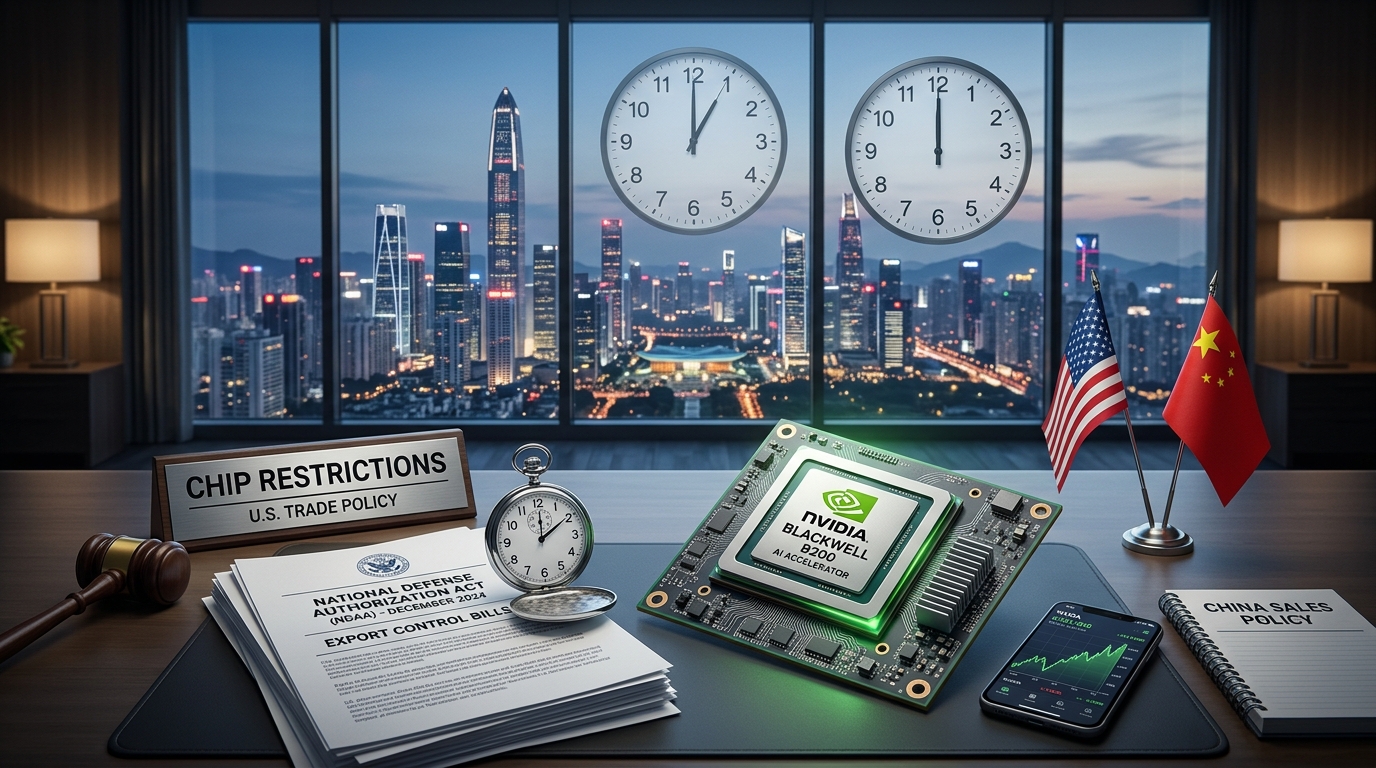
The headline out of Shenzhen looks bullish for Nvidia. Read the fine print before trading it.
Speaking to Fox News at the APEC summit in Shenzhen, Trump said the U.S. may permit sales of Nvidia’s Blackwell chips to China in “two years or three years,” provided they are no longer the most advanced on the market. He said he doesn’t want to tell Nvidia “you make chips, but you’re not allowed to sell them,” and added that in two or three years there will be something that supersedes the Blackwell chip, at which point he would say, “go ahead, you can now sell Blackwells because they’ll have something else.”
Trump’s term ends at noon on January 20, 2029, meaning the timeline he outlined would run into the final months of his presidency or beyond it. That is not a near-term catalyst. It is a conditional forecast from a president who has changed chip policy repeatedly, and it arrives the same morning Congress is working to strip that flexibility away entirely.
Market Snapshot
Shares of Nvidia and Intel rose after hours after a bruising stretch, with NVDA up about 2% and INTC higher by more than 4%. The relief is real but limited: both names were coming off steep losses, and the broader chip sector remains under pressure from overlapping policy, legal, and leadership risks. Watch the open closely. A bounce off a multi-day slide on a conditional White House comment is not the same as a resolved situation.
Stocks in Focus
NVDA: Interim CEO Colette Kress disclosed that Nvidia sold $2.4 billion worth of licensed Hopper data center products to China in the most recent quarter, but she added that the company is no longer shipping licensed Hopper data center products to China. That revenue line is gone. The Blackwell replacement Trump is dangling is two to three years out and conditional on him remaining in office.
INTC: Intel said it signed its first outside customer for its 18A process and announced a new partnership with Microsoft focused on Azure infrastructure collaboration, giving the stock its own independent catalyst beyond the China noise. The 4%-plus post-market move reflects that combination.
AMD and AVGO have no direct China Blackwell exposure today but sit in the same export-control blast radius. Any legislation that clears the NDAA tightens the rules for the entire advanced semiconductor supply chain.
Sector Watch
Semiconductors remain the most policy-sensitive sector in the market. Congress is moving to draft three legally binding bills tied to AI chip exports: the AI OVERWATCH Act, which would expand Congress’s role in reviewing changes to export rules and licensing; the Chip Security Act, which would require mechanisms to verify exported chips have not been illegally diverted; and the MATCH Act, which would push toward aligned multilateral controls with allies on covered semiconductor manufacturing equipment destined for countries of concern, including China.
House Speaker Mike Johnson said on November 12, 2026 that there is a “developing consensus in Congress” on limiting chip exports to China. That is the sentence traders should weight against Trump’s two-to-three-year promise. One sets a permissive timeline; the other moves to lock in restrictions by statute before the end of the year.
Catalyst Calendar
- Dec. 1: Jensen Huang will sit for a closed-door transcribed interview with three House committees, with Nvidia’s general counsel Tim Teter on December 2.
- Dec. 3: Huang has been asked to appear before the Senate Banking Committee on December 3.
- NDAA deadline: A separate measure aimed at restricting remote access to advanced compute has been moving through Congress, and lawmakers have been pressing to address the remote-access loophole in the year-end defense process.
Risk Radar
China’s access to AI chips has become a major flashpoint at the APEC summit following Jensen Huang’s resignation after his affair with a woman under investigation by the U.S. government for potential ties to Chinese intelligence and alleged involvement in chip-smuggling networks. That scandal accelerated the legislative push, and Huang’s resignation reduced Nvidia’s clout on Capitol Hill.
The company’s ability to lobby against tighter restrictions is weaker now than at any point in the past three years. Trump’s comment offers a sentiment lift at the open. The structural risk is that Congress codifies restrictions he cannot unilaterally reverse.
The Cheat Sheet
- Top Theme: Chip export policy is being shaped simultaneously by a president in Shenzhen and a Congress in Washington, and they are not pointing in the same direction.
- Stock to Watch: NVDA. The bounce is real, but the stock faces a December congressional hearing, stalled China revenue, and pending bills that could reduce executive discretion over export approvals.
- Sector to Watch: Semiconductors. Policy risk is the dominant variable and it escalates through December.
- Biggest Risk: NDAA passage with one or more chip provisions attached before year-end, locking in restrictions that override any future presidential flexibility.
- Biggest Opportunity: INTC, which has its own independent catalyst in the 18A milestone and the Microsoft partnership and may attract capital rotating away from NVDA’s headline risk.
- One Thing to Remember: Trump’s Blackwell comment is a two-to-three-year conditional, not a policy change. The bills moving through Congress are the ones that matter before January.