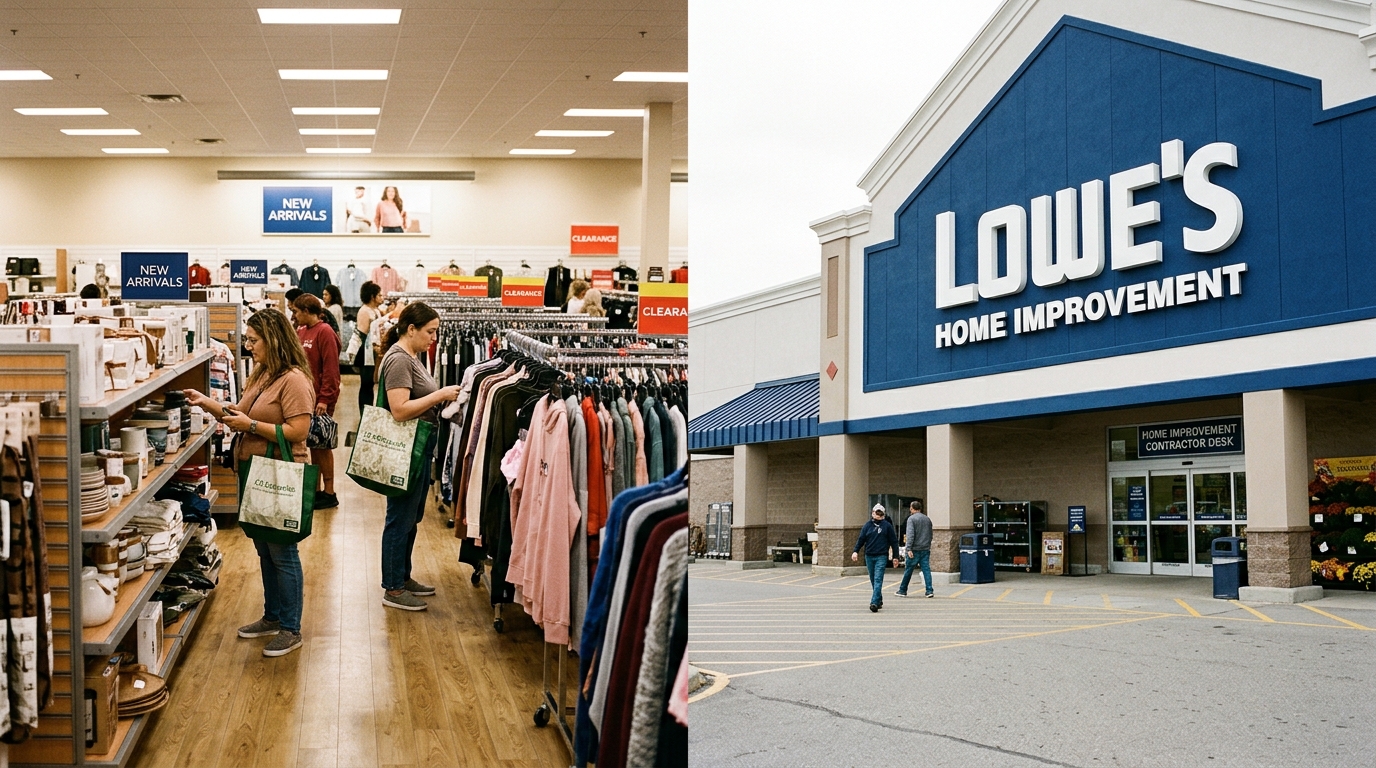
Wednesday morning, before most investors have finished their coffee, two of America’s largest retailers will drop results that tell you more about the American household than any consumer confidence survey. TJX Companies and Lowe’s both report before the open on November 18, 2026. The numbers are expected to diverge sharply, and the reason why matters far more than the quarter itself.
Two Reports, Two Very Different Stories
TJX heads into the report from a position of genuine momentum. Analysts expect earnings of $1.34 per share on revenue of $15.83 billion, while the company’s own guidance calls for $1.36 to $1.38 per share. That self-guided range sits above the Street, a pattern TJX has made a habit of. Last quarter, TJX posted $1.36 diluted EPS, while net sales rose about 5% year over year to roughly $15.2 billion.
Lowe’s is running a different race. The company reports fiscal Q3 2026 results before the open on November 18, 2026, with analysts expecting adjusted EPS of $2.86, down 6.5% from $3.06 in the year-ago quarter. Lowe’s has surpassed Wall Street’s earnings estimates in each of the last four quarters, so a beat is plausible. But beating a falling bar is not the same as growing.
The Bigger Trend: Where the American Consumer Is Actually Spending
The divergence between these two companies is not a quirk of this quarter. It reflects a structural split in how Americans are spending as long as rates stay elevated.
After a brief rebound last month, existing home sales fell to the slowest pace in more than 16 years in October, with mortgage rates back above 7% and home prices still elevated. Total existing home sales fell 5.5% to a seasonally adjusted annual rate of 3.75 million. Fewer home sales means fewer people buying appliances, flooring, or embarking on kitchen renovations. That is Lowe’s core demand engine, and it is stalled.
TJX benefits from exactly the same pressure. The off-price model has historically been counter-cyclical or at minimum recession-resistant: when consumer budgets tighten, shoppers trade down from full-price department stores to TJX. Consumer preference for value has been durably strengthened by the inflation cycle of 2022 to 2024, which introduced millions of middle-income shoppers to off-price channels who had previously shopped at full-price retailers.
The same value-seeking behavior reshaping TJX’s customer base is also reordering the holiday retail calendar. Stretched consumers are waiting for discounts as deep as 30% before committing to holiday purchases, a pattern that rewards off-price and discount channels at the expense of full-price retailers.
The Investment Case
Lowe’s is not a bad business. Its Pro customer segment, which serves contractors and tradespeople, has been a consistent bright spot. CEO Marvin Ellison has said that roughly 60% to 65% of Lowe’s revenue comes from the do-it-yourself customer, calling it a difficult DIY housing market. The company is working to rebalance toward Pro, but comparable transactions fell 2.1% in the second quarter as demand leaned toward repair and maintenance, with discretionary DIY spending remaining weak. A housing recovery remains the primary catalyst for a meaningful Lowe’s re-rating, and that recovery is not close.
TJX offers something more durable. The off-price sourcing model keeps cost of goods low because TJX buys branded overstock opportunistically. That sourcing advantage compounds when brands are over-inventoried, which they frequently are during uncertain periods. For the full year, consensus estimates project TJX earnings of $5.22 per share and revenue of $63.91 billion, representing changes of roughly 10% and 8%, respectively, from the prior year.
Risks to Monitor
TJX is not without risk. The stock has retreated over the past quarter, with shares recently around $134, and valuation remains a legitimate conversation. The stock trades above its long-term average multiple. If the consumer deteriorates sharply enough, even value-oriented shoppers cut spending.
For Lowe’s, the question is timing. Chairman Ellison has said the company is well-positioned to participate in the expected recovery in housing, citing long-term demand from aging homes and housing supply imbalance. That thesis is structurally sound. The problem is that aging homes and supply imbalances do not set a schedule, and in the meantime earnings are declining.
Daily Wealth Takeaway
Wednesday’s reports will produce plenty of noise around beats and misses. The more important question for a five-year investor is which business benefits from conditions that already exist, not conditions that might arrive. TJX is built for a consumer who is stretched, value-conscious, and not buying a house. That consumer is very much here. Lowe’s needs a housing market that remains frozen. Both stocks can be held, but they serve different roles: TJX as a core position in a durable consumer theme, Lowe’s as a patient bet on a recovery that will eventually come. Knowing which is which is the first step to sizing them correctly.