The index number that matters most this morning is not the Nasdaq 100 futures contract, which is down roughly 2% heading into Friday’s open. It is the 406 S&P 500 stocks that rose on Thursday while Alphabet was posting its worst single-session loss since its IPO.
Read those two facts together and the message is harder to dismiss than it first appears.
What Actually Moved
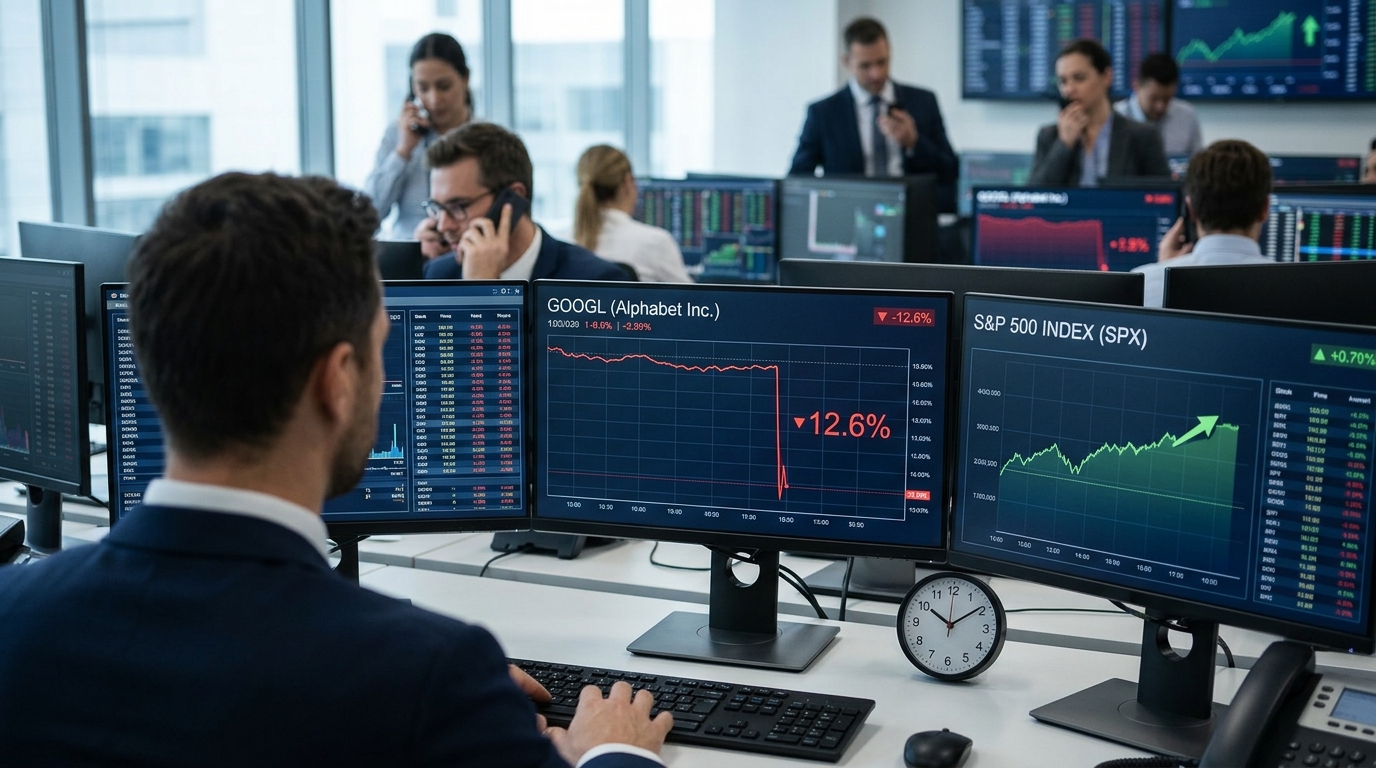
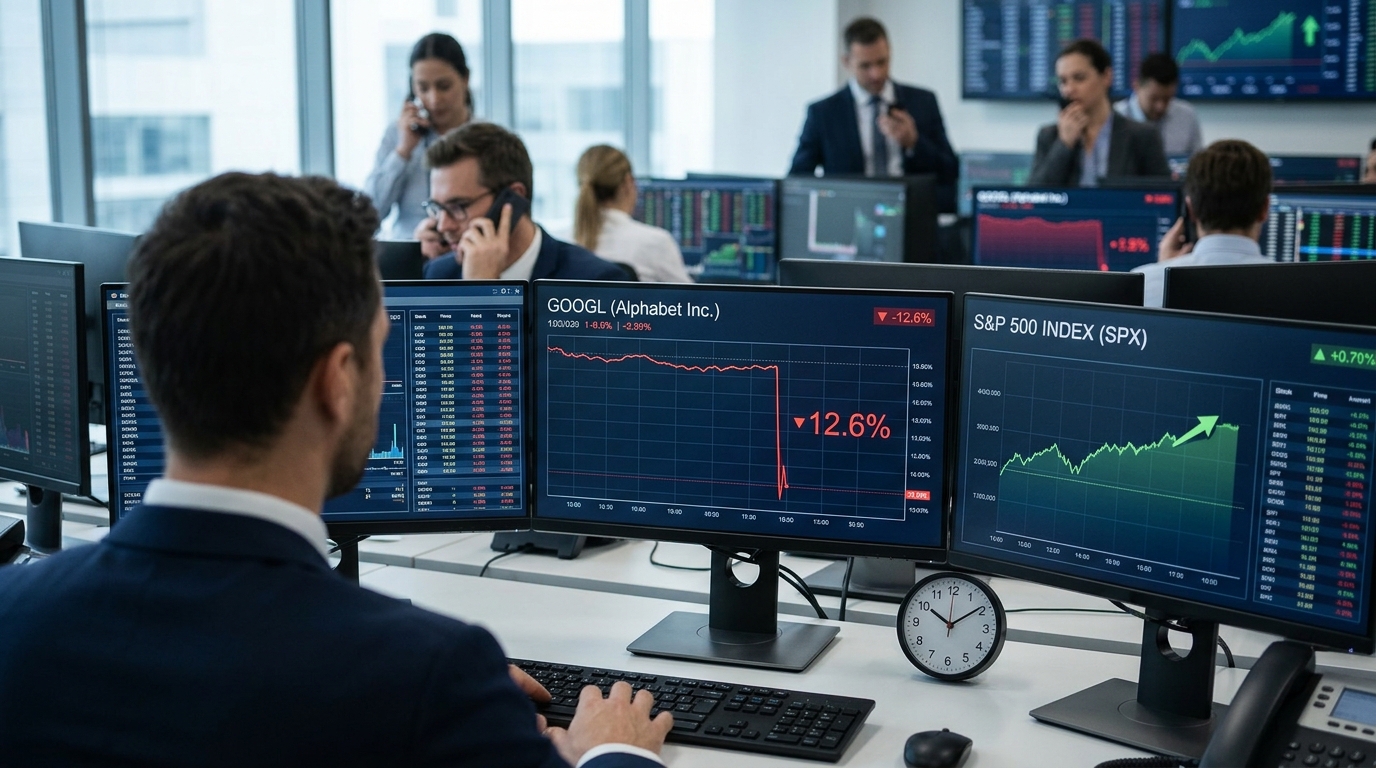
Alphabet fell about 12.6%, erasing roughly $500 billion in market value. Ad and search growth disappointed, and the company guided 2026 capex to $195 to $205 billion, with more to come in 2027. Then, after Thursday’s close, Amazon slumped about 7% in after-hours trading as investors focused on heavy AI spending, while Intel plunged about 23% after its revenue forecast missed analysts’ estimates. Amazon and Intel are together poised to lose about $300 billion in market value if losses hold.
The yield on the 10-year Treasury note eased to about 4.92% on October 30, marking roughly a 0.07 percentage point decrease from the previous session’s close. A modest move in isolation, but one that extends a pattern. Treasuries have caught a bid across each of the past four sessions as the AI capex story has soured.
Why It Happened
The market is no longer asking simply whether AI revenue is growing. As one capital markets strategist put it, the market is now asking what companies have to spend to get there. That distinction matters enormously for free cash flow. Amazon reported negative free cash flow of $42.4 billion over the past 12 months. Alphabet posted negative free cash flow of about $9.1 billion in Q3.
The dividing line is between companies whose AI spending is funded by cash-generating cloud businesses and those whose spending is outrunning revenue. Investors rewarded Microsoft and Oracle for funding their AI buildouts with cash, while punishing Alphabet for spending heavily as Google Search growth slowed. Microsoft topped analysts’ expectations for both earnings per share and revenue, and the company said it expects Azure growth to accelerate to about 49% to 50% in the current quarter on its outlook.
What the Market May Be Missing
The breadth reading is the most important data point of the week, and it is getting the least attention. The Russell 2000 rose for a fourth straight day and the equal-weight S&P 500 gained 1.2%, its largest gain in about two weeks, even as the Nasdaq fell 1.4%. Financials, housing, utilities, consumer names and other rate-sensitive parts of the market found buyers. That combination, broad advances plus falling yields, describes a rotation rather than a risk-off exit. Capital did not leave the equity market when Alphabet fell. It moved within it.
Month-end rebalancing could account for some of this. But four consecutive sessions showing the same pattern, beats sold, Treasuries bid, and the non-tech S&P advancing, is a pattern that deserves more than a one-day explanation.
Where It Shows Up
The AI trade is not dead, but the market is becoming far less charitable about who gets to keep the premium multiple as capex, financing, and monetization come under harder scrutiny. The ETF most directly exposed to Friday’s session is QQQ, which tracks the Nasdaq 100. TLT, the long-duration Treasury fund, has been the cleaner beneficiary of the rotation. AI-exposed miners fell hardest, with Iren and Cipher Digital each losing close to 9%, as Alphabet’s capital spending revived doubts about hyperscaler demand for their data-centre capacity.
The rotation away from mega-cap tech toward rate-sensitive and equal-weight names is not a new phenomenon. Institutional flow data showing the Magnificent Seven underperforming the equal-weighted S&P 500 by roughly six percentage points over a 90-day stretch pointed to exactly this kind of capital redistribution.
Nvidia sits at the center of the unresolved tension. Microsoft says it expects capex to accelerate in the second half, driven in part by spending on CPUs and GPUs, and it has pointed to about $170 billion of capital expenditures in calendar 2026, which would be a direct positive for Nvidia’s order book, even as the stock gets dragged lower in the sector selloff.
Risks and Counterpoints
The bear case is straightforward: Bloomberg reports about $750 billion of collective AI spending in 2026 by America’s technology giants, and several companies have tapped the bond market to finance those investments, amplifying concerns that debt-funded spending will become harder to justify as borrowing costs rise. If the 10-year yield reverses back toward 5.1%, the rotation loses its engine.
The bull case rests on the breadth data. With the third-quarter reporting season past the halfway mark, most reporting dashboards show a large majority of S&P 500 companies beating analyst expectations, and estimates for year-on-year earnings growth have moved sharply higher. That is not a market falling apart. It is one recalibrating which companies deserve the highest multiples.
What to Watch Next
Friday’s open will tell investors whether the futures move is being confirmed by volume or fading. Watch the equal-weight S&P against the cap-weight version: if equal-weight holds its gains into the close while the Nasdaq remains under pressure, the rotation reading strengthens considerably. Meta reports next week, giving the market another data point on whether ad-funded AI spending faces the same verdict Alphabet just received. The 10-year yield at about 4.92% is the level to monitor in fixed income. A sustained move below 4.85% would suggest the bond market is seeing something in this earnings season that goes beyond a few disappointing capex lines.