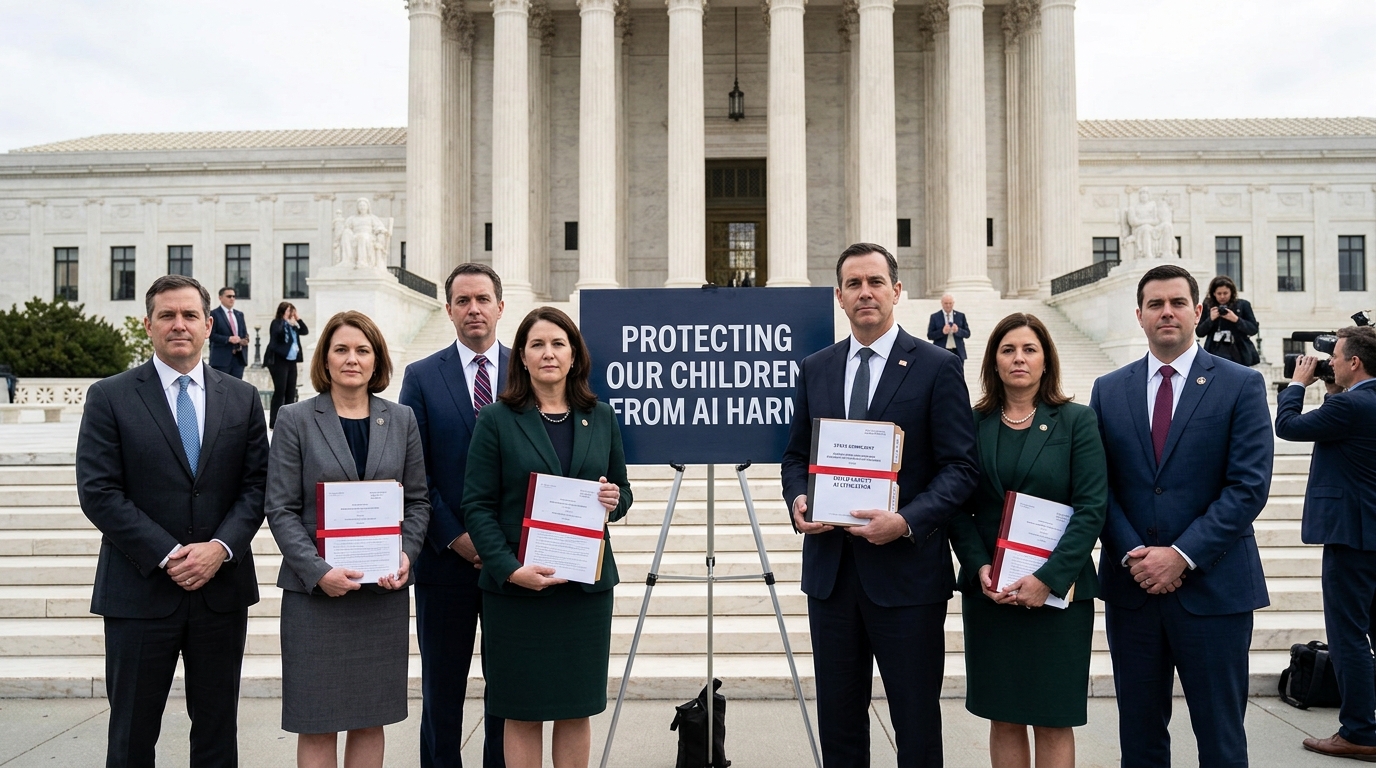
The lawsuits themselves name only OpenAI. But investors in Microsoft, Alphabet, and Anthropic should read the complaints filed October 14, 2026 as carefully as OpenAI’s own lawyers will.
Eight state attorneys general, Iowa, Kansas, Nebraska, West Virginia, Arkansas, Arizona, Idaho, and Montana, filed coordinated lawsuits against OpenAI, alleging that ChatGPT harms children and that the company has misled parents about the risks. The lawsuits include claims under state consumer protection laws and allege that ChatGPT’s design encourages excessive use and emotional dependency, making it particularly harmful to vulnerable users, including children. Alleged harms include encouraging users toward suicide or self-harm, facilitating violence against others, and providing dangerous medical advice.
This did not arrive in a vacuum. Just one day before the OpenAI suits were filed, AI chat startup Character.ai filed for Chapter 11 bankruptcy after facing a wave of claims that its app contributed to mental health issues and suicides among teens. That filing followed regulatory scrutiny and civil litigation regarding youth protection and algorithmic harm. Character.ai’s bankruptcy establishes something important: chatbot child-safety litigation is no longer a theoretical risk. It is a business-ending one.
That is precisely why the exposure extends well beyond OpenAI. The three platforms children most likely encounter, ChatGPT from OpenAI, Claude from Anthropic, and Gemini from Google, all have minimum age requirements, content filtering, and safety policies. But these policies differ significantly, the safeguards are not all automatically enabled, and the data privacy implications of children’s AI conversations are not widely understood.
Microsoft’s position is particularly complex. Microsoft 365 Copilot is a multi-model product that runs on OpenAI’s GPT family, the same model family that powers ChatGPT, and it can also use Anthropic’s Claude models in specific Copilot experiences where organizations enable that option. Copilot ships inside products used by students every day. If state attorneys general decide to widen their theory of the case, the distributor of a chatbot with documented design choices that allegedly harmed minors could face the same consumer-protection statutes the eight states are currently citing against OpenAI directly.
Courts have already started asking who in the supply chain can be held liable. In the Garcia case involving Character.AI, Google argued it should not be held liable because it was not the provider of the chatbot. A federal judge found the allegations were sufficient at the motion-to-dismiss stage to treat Google as a potential “component part manufacturer,” largely because the plaintiff alleged the underlying model integration itself contributed to the alleged defect. That precedent matters because Alphabet sits at every level of the stack, as a model developer through Gemini, as a cloud infrastructure provider, and as a consumer app distributor.
Separately, the European Commission has proposed an EU KIDS Act that would impose safety-by-design requirements on online services used by minors, including AI companions and chatbots. The regulatory direction is consistent on both sides of the Atlantic, and it is tightening.
The eight state filings land four months after Florida’s attorney general brought a similar case against OpenAI in June 2026, and they arrive about two months after the company rolled out a restricted ChatGPT experience for teenagers on August 18, 2026. Together, the eight suits set up what could become the most consequential legal test yet of how far a consumer AI product has to go to protect minors, and how much liability a company faces when it falls short.
For investors, the near-term question is not whether OpenAI settles, but what conditions any settlement or court ruling imposes on how consumer chatbots must operate around minors. Design mandates, age-verification requirements, or new consent frameworks would reshape the cost structure for every company distributing a general-purpose chatbot at scale. Microsoft and Alphabet are profitable enough to absorb compliance costs. The smaller players are not, as Character.ai has just demonstrated.
The wealth-building lesson here is straightforward. Legal risk in AI is no longer confined to the company whose name appears on the complaint. As chatbots become embedded in operating systems, productivity suites, and consumer devices, the liability surface expands with the distribution footprint. Own the platforms with the balance sheets to navigate that, and be skeptical of concentrated exposure to companies whose only moat is the model itself.