October 5, 2026
Bonus Content: Deutsche Telekom’s AI Plan Pays You a €1 Dividend to Own T-Mobile US
Pentagon Wants 300,000 Drones. Which U.S. Companies Are Ready?
Investors follow the numbers. And right now, the drone market is telling a story that is getting difficult to ignore.
The global market was valued at $83.8 billion in 2025 and is projected to reach $182.4 billion by 2033. North America already accounts for more than 40% of it.
Those are the market numbers…
Now follow Washington’s numbers…
The Pentagon wants around 300,000 drones while a new Executive Order aims to prioritize domestic manufacturing, secure supply chains and wider adoption of American made systems.
Put those figures together and this opportunity starts to come into focus.
Making this Nasdaq drone manufacturer intriguing; as it has spent more than 25 years developing a patented technology.
This growing patent portfolio helps secure that position as demand expands.
As more of the world’s drone spending flows toward American companies, this unnoticed, Nasdaq may gain attention quickly.
Deutsche Telekom’s AI Plan Pays You a €1 Dividend to Own T-Mobile US
T-Mobile US is one of the best-run wireless carriers in North America. Most investors who want a piece of it buy TMUS and move on. That may be the less efficient choice.
This morning in Bonn, Deutsche Telekom held the first dedicated AI Investor Day by a major global carrier, attaching hard numbers to a strategy that, when read alongside the company’s capital-return program, reframes DTEGY as something more than a German telco with an American subsidiary. It looks increasingly like a leveraged, income-paying vehicle for owning T-Mobile US at a discount, with an AI growth option layered on top at no extra charge.
What the AI Day Actually Said
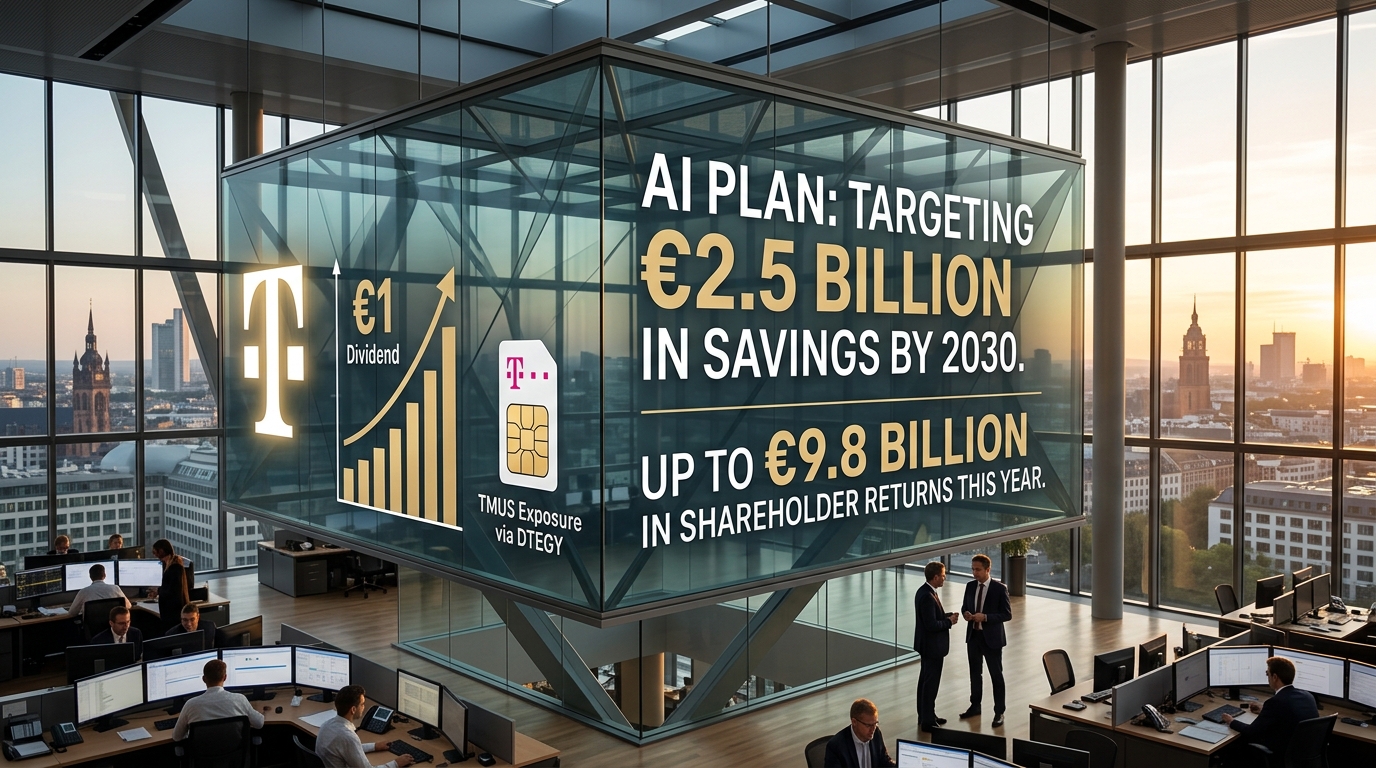
Deutsche Telekom announced ambitious AI targets, forecasting gross savings of approximately €1.1 billion by 2027 and indirect cost reductions nearing €2.5 billion by 2030. It also expects approximately €250 million of AI-related revenue from businesses outside the U.S. for 2026 and aims to increase that to approximately €800 million by 2030. Add those two together and you get roughly €3.3 billion in combined AI-driven savings and new revenue targeted by decade’s end, on a non-U.S. base that currently runs at a fraction of T-Mobile’s scale.
Deutsche Telekom framed the savings as indirect costs, a category that typically covers procurement, administration, customer operations and support functions rather than the capital-intensive buildout of network equipment. That matters because cost reductions in those areas flow directly to free cash flow. The company confirmed its guidance and medium-term targets alongside the AI announcement.
The AI infrastructure behind these numbers is already running. Deutsche Telekom launched its Industrial AI Cloud in Munich, a facility aimed at providing sovereign computing capacity for AI workloads across industry, research, and the public sector, developed over six months with Nvidia and data center partner Polarise. The integrated stack combines Deutsche Telekom’s connectivity and security capabilities, its sovereign T Cloud, and orchestration software from SAP’s Business Technology Platform.
The T-Mobile Angle Competitors Miss
Here is the comparison that matters. T-Mobile US contributed €1,382 million to organic EBITDA AL growth with a 9.6% expansion rate, and generated €15.7 billion in adjusted EBITDA AL in the first half of 2026, representing approximately 67% of the group total. Owning TMUS directly gives you that growth, but at a price. DTEGY trades at a forward price-to-earnings ratio of 10.04 as of early October 2026, while T-Mobile US carries a trailing P/E closer to 20. You are buying essentially the same underlying U.S. cash flow engine at half the earnings multiple when you go through the Bonn parent.
Fitch upgraded Deutsche Telekom’s credit rating to A- from BBB+ on June 22, 2026, and the company’s stake in T-Mobile US reached 54.3% as of July 17, 2026, as Deutsche Telekom chose not to participate in T-Mobile’s own buyback program, allowing its ownership position to increase passively. That is a steadily increasing claim on T-Mobile’s future earnings, acquired at zero premium.
The Capital Return That Makes the Wait Worthwhile
TMUS now pays a dividend. DTEGY does too. Management proposed a record dividend of €1 per share for the past fiscal year. The total 2026 buyback authorization was raised to up to €5 billion. Combined with dividends, total shareholder remuneration could reach up to approximately €9.8 billion for the year. For an income-oriented investor, that changes the calculus considerably.
Underpinning every bull case is a single number: roughly €20 billion in adjusted free cash flow targeted for full-year 2026, which funds shareholder distributions, debt reduction, and steady network investments.
Risks to Monitor
The discount to analyst targets is wide. Investing.com lists 16 Buy ratings and two Hold ratings among 18 analysts, with an average target of €36.44 against a recent price around €26. That gap reflects real concerns: currency drag for dollar-earning investors, the unresolved question of a full T-Mobile merger, and the fact that AI cost savings, however credibly quantified, still have to be realized over four years.
The bear case is less about the day-to-day business than about the strategic fog surrounding the U.S. operation. If a merger is definitively off the table, Deutsche Telekom remains limited to a majority stake without clarity on how minority shareholders and U.S. regulators would respond to future consolidation efforts.
The Wealth-Building Takeaway
The lesson from today’s AI Investor Day is not simply that Deutsche Telekom is deploying AI. It is that a company generating €20 billion in annual free cash flow, holding a growing 54% stake in one of the best wireless businesses in the world, paying a record dividend, buying back €5 billion of its own stock, and trading at 10 times forward earnings deserves more attention from income-plus-growth investors than it typically receives. The AI targets give the European business a credible path to margin expansion independent of T-Mobile altogether. That combination is rare, and today’s numbers make it harder to ignore.