September 29, 2026
Bonus Content: Farm Labor Is Shrinking. Machines Are Filling the Gap.
Copper is breaking records – and attention is turning toward early-stage discovery stories with real scale.
As electrification, AI data centers, and grid expansion collide with tightening supply… copper has become strategic infrastructure for the global economy.
And right now, one under-the-radar Canadian copper company – still largely undiscovered below $2 per share – is unlocking a district-scale opportunity across a historic copper belt in Canada’s Yukon.
For generations, high-grade copper, gold, and silver were mined across this prolific belt.
Yet the deeper story was never told.
The land was fragmented, exploration tools were limited, and no operator ever controlled the entire belt.
That has now changed.
For the first time, this historic copper belt has been consolidated under a single, well-funded Canadian operator – creating the opportunity to explore the district as a unified system.
And this is not a single-deposit story.
Across the belt, multiple opportunities are advancing:
- High-grade results across the flagship
- Past-producing areas getting a second look via the drill bit
- Multiple additional targets advancing toward drilling
This is still early. And the opportunity is getting even bigger.
Multiple rigs are already operating, more are being added, and the company is fully funded through the end of 2027 for its biggest exploration program yet.
More rigs. More drilling. Multiple shots at discovery.
And all of this from a small-cap copper company still trading below $2 per share.
We’ve put together a FREE online report with the full story – including our exclusive, in-depth interview with the company’s CEO – detailing what recent high-grade results are confirming and where the fully funded 2026-27 drill campaign goes next.
Click here for instant access – and get the full story as drilling accelerates across this still-under-the-radar Yukon copper opportunity.
Farm Labor Is Shrinking. Machines Are Filling the Gap.
The numbers are no longer theoretical. In the labor-intensive parts of U.S. agriculture, the field and crop workforce fell by roughly 20% in the years leading up to the mid-2010s, and more recent data continue to show an aging, tightening labor pool. Simultaneously, 96% of specialty crop growers reported labor costs either rising or holding steady last year, with 41% describing the increase as significant, according to the 2026 Specialty Ag Labor Survey. Fruit and vegetable producers can see labor run up to roughly 40% of variable production expenses, depending on the crop and how mechanized the harvest is. That is not a rounding error. That is an existential margin problem.
The pressure is structural, not cyclical. Immigration enforcement has narrowed the undocumented farmworker pool, the hired farm workforce is aging, and younger workers are not replacing them. California alone, which grows nearly half of the country’s vegetables and more than three-quarters of its fruits and nuts, routinely leaves crops unharvested when labor comes up short. No policy adjustment resolves that math in the near term.
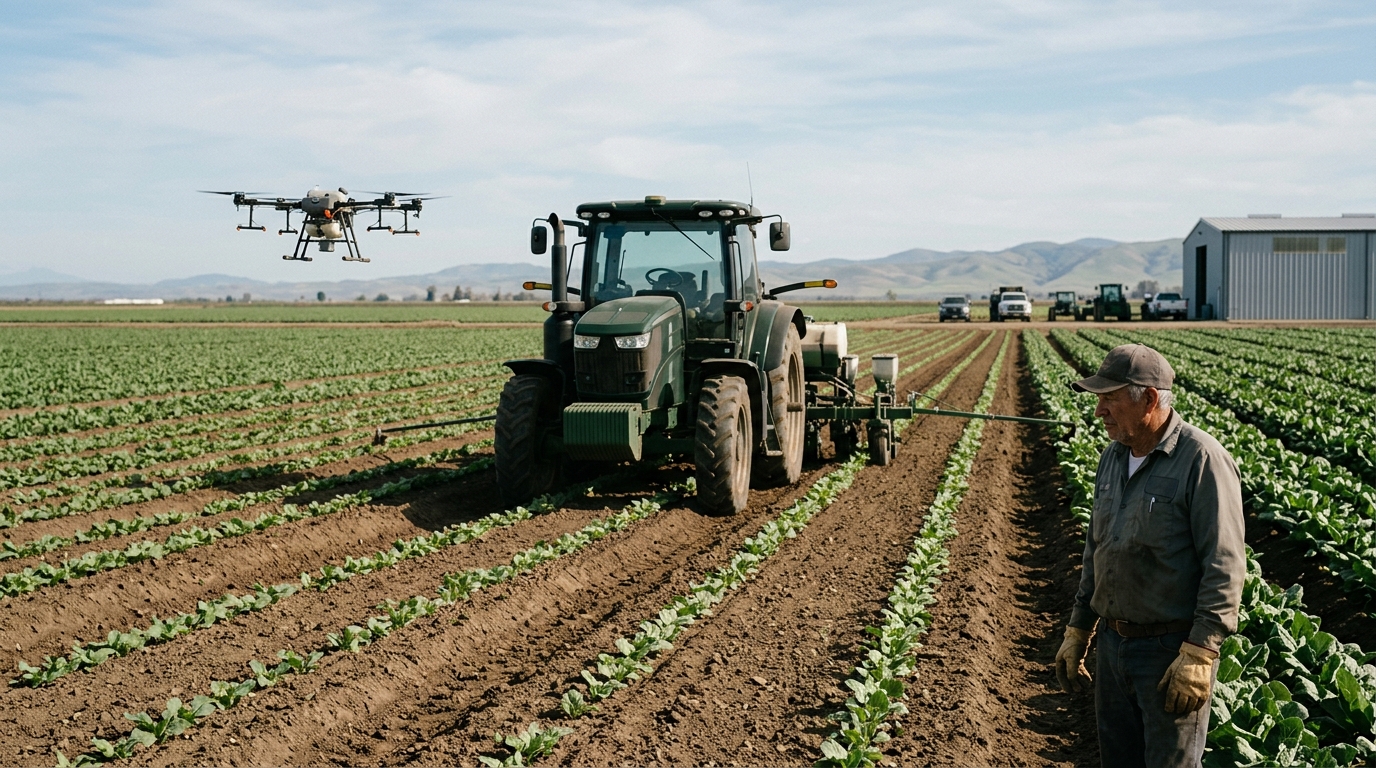
What is resolving it, at scale, is hardware. By 2026, a little over one million acres in North America have been logged under autonomous tractor operations by major commercial platforms, based on reported telemetry from multiple providers. John Deere introduced its next-generation perception system for tillage autonomy with model-year 2025 autonomy-ready equipment and has been expanding real-farm deployments through its connected platform. Management has said 2026 is the bottom of the current agricultural equipment cycle, which makes the timing of technology adoption particularly relevant for investors watching the next upswing.
CNH Industrial is moving in parallel. Its FieldOps platform has expanded, and New Holland has showcased its R4 autonomous robot concept for specialty crops. AGCO’s Fendt brand is also pushing further into higher-autonomy offerings, including the availability of its PTx OutRun automated solutions on select Fendt tractor series.
Above the tractors, AI-equipped drones are compounding the gains. Systems can now reach crop-versus-weed identification results above 90% in controlled settings, with precision application approaches that can materially cut chemical use in the right agronomic context. One operator using WingspanAI tools associated with Monarch’s platform can supervise a fleet of up to eight autonomous machines from a tablet, a ratio that fundamentally changes the cost of field coverage.
The broader autonomous farm equipment market is often estimated in the tens of billions of dollars today, and one widely cited market forecast puts it at about $75 billion in 2026 with a path toward roughly $145 billion by 2035. For investors, the clearest near-term expression of this shift is in Deere and CNH, both of which are transitioning from hardware sellers toward software-defined platforms with recurring revenue streams. That recurring model changes the earnings quality of the business as much as the machines change the economics of the farm.
The risk worth watching: farms running tight margins may delay capital investment if commodity prices stay soft. USDA’s latest farm income forecast calls for inflation-adjusted net farm income to fall in 2026 versus 2025, which creates a real tension between the need for automation and the cash available to fund it. The cycle turns on commodity prices, credit conditions, and whether government incentive programs expand meaningfully for smaller operators who cannot yet justify the upfront cost.
The core lesson is this: labor shortages that compress farm margins are permanent features of the agricultural landscape, not temporary disruptions. The companies solving that problem with software and machines are building durable competitive positions. The current equipment downcycle may be the best moment to build exposure before the next upcycle rewards adoption at scale.