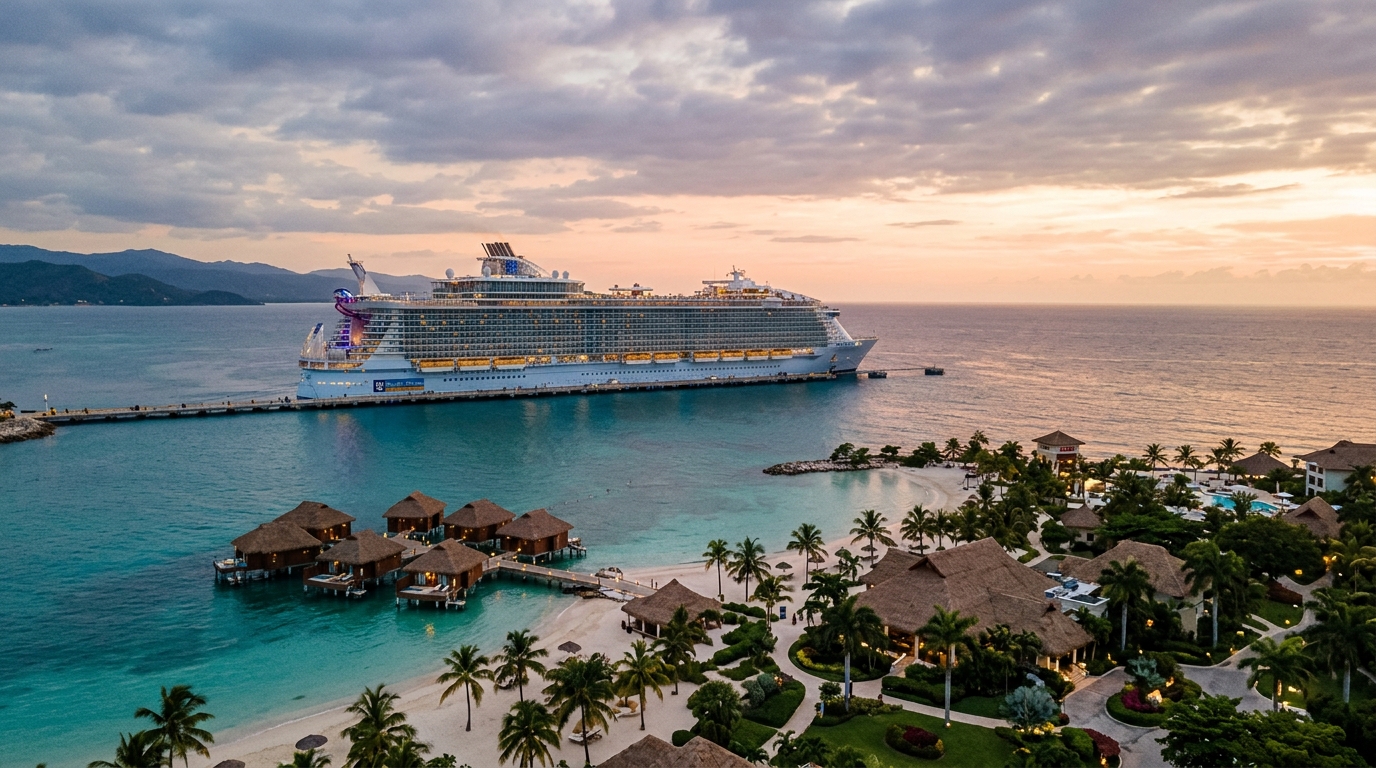
Royal Caribbean just confirmed its largest acquisition in company history, and the market’s first response was to sell the stock. That sequence tells you almost everything you need to know about where investor confidence stands heading into this deal.
Royal Caribbean Group said on Wednesday it had agreed to acquire a 50% stake in Caribbean resorts operator Sandals Resorts International for $3 billion, expanding the cruise company’s presence in land-based vacation experiences, Reuters reported. Royal Caribbean shares fell about 6% after the talks were disclosed in a Financial Times report. The confirmation this morning did little to reverse the damage. That decline is the market’s verdict on the capital allocation, and it deserves serious examination.
Why Now Is a Difficult Moment to Write a $3 Billion Check
The company’s stock is down about 25% over the past year. In its Q2 2026 update, Royal Caribbean trimmed its full-year revenue growth outlook to about 9% from about 10% and flagged softer demand for certain sailings tied to geopolitical uncertainty. Against that backdrop, committing $3 billion to a land resort business is a bold ask of shareholders who are already sitting on meaningful losses.
Royal Caribbean said the deal values the resort business at about 10 times forward EBITDA, and the company has secured committed debt financing from Morgan Stanley to fund the transaction. The 10-year U.S. Treasury yield stood at 5.01% on September 18, up from 4.94% the prior day, according to Federal Reserve data. A large debt-funded deal struck against that backdrop costs more to service than the same deal would have a year or two ago, which helps explain why the market’s first instinct was to mark the stock down.
The Strategic Logic Is Real, Even If the Timing Is Awkward
Royal Caribbean announced it will acquire a 50% equity interest in Sandals and Beaches Resorts for approximately $3 billion, forming a joint venture in the all-inclusive resort sector. The partnership will be governed by a board under shared leadership of Jason Liberty, Chairman and CEO of Royal Caribbean Group, and Adam Stewart, Executive Chairman of Sandals and Beaches Resorts.
The deal is expected to close in early 2027, subject to regulatory approvals, and Royal Caribbean says it expects the transaction to be accretive to earnings next year. The partnership will seek to accelerate the expansion of Sandals and Beaches resorts while broadening distribution and allowing customers to access resort and cruise experiences across both companies’ portfolios. Royal Caribbean has been focused on broadening its land-based vacation offerings, including its Royal Beach Club private destinations and Perfect Day destinations, as cruise operators seek to capture a larger share of consumers’ overall travel spending, Reuters reported. Sandals, with its 20 Sandals and Beaches resorts across the Caribbean, is a natural extension of that push rather than a random diversification.
Cruising is a small slice of global tourism, and CLIA has described the industry as about two percent of global tourism. Owning a piece of the far larger land-based leisure market is strategically coherent. The question is whether this is the right asset at the right price at the right moment.
Bull Case
Cross-selling is the central promise. By integrating Sandals’ land properties into its ecosystem, Royal Caribbean aims to convert traditional resort guests into cruise passengers and offer combined vacation packages. Royal Caribbean’s loyalty base numbers in the tens of millions. Routing even a fraction of those guests through Sandals properties, or funneling Sandals’ customers onto a Celebrity or Silversea sailing, could produce returns that justify the entry price. The accretion Royal Caribbean is talking about for the year after closing would help silence critics quickly if it materializes.
Bear Case
The balance sheet was already busy before this announcement. As of December 31, 2025, Royal Caribbean disclosed scheduled debt maturities for 2026, 2027, 2028, 2029, and 2030 of $3.2 billion, $2.6 billion, $3.2 billion, $1.1 billion, and $1.1 billion, respectively. Layering another $3 billion of Morgan Stanley-committed debt on top of that wall of maturities narrows the margin for error. If European sailings remain soft or a recession trims Caribbean leisure spending, Royal Caribbean will be servicing an expensive new obligation at the worst possible time. One widely cited third-party compilation of insider filings shows heavy net insider selling over the past 12 months, with about $631 million in sales and no reported insider buying.
What to Watch
Three things will determine whether this deal looks prescient or premature by mid-2027. First, the debt cost: the Morgan Stanley commitment is in place, but the pricing has not been disclosed, and investors will want to know what rate Royal Caribbean locked in. Second, European booking trends through the winter season. In recent guidance, Royal Caribbean has pointed to geopolitical uncertainty and more close-in booking behavior as factors that can reduce revenue visibility. A recovery there would ease the pressure on the core business and make the Sandals bet easier to justify. Third, any early signs of cross-selling traction once the deal closes.
The thesis here is not wrong. A vacation company that can capture a guest from the airport to the beach to the ship holds a structurally stronger position than one that only operates at sea. But Royal Caribbean is asking its shareholders to fund an ambitious land grab at a moment when its core cruise business is growing more slowly than expected and its stock has already fallen sharply. That tension, not the Sandals brand itself, is what the 6% selloff was pricing.