August 12, 2026
SMCI Guided to $72B. The Cash Hole Is Real.
Supermicro crushed every estimate Tuesday night. The working capital problem did not disappear with the guidance beat.
First a note from The Oxford Club
Dear Reader,
Most investors know SpaceX as Elon Musk’s rocket company.
Almost nobody knows the real story behind it.
And trust me… the story is bizarre.
Back in 2008, Musk was staring at the end of everything.
He’d poured $100 million into SpaceX. His first three rockets had exploded.
He had cash for maybe one more launch.
If another rocket blew up, Musk would go from a “hero to a zero” …
Then Musk made a desperate outreach to a billionaire named Peter Thiel.
From a quiet office inside a former military base called the Presidio – just north of the Golden Gate Bridge – Peter Thiel did something amazing…
Find out what happened by going here now (it could change your investing life forever) …
Yours in smart speculation,
Bryan Bottarelli, Co-Founder
Monument Traders Alliance
SMCI Guided to $72B. The Cash Hole Is Real.
Super Micro Computer reported Q4 fiscal 2026 results Tuesday evening and the fiscal 2027 revenue guide stopped analysts mid-sentence. The San Jose AI server maker said it expects $65 billion to $72 billion in revenue next fiscal year. The Street had penciled in roughly $54 billion. That gap is not a guidance beat in the traditional sense. It is a different order of magnitude entirely.
SMCI stock jumped about 9% in extended trading. The reaction is understandable. What sits underneath the guide is worth examining carefully before adding it to a portfolio.
Scoreboard
Here is what Supermicro actually reported for the fourth quarter of fiscal 2026, the period ended June 30:
- Revenue: $11.1 billion, up 93% year over year. Slightly below the consensus estimate of roughly $11.7 billion, but within the company’s previously guided range.
- Gross margin: 17.5% GAAP, 17.6% non-GAAP. A year ago the same figure was 9.5%. The margin nearly doubled in twelve months.
- Net income: $1.18 billion versus $195 million in Q4 FY2025. Diluted EPS of $1.62 GAAP, $1.70 non-GAAP. The non-GAAP figure blew past the consensus of roughly $0.71 to $0.96.
- Full-year revenue: $39.1 billion, up 78% from $22 billion in fiscal 2025.
- Full-year non-GAAP EPS: $3.63, versus $2.06 a year prior, a 76% jump.
- Full-year gross margin: 10.8%.
- Operating cash flow, full year: Negative $6.8 billion.
- Q1 FY2027 guidance: Revenue of $14.5 billion to $15.5 billion. Analysts had expected $11.68 billion, Reuters reported. Adjusted EPS of $1.01 to $1.10 against a consensus of roughly $0.76.
The Q1 midpoint of $15 billion already implies an annualized run rate that covers the low end of fiscal 2027 guidance before any ramp. That is a remarkable starting position.
Trump: Don’t Mess With This American Stock!
One little-known U.S. stock is 20x cheaper than AMD – yet more profitable than Airbnb, Chipotle, and Hilton.
Backed by Trump and now partnering with a top AI firm, it’s poised to explode.
Why the Stock Moved
The market already had the broad revenue and margin outlines. Supermicro’s July 21 preliminary business update disclosed more than $60 billion in new orders during Q4 alone and signaled margins would land well above the 8.2% to 8.4% guided in May. SMCI had already recovered from its lows before Tuesday’s call began.
What nobody could price was the full fiscal 2027 revenue target. A guide of $65 billion to $72 billion sits far above where any external model had landed. The Q1 guide of $14.5 billion to $15.5 billion is striking on its own: it cleared even the most optimistic analyst view Reuters had cited heading into the print.
Management framed the fiscal 2027 target as “selective,” signaling a focus on higher-margin business rather than revenue volume for its own sake. That distinction matters for the margin trajectory discussion below.
What This Business Actually Is
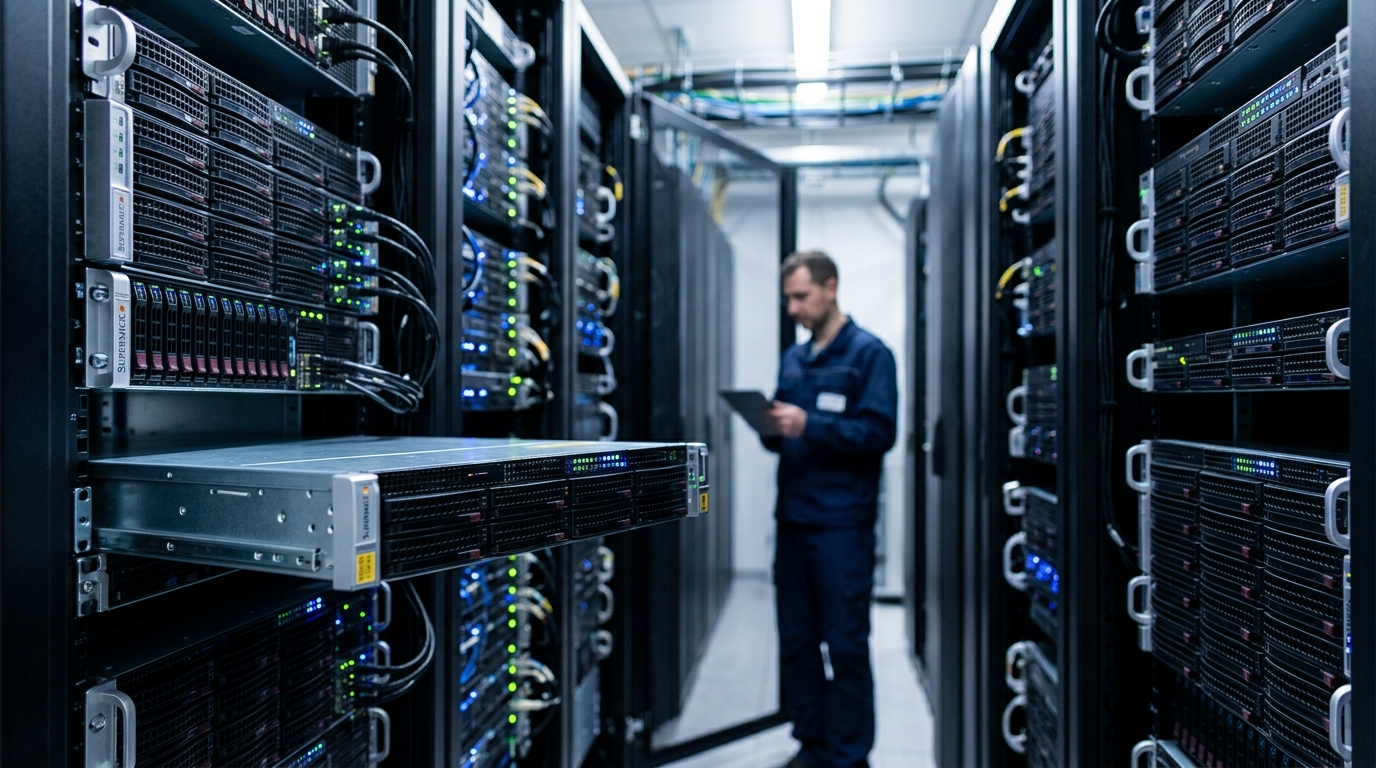
Calling Supermicro an AI server company is now too narrow. The manufacturer is positioning itself as a full data center infrastructure provider through its Data Center Building Block Solutions platform, or DCBBS. The offering bundles compute, storage, direct liquid cooling, networking, management software, and lifecycle services into a single deployment package for customers building AI factories.
Supermicro pre-tests and pre-validates the full stack in its own facilities before shipment, compressing time-to-online for cloud operators and enterprise buyers who need racks live fast. Manufacturing runs across Silicon Valley and overseas sites. Management has discussed scaling rack production to around 6,000 units per month.
The DCBBS pitch is also the margin story. A standalone GPU server puts Supermicro in a direct price contest with Dell Technologies and Hewlett Packard Enterprise. A complete racked, cooled, networked, and managed data center block positions it as a solutions vendor. Q4’s 17.5% gross margin, versus mid-single-digit results from earlier in fiscal 2026, suggests the mix shift is already working. Management said AI-related products are expected to represent more than 80% of future revenue, with enterprise, storage, and services improving the blended margin over time.
The Numbers That Matter
Revenue trajectory:
- FY2024: roughly $14.9 billion
- FY2025: $22.0 billion (+47%)
- FY2026: $39.1 billion (+78%)
- FY2027 guidance: $65 billion to $72 billion (implied growth of 66% to 84%)
Margin recovery:
- Q2 FY2026 gross margin: 6.3% (the trough)
- Q3 FY2026 gross margin: 9.9%
- Q4 FY2026 gross margin: 17.5%
- Q1 FY2027 guidance: 10.4% to 10.8%
That Q1 step-down matters. Management acknowledged on the call that Q4 margins included nonrecurring benefits: lower tariff costs and reduced excess-and-obsolete inventory charges. The guided 10.4% to 10.8% for Q1 is the more sustainable baseline. Still better than anything seen before Q4, but the 17.5% result is not the new floor.
Balance sheet snapshot (as of March 31):
- Cash: $1.29 billion
- Inventory: $11.10 billion
- Receivables: $8.41 billion
- Total bank debt and convertible notes: $8.8 billion
Inventory and receivables combined totaled nearly $19.5 billion at the last quarterly snapshot. Revenue can grow fast while cash lags badly. The full-year operating cash outflow of $6.8 billion is the loudest evidence of that dynamic, as the company scaled inventory and capacity to meet AI infrastructure demand.
To fund the working capital gap, Supermicro leaned on equity and equity-linked financing, including a roughly $7 billion capital raise during fiscal 2026. That is dilution. It is also the cost of scaling at 78% annual revenue growth while carrying enough inventory to service a record order book.
Backlog and orders:
- New orders received in Q4 FY2026: more than $60 billion
- Backlog: record level entering fiscal 2027
- Q4 revenue recognized: $11.1 billion
One quarter’s new orders were more than five times the revenue recognized that same quarter. That ratio is either the most compelling demand signal in AI infrastructure right now, or evidence that delivery timelines are stretching materially. Management pointed to power availability, cooling readiness, and networking constraints at customer sites as partial explanations for Q4 revenue slipping into later quarters.
Is It Cheap?
SMCI closed Tuesday at $31.68 and remains down roughly 32% over the past year despite the latest rebound. At that price, the stock trades at a single-digit to low-double-digit forward earnings multiple. The peer comparison is pointed:
- Dell Technologies: forward P/E in the low-to-mid teens, up sharply year to date on AI server demand
- Hewlett Packard Enterprise: forward P/E in the low-to-mid teens, also up materially year to date
- SMCI: forward P/E in the single digits to low double digits, with the stock far less loved this year
The discount is real. So is the reason for it. The board is conducting an independent review of certain transactions related to export-control issues, and results remain preliminary and unaudited. Supermicro has faced scrutiny tied to export controls, and it has a documented near-delisting from Nasdaq in its recent past. Those facts live in the multiple, not in a footnote.
The question is whether a $60 billion order intake, 78% revenue growth, and a $65-to-$72 billion fiscal 2027 guide justify buying into a company that still carries genuine governance risk. That calculus is individual. What is not individual: any single analyst price target after a guide like this is a snapshot, not a promise.
Bull, Base, Bear
Bull
The $60 billion order wave converts at a pace that keeps fiscal 2027 near the high end of the $65 to $72 billion range. Gross margins stabilize in the 12% to 14% corridor as enterprise mix grows and DCBBS adoption scales. Governance risk fades as filings and auditor work stay on schedule. At 14 times forward earnings on $5-plus EPS, SMCI trades near $70, roughly a double from current levels.
Base
Fiscal 2027 revenue lands near the midpoint at around $68 billion. Margins settle into a 10% to 12% range as Q4 tailwinds fade. Cash flow turns positive in the second half as backlog deliveries accelerate and receivables normalize. Stock re-rates from a single-digit forward multiple toward the low teens, implying a price in the $40 to $45 range.
Bear
Compliance or governance issues flare again, forcing a restatement or renewed listing risk. Alternatively, power and site-readiness constraints push backlog deliveries into FY2028, landing revenue well below the $65 billion floor. Operating cash flow stays deeply negative, requiring another equity raise at dilutive prices. Gross margin guidance of 10.4% to 10.8% for Q1 proves optimistic as hyperscaler customers renegotiate terms. Stock revisits the mid-to-high $20s or lower.
Action Plan
Supermicro is not a stock for investors who require clean governance and fully audited books before they act. Those investors should wait. The audit sign-offs and filing timeliness are the specific events that remove the largest discount embedded in this valuation. When they arrive, the risk-adjusted picture changes sharply.
For investors willing to carry governance risk, the entry math is straightforward. At a single-digit to low-double-digit forward multiple with a fiscal 2027 revenue guide far above consensus, SMCI is priced as if the market still expects something to go wrong. If the company delivers anything close to the midpoint of its own guidance, that multiple is hard to defend.
Scale-in approach for aggressive buyers: Take a partial position now, ahead of a clean bill of health, then add on confirmation. Target no more than half your intended position before the auditor work and filing cadence look fully settled. The remaining half belongs in dry powder waiting for that specific catalyst, not for the guidance beat that already happened.
Trim or avoid if: board or regulator-related risk worsens, Q1 FY2027 revenue misses its own $14.5 billion floor, or gross margins slide back below 9%. Any of those three would suggest Q4’s recovery was a one-off rather than a business model shift.
Cheap Investor Checklist
- Audit and filing cadence: Watch for timely filings and clean auditor work on FY2026 and subsequent quarters. This is the single biggest valuation unlock.
- Export-control and compliance risk: Any new disclosure here changes the valuation overnight. The board’s independent review is ongoing.
- Q1 FY2027 revenue: Track against the $14.5 billion to $15.5 billion guided range. A miss resets fiscal 2027 guide credibility immediately.
- Gross margin sustainability: Q1 guidance is 10.4% to 10.8%. Watch whether it holds or compresses back toward the Q2 FY2026 trough of 6.3%.
- Operating cash flow inflection: Management says cash conversion should normalize as backlog ships with improved customer terms. Positive operating cash flow in the first half of FY2027 is the target signal.
- Backlog conversion rate: $60 billion in new Q4 orders against $11.1 billion in Q4 revenue is a wide gap. Track quarterly revenue as a percentage of backlog to gauge delivery pace.
- Enterprise mix shift: Management is targeting a richer enterprise and DCBBS revenue mix to sustain margins. Monitor whether hyperscalers or commodity GPU-server buyers dominate Q1 revenue.
- Dilution pace: The company has used equity and equity-linked financing to fund working capital. Any new deal signals the model is still stretched.
- Dell and HPE comparables: If Dell and HPE AI server revenue decelerates, that is a sector signal. If SMCI decelerates while peers accelerate, it is company-specific.
- Nvidia GPU allocation: Supermicro’s AI server business depends on Nvidia GPU supply. Any public signal from Nvidia about allocation shifts is a direct input to SMCI’s delivery schedule.
Bottom Line
Supermicro is one of the cheapest AI infrastructure names available on a forward earnings basis. It is also one of the riskiest on a governance basis. Those two facts are not a coincidence: one is the price of the other.
A stock at a single-digit to low-double-digit forward multiple with a fiscal 2027 revenue guide of up to $72 billion looks mispriced if auditor work and compliance risk settle without surprises. If the governance story produces another chapter of dysfunction, the discount becomes a fair value.
Tuesday’s guidance number was genuinely extraordinary. The question is not whether SMCI is cheap. The question is whether you are willing to hold real governance and cash-conversion risk while you wait for the numbers to get fully signed off and the cash model to catch up. That answer is personal. The position size should reflect exactly that level of uncertainty.