July 5, 2026
SpaceX Joins the Nasdaq-100 Monday
Forced buying meets a float that barely exists.
First a note from Base Camp Trading
Dear Trader,
My top income trading expert, Dave Aquino, just released a 1-hour trading strategy designed specifically to help regular investors generate enough income to become financially independent…
Without taking on excessive amounts of risk.
I’m talking about having the opportunity to collect $500 on Monday…
$563 on Wednesday…
Then as much as $625 on Friday.
Week in. And week out.
To better trading,
– Drew Day
Partner
Base Camp Trading
FEATURED
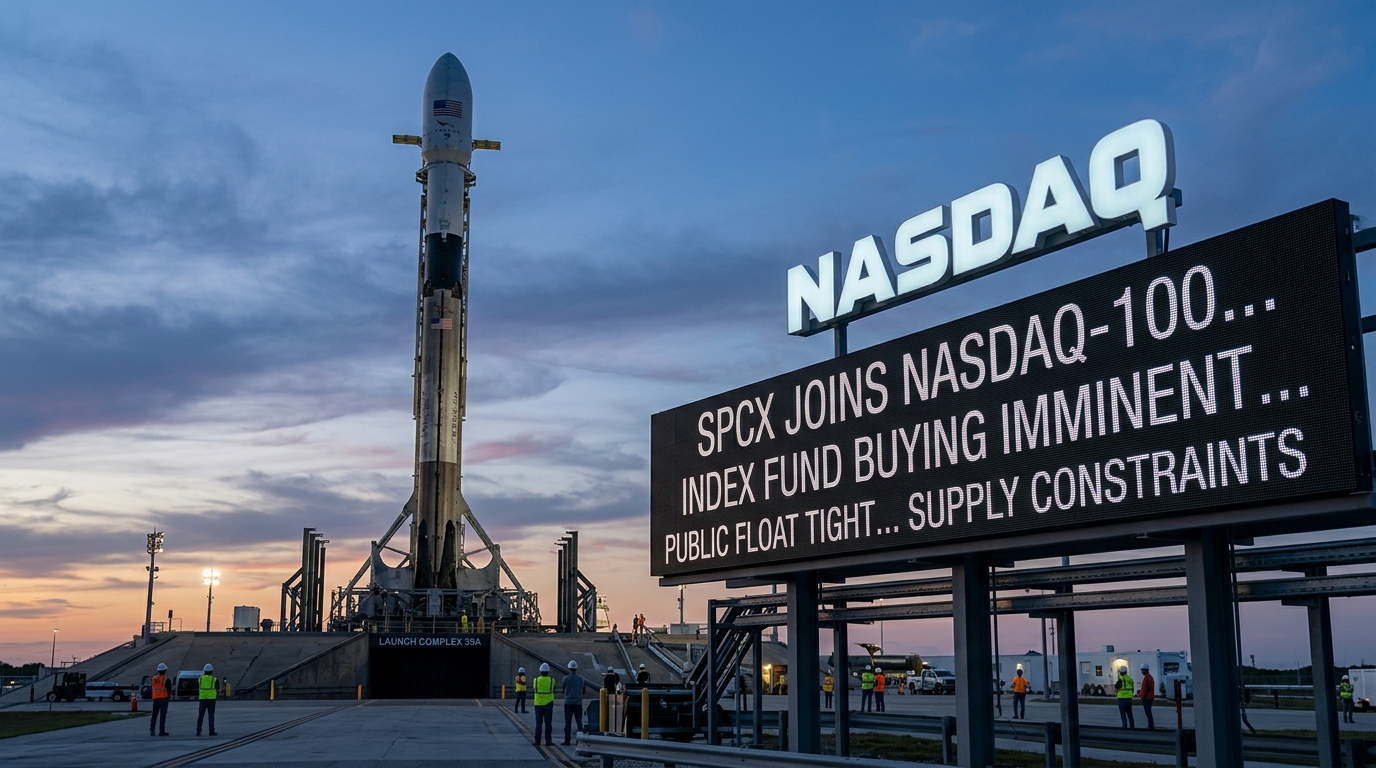
- SpaceX (SPCX) enters the Nasdaq-100 before Monday’s open, just 15 trading sessions after its June 12 IPO. One of the fastest index inclusions ever for a newly public company.
- Estimated forced buying from Nasdaq-100-tracking products: roughly $4.3 billion. Public float available to absorb it: approximately 3–5% of 13.16 billion shares outstanding.
- SPCX hit $225.64 on June 16, closed at $162.00 on July 2. Down about 28% from the high. The 52-week low of $147.11, set June 23, is the key floor heading into the week.
- Analyst targets: Oppenheimer at $250 (Outperform), Wedbush at $190 (Outperform), Susquehanna at $170 (Neutral). Consensus sits near $188 per S&P Global and $211 per TipRanks across 9 analysts. Morningstar’s bear-case fair value: $63.
- TTM revenue through Q1 2026 was $19.3 billion. At a roughly $2.13 trillion market cap, that is about 110x trailing sales. On projected 2026 revenue of $38.6 billion, the forward multiple compresses to around 54x if the AI compute contracts hold.
- First earnings report: August 6. That same date is expected to trigger the initial insider lockup release window, adding new supply into a stock that has traded on scarcity since day one.
- Among 35 Nasdaq-100 additions announced at least 10 days in advance since 2022, the average first-day move was a loss of 1.13% and the average five-day return was a loss of 3.41%. SPCX’s float situation makes those averages a rough guide at best.
The Mechanics Most Coverage Is Missing
There is no debate about the inclusion itself. What is worth paying attention to is what happens when $4.3 billion in non-negotiable buying meets a float that amounts to a few hundred million tradable shares.
SpaceX Just Went Public. Here’s What Nobody’s Telling You to Do Next.
The headlines are calling it the wealth event of our generation.
But the trader whose research has been sought out by legends like Stan Druckenmiller says everyone’s watching the wrong thing.
The real fortune-making move isn’t buying SpaceX.
Instead, it’s positioning yourself for what he calls the “Aftershock” BEFORE it hits.
Click here now to see how Aftershocks have made people rich.
Every passive vehicle benchmarked to the Nasdaq-100 has to own SPCX at its index weight as of Monday. Pension funds, ETFs, endowments, target-date funds. None of them have a choice. Nasdaq confirmed the addition on June 26, and the estimated buying from those products alone runs to about $4.3 billion. Fold in Russell index reweighting and that number could be meaningfully higher.
The part people keep glossing over: SpaceX has 13.16 billion shares outstanding, and only 3–5% of those are in the public float. That is the entire pool of freely tradable supply available to absorb the index demand. Funds that saw this coming have been buying for days. Some of the forced-buy pressure was almost certainly pulled forward. The real question heading into Monday is how much dry powder remains, and whether the open looks like a continuation or a reversal.
The AI Revenue Layer
Bears keep anchoring to the 2025 number: $18.67 billion in full-year revenue, a GAAP net loss, a $2.13 trillion valuation. At 110x trailing sales, the short thesis basically writes itself. Fine. That framing is not wrong. It is just incomplete.
The February 2026 acquisition of xAI changed what this business actually is. Elon Musk’s Colossus compute cluster is now on SpaceX’s balance sheet, along with a set of AI compute contracts already generating cash. The Anthropic arrangement reportedly pays roughly $1.25 billion per month for 300 megawatts of Colossus capacity. The Google deal adds about $920 million per month for 110,000 GPUs through 2029. Both carry 90-day termination clauses, which is real risk. But stack those against Q1 2026 revenue of $4.69 billion and the annualized picture looks nothing like the 2025 financials most people are still citing. On $38.6 billion in projected 2026 revenue, the forward multiple comes down to about 54x. Expensive, yes. But not the same conversation as 110x trailing.
Quick tangent worth noting. Starlink is the only segment currently turning a profit. The Connectivity division had around 12 million subscribers as of early July, averaging roughly $66 in monthly revenue per user. The Space segment is Falcon 9 and Starship. The AI division covers Grok, the X platform, and Colossus. When the IPO priced at $135, most buyers thought they were getting a rocket company. What they actually got is considerably more complicated.
Sector Backdrop and Macro Context
The S&P 500 closed at 7,483 on July 2. The Dow finished at a record 52,900. But the Nasdaq fell 0.8% as semiconductors dropped for a second straight session heading into the holiday weekend. Chipmakers got hit hard. Teradyne fell 13.6%. KLA dropped 11.5%. The VanEck SMH ETF was down 4.5% on the day. Tech had a monster first half of 2026, and the profit-taking is now visible.
Here is why that matters specifically for SPCX. Capital rotating out of pure chip and software names tends to look for companies with real asset bases and revenue that does not depend entirely on AI spending cycles continuing indefinitely. SpaceX has rockets, satellites, and ground infrastructure alongside its AI exposure. That mix is almost nonexistent in the Nasdaq-100 right now. Most of the index is software or semiconductors. When SPCX enters at even a sub-1% weighting, the composition of what investors are actually holding in their Nasdaq-100 products shifts in a meaningful way.
The Lockup Clock
This is the risk most people are not pricing correctly. The August 6 earnings report is expected to coincide with the first lockup release window. About 20% of locked insider shares become eligible for sale at that point. More tranches follow at time-based intervals after that, with the biggest release expected at the 180-day mark in December 2026.
The timing creates a specific dynamic. All of the forced Nasdaq-100 buying hits the market before any meaningful insider supply enters. July 7 rebalancing demand lands on a float of a few hundred million tradable shares with no insider selling in sight. Then August 6 arrives and that changes. Anyone positioning around the inclusion event needs to understand that the supply picture is not static. It shifts materially within 30 days.
Your Free Options Book Is About to Vanish
In case you missed it… make sure you get your free “Simple Options Trading For Beginners” book before your link expires.
I eventually plan to charge money for this training, so do yourself a favor and download it now…
That way, no matter what it costs in the future, you’ll have a free copy.
Sound good?
Scenario Modeling
Bull Case
Monday’s forced buying pushes SPCX through recent resistance, short-covering kicks in, and the stock runs toward the upper end of the analyst target range. Oppenheimer is at $250, citing SpaceX’s positioning across the full AI infrastructure stack. Wedbush is at $190. If the August 6 earnings report confirms the annualized AI contract revenue with actual disclosed figures, the forward multiple gets validated and the stock likely holds well above the $135 IPO price before the first major lockup release hits.
Base Case
Inclusion day produces a brief pop as passive flows absorb available supply, then the stock fades back as pre-positioned funds lighten up. The $162 area becomes the center of gravity through mid-July. August 6 is the real catalyst. If AI segment revenue gets disclosed with enough specificity to confirm the contract figures, the stock moves. If not, consensus stays range-bound between roughly $188 and $210 until there is something more concrete to work with.
Bear Case
The forced buying was already fully absorbed before Monday’s open. The inclusion becomes a sell-the-news event. SPCX drifts back toward the $147–150 area. Earnings on August 6 disappoint on GAAP profitability even if revenue beats, the first lockup release adds supply into an already-soft stock, and the 110x trailing sales multiple starts looking difficult to defend in a risk-off environment. The $135 IPO price comes back into view. Morningstar’s bear-case fair value of $63 is a reminder of just how wide the range of reasonable outcomes actually is here.
Active Trader Framework
$162 is where the stock closed heading into the holiday. That is the line. A sustained move above it, with volume that confirms index buying is genuinely absorbing supply rather than just gapping the price temporarily, is the signal that Monday is a real catalyst. Without that volume confirmation, a move above $162 is noise.
$147.11 is the 52-week low. That is the floor. A break below it on real volume before August 6 would suggest the market is already discounting the lockup supply before the release even arrives. That is not a great sign for anyone long into earnings.
On the options side, the asymmetry is real but so is the execution risk. A supply squeeze on short-dated calls could produce fast moves. But thin floats also mean wide bid-ask spreads in options and unpredictable fills. Size accordingly. Implied volatility will almost certainly expand as August 6 gets closer, which affects both sides of the vol market. Watch IV rank as the date approaches, not just directional exposure.
Why is Elon giving away money?
Elon Musk wants to send you money. It’s a free bonus if you sign up for his new bank. Lots of people are already flocking to the bank – including Star Trek star William Shatner.
The July 7 inclusion is well-covered. What is not getting enough attention is what happens when you stack the Nasdaq-100 rebalancing, the first public earnings disclosure, and the first lockup expiration all within a 30-day window in a stock with one of the thinnest floats in the large-cap universe. Three high-impact events. One month. Very little tradable supply between now and when the supply picture changes permanently.
Know your levels. Know the lockup dates. Size accordingly.
For informational purposes only.