Something shifted in the nuclear sector this week that most investors scrolled past.
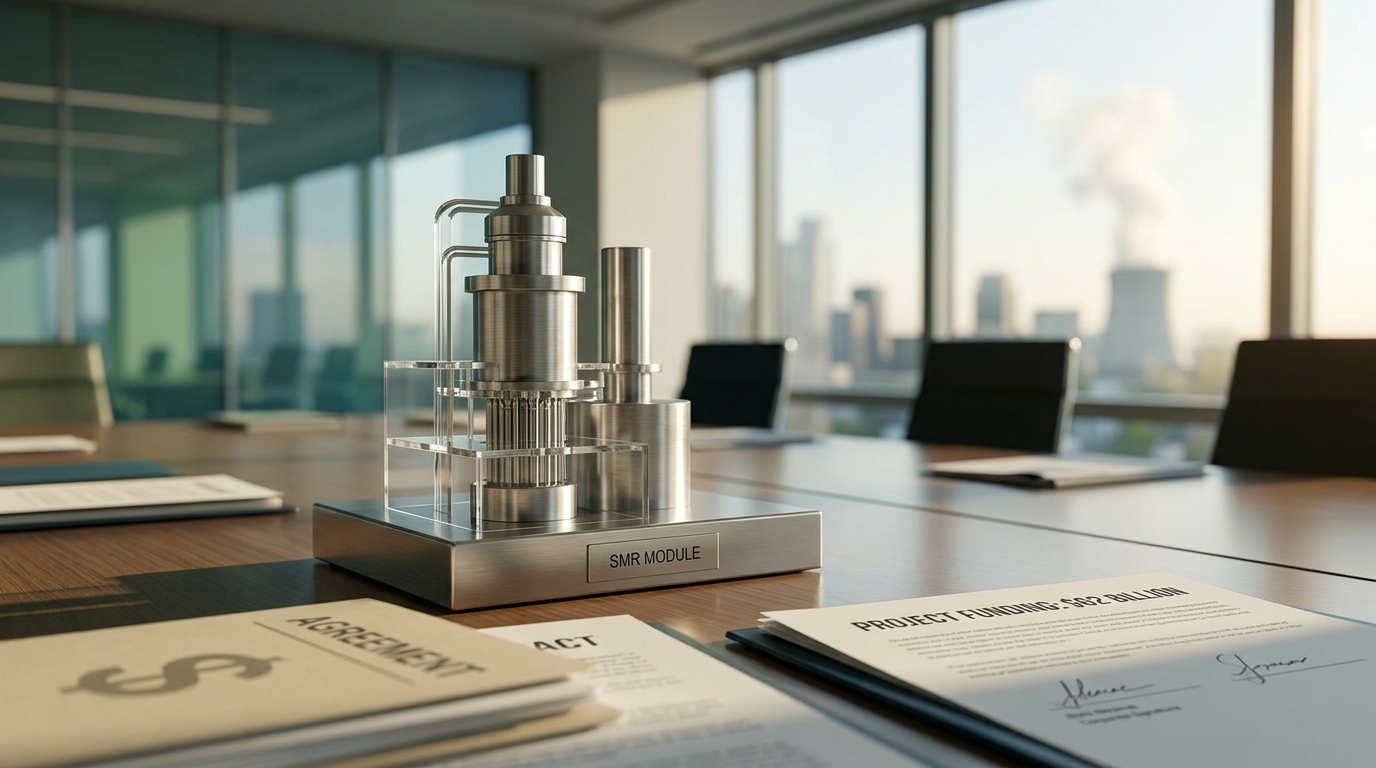
On June 16, U.S. nuclear stocks surged sharply after reports surfaced that Japan may commit as much as $62.3 billion into nuclear power projects as part of its broader $550 billion trade agreement with the U.S. Amazon-backed X-Energy led with a 16% single-day gain. NuScale Power jumped roughly 10%. Oklo added 5%. This was not a speculative pop driven by social media chatter. It was the market responding to a geopolitical commitment with real numbers attached.
Here is what matters. The nuclear story has been building for a while, but it has historically suffered from one obvious problem: the distance between aspiration and execution. That gap is starting to close. Fast.
NuScale Power is the only SMR developer in the U.S. with a design formally approved by the Nuclear Regulatory Commission. A possible $25 billion Japanese commitment specifically mentioning NuScale is now reportedly on the table. Meanwhile, Commerce Secretary Howard Lutnick has been in active discussions to secure up to $40 billion in SMR commitments from Japan alone, with GE Vernova and Hitachi lined up as builder partners.
Slight tangent, but it matters: the reason this acceleration is happening now is not just about clean energy goals. Governments across the U.S., UK, France, Japan, South Korea, and Canada have all announced nuclear expansion programs in 2026 in a way that has no precedent since the 1970s. Nuclear has become a bipartisan political priority, and government support means long-term offtake contracts, tax credits, and regulatory pathways that materially reduce risk for private investors.
The part people skip is the fuel side.
Centrus Energy is the only company outside of Russia licensed to produce High-Assay Low-Enriched Uranium (HALEU) – the specialized fuel required by most next-generation reactor designs. That gives it a near-monopolistic position at a strategic chokepoint in the entire nuclear fuel cycle. Oklo has already signed a large-scale commercial HALEU supply agreement with Centrus, structured to cover multiple years of reactor cores across up to five Aurora powerhouses as part of Oklo’s planned 1.2 GW Clean Energy Campus. The geopolitical pressure to decouple from Russian fuel has quietly transformed Centrus from a legacy enricher into a cornerstone of U.S. energy security.
Then there is Cameco. In Q1 2026, Cameco posted net earnings of $131 million and adjusted EBITDA of $509 million, with both uranium sales volumes and average realized prices moving higher versus 2025. Cameco also owns a 49% stake in Westinghouse, which is itself a party to an $80 billion agreement with the U.S. government to build new reactors for AI deployment.
The real question is not whether nuclear is happening. It’s whether the market has correctly priced the pace.
SMRs promise to make nuclear cheaper and faster to deploy. Instead of a $15 billion plant requiring 20 years to build, an SMR could theoretically cost under $1 billion and be deployed in five years. That math is what Big Tech is responding to. Oklo has partnerships with both Meta and Nvidia. The Aurora microreactor recently upsized its design to 75 MWe specifically to meet surging demand from AI data centers.
The risk here is real. NuScale still has no firm commercial sales. Its first planned project was canceled due to rising costs. The space remains speculative at the developer level. BWX Technologies, which has beaten earnings estimates in seven consecutive quarters, may offer more near-term financial stability for investors who want nuclear exposure without the binary risk of a pre-revenue company.
What investors may be underweighting is the speed at which the story is shifting from “theoretical potential” to “active procurement.” Japan just put a number on it. The U.S. government is considering financing components for large reactors facing long procurement lead times. Ontario Power Generation installed the first basemat module for its new Darlington project in June. TerraPower’s NRC final safety evaluation is expected by mid-2026.
The sector is no longer waiting for demand to arrive. Demand arrived. The question now is which companies survive the commercialization gap long enough to capture it.