June 8, 2026
Smucker Keeps Raising Prices
Four increases in 12 months. Consumers still buying. For now.
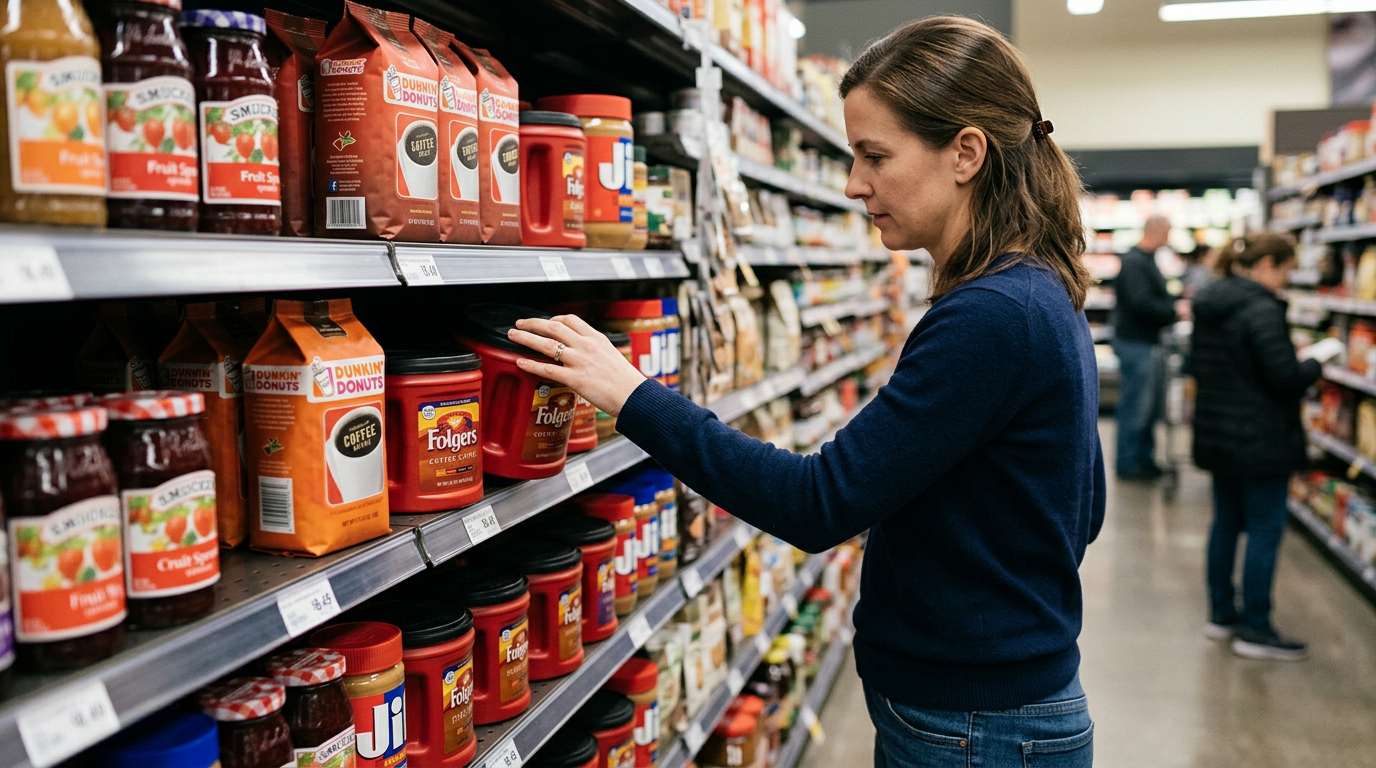
Folgers went up again. So did Dunkin’ at Home and Cafe Bustelo. Four separate price increases over the last 12 months, and the can on the shelf now costs more than 20% more than it did a year ago. The U.S. average retail price for ground roast coffee hit $9.14 per pound in September 2025, up 41% from the prior year according to Bureau of Labor Statistics data. That number is not a typo.
And yet volume held.
That is the part worth paying attention to heading into J.M. Smucker’s Q4 fiscal 2026 results on June 9. Not the revenue number. Not the EPS beat or miss. The volume line. Because everything else in this story depends on whether consumers keep absorbing prices that would have felt absurd three years ago.
We can’t keep this report public much longer.
We printed 1,000 copies of this report. 688 are gone.
When the last one goes out, we’re pulling it offline – the information inside is too sensitive to leave up indefinitely.
Here’s what’s inside the remaining copies:
This isn’t a newsletter. It’s not evergreen content.
It’s a window. And 688 people already jumped through it.
Here is what the most recent data actually looks like. Q3 FY2026, ended January 31, 2026: net sales of $2.34 billion, up 7% year over year. Comparable sales up 8% when you strip out the divestitures. Adjusted EPS of $2.38, down 9% from the prior year, but still ahead of the analyst consensus at $2.26. Stock jumped more than 8% the session after the report. The coffee segment drove the whole thing, with U.S. Retail Coffee sales hitting $908.2 million in the quarter, up 23% year over year. Almost all of that was price. Net price realization alone contributed 10 percentage points to that 23% move. Volume was flat at best. Coffee segment profit margin compressed to 21.9%, down 630 basis points from a year earlier. Free cash flow came in at $487 million versus $151 million in the same period the prior year. That swing is real and it matters.
What is interesting is that the cost side of this story is not going away quietly. Arabica futures roughly doubled from late 2023 and were sitting near $4 per pound heading into mid-2025. Smucker buys approximately 500 million pounds of green coffee annually, sourcing primarily from Brazil and Vietnam. Brazilian imports now face a 50% tariff. Vietnamese beans carry a 20% duty. That is a structural cost shift, not a seasonal blip. The price increases were not optional. They were the only way to protect the margin line at all.
Slight tangent, but it is worth saying: the at-home coffee trade-down dynamic has actually worked in Smucker’s favor. Consumers walking away from $8 cafe drinks and landing on a $15 can of Folgers are still a net volume win for SJM. That behavioral shift has softened what could have been a much steeper volume cliff. The question is how durable that behavior is when the can itself keeps getting more expensive.
Elon Musk: This is a “supersonic tsunami.”
This AI game-changer could rival the impact of the printing press, the steam engine, and electricity…
And roll out faster than mobile phones, personal computers, and even the internet.
Full-year context: for fiscal year ending April 2025, SJM posted revenue of $8.73 billion, up roughly 7%, with adjusted EPS of $10.12 and free cash flow of $816.6 million. For fiscal 2026, the company is guiding net sales growth of 3.5% to 4.0%, adjusted EPS of $8.75 to $9.25, and comparable sales growth of 5.0% to 5.5%. Adjusted gross margin is expected to land near 35.0%. Full-year free cash flow guidance remains at $975 million, even after a manufacturing fire at the Emporia, Kansas facility in February 2026 that shaved roughly $25 million off expected Q4 sales. That hit is already reflected in the updated guidance range.
Heading into June 9, the Street is looking for adjusted EPS of approximately $2.65, up roughly 15% from the $2.31 reported a year ago. Revenue consensus is around $2.27 billion.
Portfolio cleanup has been part of the story too. Smucker sold the Voortman business in December 2024 and offloaded certain Sweet Baked Snacks value brands in March 2025. That is why total sales growth looks softer than comparable growth. The business they kept is performing better than the headline number suggests.
Here is where I am on the actual investment question. SJM at roughly 11x forward adjusted EPS is not expensive for a business generating close to $975 million in annual free cash flow with a $4.40 per share annual dividend that has stayed intact through all of this. The brands are real. Jif, Uncrustables, Cafe Bustelo, Meow Mix. These are not generic assets. But the Hostess acquisition added debt and GAAP earnings have been distorted by impairment charges for several quarters running. The underlying business is cleaner than the reported numbers imply, but the leverage is real and it limits flexibility.
Wall Street Wants SpaceX Before You Do
Before the public gets access to major IPOs, insiders often lock in the biggest gains first.
Mark Skousen says SpaceX may be no different.
After decades of calling major market turning points, he’s now sharing a “backdoor” strategy tied to the coming IPO frenzy.
The things I am watching on June 9:
- Coffee segment volume and mix – flat is acceptable, negative is a problem
- Coffee margin trajectory – any recovery from 21.9% or still compressing?
- Management language around a fifth potential price increase and what they are seeing on elasticity
- Uncrustables and Cafe Bustelo volume – the two brands that carry the story when Folgers stumbles
- Private-label coffee share trends – this is the slow leak that does not show up in headlines
- Free cash flow delivery confirmation: is $975 million still realistic post-Kansas?
- Any early color on FY2027 – current consensus sits near $9.80 adjusted EPS, which feels optimistic if commodity costs stay elevated
Four price increases in 12 months is not a pricing strategy. It is a response to a cost structure that moved faster than anyone modeled. The part people skip is that it worked longer than it should have. Whether it keeps working is the only question that matters right now.
Watch the volume number on June 9. Everything else is context.