
May 12, 2026
Aurora Innovation: A Berkshire Company Just Let a Computer Drive Its Trucks
Driverless semis are hauling real freight. The $14 billion question is what comes next.
Hey there, bargain hunter.
Most milestones in autonomous trucking have been demos. Controlled routes, safety drivers on standby, carefully staged press events. What happened last week was different.
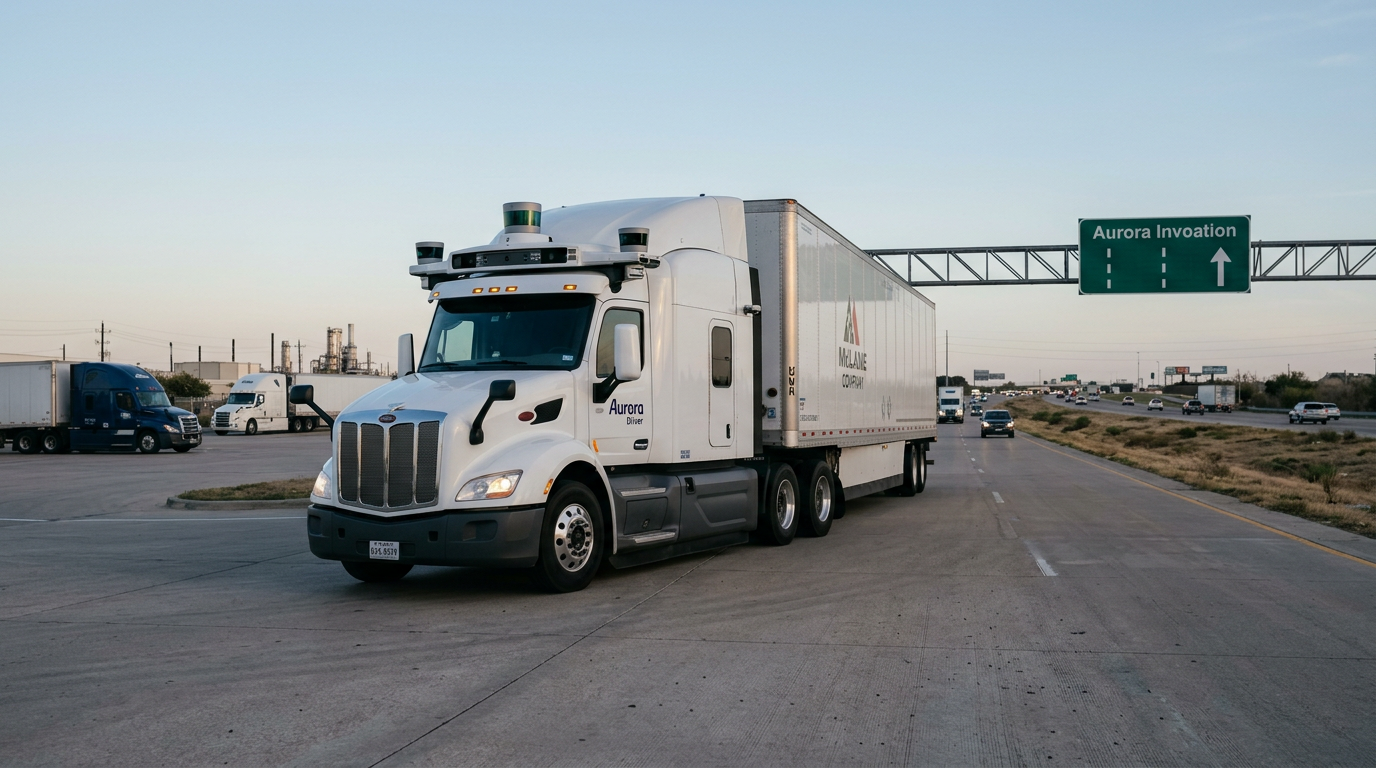
McLane Company – a Berkshire Hathaway subsidiary and one of the largest supply chain distributors in the country, servicing chain restaurants, convenience stores, and mass merchants – started running fully driverless hauls between Dallas and Houston using Aurora Innovation’s self-driving system. No safety driver. No observer seat. SAE Level 4 autonomy, moving real commercial freight on a public highway.
This is not a test. This is a shipping lane.
McLane has been in Aurora’s ecosystem since 2023 and logged 280,000 supervised autonomous miles in Texas before pulling the safety driver. That track record matters. It is also why this particular announcement carries more weight than a typical tech company press release. Berkshire does not typically associate its subsidiaries with things that do not work.
Aurora (AUR) now has seven customers in its driverless cohort. Trading volume hit 48.4 million shares the day the news broke – roughly 136% above the three-month average. The stock surged, then gave some of it back. That kind of move, in both directions, tells you the market has not landed on a consensus here.
Hidden in Tesla’s Filing: A $12 Billion “Super Startup”
Pull up Tesla’s most recent SEC filing. Page 5.
And you’ll see a single line showing $12 billion in revenue from a brand-new “super startup” Elon Musk has been quietly incubating inside Tesla.
This new “super startup” has nothing to do with cars or robots or space or AI…
But it sits at the center of what Blackstone calls “a $23 trillion investment opportunity.”
And on July 22, Elon is expected to pull back the curtain and reveal exactly what he’s building.
But Adam O’Dell already knows… and he reveals it all in this urgent video.
Here is what Aurora actually does, stripped of the hype. The company builds autonomous driving systems – the Aurora Driver – for commercial trucks and passenger vehicles. It has two commercial service lines: Aurora Horizon for long-haul trucking and Aurora Connect for ride-hailing. The business model they are building toward is Driver-as-a-Service: carriers pay per mile, Aurora handles the technology. No hardware ownership required from the customer side.
Right now, Aurora owns and operates the fleet. Starting in 2027, the plan is to shift toward customers owning their own trucks while paying for the Aurora Driver software on top. That is when the capital-light model actually kicks in.
The route footprint has grown fast. Dallas to Laredo came online in six weeks flat after supervised runs began. A bidirectional Dallas to Oklahoma City corridor is live. Twelve distinct commercial routes are now in operation. Hirschbach Motor Lines signed a memorandum of understanding for 500 Aurora-powered trucks, with deliveries starting in 2027 – management frames it as a potential multi-year revenue stream worth hundreds of millions, though binding terms have not yet been finalized.
Slight tangent, but worth saying: the partner list is not a collection of small bets. FedEx. Ryder. Schneider. Werner. PACCAR. Volvo. NVIDIA. Toyota. Uber Freight. When that many serious freight and technology operators are embedded in your ecosystem, the company is not operating in isolation. That depth of partnership matters when you are trying to figure out whether this thing can actually scale.
The numbers, which are where it gets real
Full-year 2025 revenue: $3 million. Q1 2026 revenue: $1 million, up 10% sequentially on a record number of commercial miles driven. Aurora’s full-year 2026 guidance is $14 million to $16 million. Management calls that roughly 400% year-over-year growth at the midpoint, which is technically accurate.
It is also $15 million against a $13.9 billion market cap. That price-to-sales ratio does not fit inside any traditional valuation framework. You are not buying what Aurora earns today. You are buying what you believe it earns five to eight years from now.
The cash burn is significant. Q1 2026 operating loss including stock-based compensation was $244 million. Operating cash used in the quarter was $159 million, with $25 million in capital expenditures on top of that. Management guided for average quarterly cash outflows of $190 million to $220 million throughout 2026, with full-year capex of approximately $150 million. Aurora is calling 2026 the peak spend year, with capex expected to fall sharply in 2027 as the Driver-as-a-Service model comes online.
They ended Q1 with nearly $1.3 billion in cash, short-term investments, and long-term investments. Management says that covers at least twelve months of operations and gets them to positive free cash flow by 2028. During Q1 they also used an at-the-market equity program, issuing shares for net proceeds of $14 million – mostly tied to employee RSU tax obligations. Dilution exists, but it has been measured so far.
- Market Cap: ~$13.9B (May 12, 2026)
- Full-Year 2025 Revenue: $3M
- Q1 2026 Revenue: $1M (10% sequential growth)
- Q1 2026 Operating Cash Used: $159M
- Q1 2026 Operating Loss (incl. stock comp): $244M
- Liquidity at Quarter-End: ~$1.3B
- 2026 Revenue Guidance: $14M to $16M
- Target Fleet by Year-End 2026: 200+ driverless trucks
- Run-Rate TaaS Revenue at 200 Trucks: ~$80M
- Positive Free Cash Flow Target: 2028
You’re Being LIED To About The Iran War
Forget EVERYTHING you’ve heard about the Iran war.
Especially the reasons why we’re bombing the country.
Wall Street is not aligned on this one. Morgan Stanley raised its target to $14 from $12, Overweight. Needham sits at $13, Buy. Goldman Sachs raised to $5 from $4 and stayed Neutral. TD Cowen moved to $7, Hold. The average analyst target across the tracked coverage sits near $10. When the bull case and bear case are $9 apart on a stock trading in the low teens, that spread reflects genuine disagreement about timing and execution – not just style preference.
Morningstar’s quantitative model flags the stock at a significant premium to estimated fair value. That is worth knowing. It is not a sell signal. It is context.
The bull case: Berkshire’s indirect stamp of approval via McLane is not nothing. Aurora’s second-generation hardware – built to last one million miles at less than half the cost of the first generation – is on track for Q2 2026. California recently opened its roads to autonomous trucking, expanding the addressable market meaningfully. S&P Global consensus forecasts project Aurora’s total revenue reaching $3.1 billion by 2030, with $2.4 billion of that coming from trucking. Get to 200 trucks by year-end, close the Hirschbach deal in 2027, and the unit economics start to look like an actual business.
The bear case is just as grounded. Burning $190 million to $220 million per quarter requires either continued share issuance or fresh capital raises. Hirschbach is still an MOU. Fewer than 200 trucks are on the road today. The distance between current operations and the scale that justifies a $14 billion market cap is measured in years and hundreds of millions in additional spend. Technology shifts, regulatory changes, and a competitive field that includes well-capitalized players all add to that risk.
Here is where I land on it.
Aurora is further along, operationally, than most people give it credit for. The McLane move – 280,000 supervised miles logged, now fully driverless on a live commercial route – is a real proof of concept, not a headline. The partner network is deep. The second-generation hardware could change the cost structure materially. This is a company that has crossed an important threshold.
But the stock is priced for a version of Aurora that does not exist yet. It is priced for 2029 or 2030, assuming clean execution, no major setbacks, and a regulatory environment that keeps cooperating. Any of those assumptions can crack.
This is not a value play. It is a high-conviction, long-duration bet on a technology that just crossed from theory into a live Dallas-to-Houston freight lane. Whether you size into that or watch from the sideline probably says more about your portfolio construction than it does about Aurora.
The $14 billion question does not have a clean answer yet.