
May 6, 2026
VRT Is Quietly Compounding While the Market Chases Flashier AI Names
$15B backlog. 28% revenue growth. An options setup worth knowing about.
First a note from Oxford Club
There is no doubt that Elon’s SpaceX IPO is going to be a HUGE event…
But here’s the nasty truth about IPO’s…
By the time most folks can buy SpaceX stock through a regular broker, the biggest money will be long gone.
See…
In any major IPO, roughly 95% of the gains happen before the public ever gets a shot.
Pre-IPO shares get carved up by hedge funds, Goldman partners, and the banks underwriting the deal.
They buy in cheap.
They wait.
And by the time the stock opens to the public – at a price they helped set – they’re already deep in the green.
It happens almost every single time.
The Facebook IPO. Uber. Airbnb.
It’s always the same script.
But I refuse to let that happen with SpaceX…
I’m 77 years old.
And after meeting Elon Musk face to face at a private gathering of the financial elite, I made a decision.
I was going to find a way around it.
So I did.
I uncovered a “backdoor” that lets regular Americans take a pre-IPO position in SpaceX.
Right now.
Before Wall Street pops the champagne.
Before the easy money walks out the door.
Nearly 15,000 of my readers have already learned how to us it.
Click here to see how the backdoor works.
I’ve opened the door to a pre-IPO stake in SpaceX.
Yours for peace, prosperity, and liberty, AEIOU,
Dr. Mark Skousen
Macroeconomic Strategist, The Oxford Club
P.S. 95% of the gains in any major IPO are gone before retail investors can even place a trade. SpaceX won’t be different – unless you act before June. Click here for the full story.
FEATURED
Vertiv Holdings (VRT): The AI Infrastructure Play No One Talks About
The Market Is Looking at the Wrong Part of the AI Stack
Everyone wants to own the algorithm. The model. The application layer. But artificial intelligence does not run on ambition – it runs on power, cooling, and thermal management infrastructure that most investors have never thought twice about. That oversight may be creating one of the more compelling setups in the industrial sector right now.
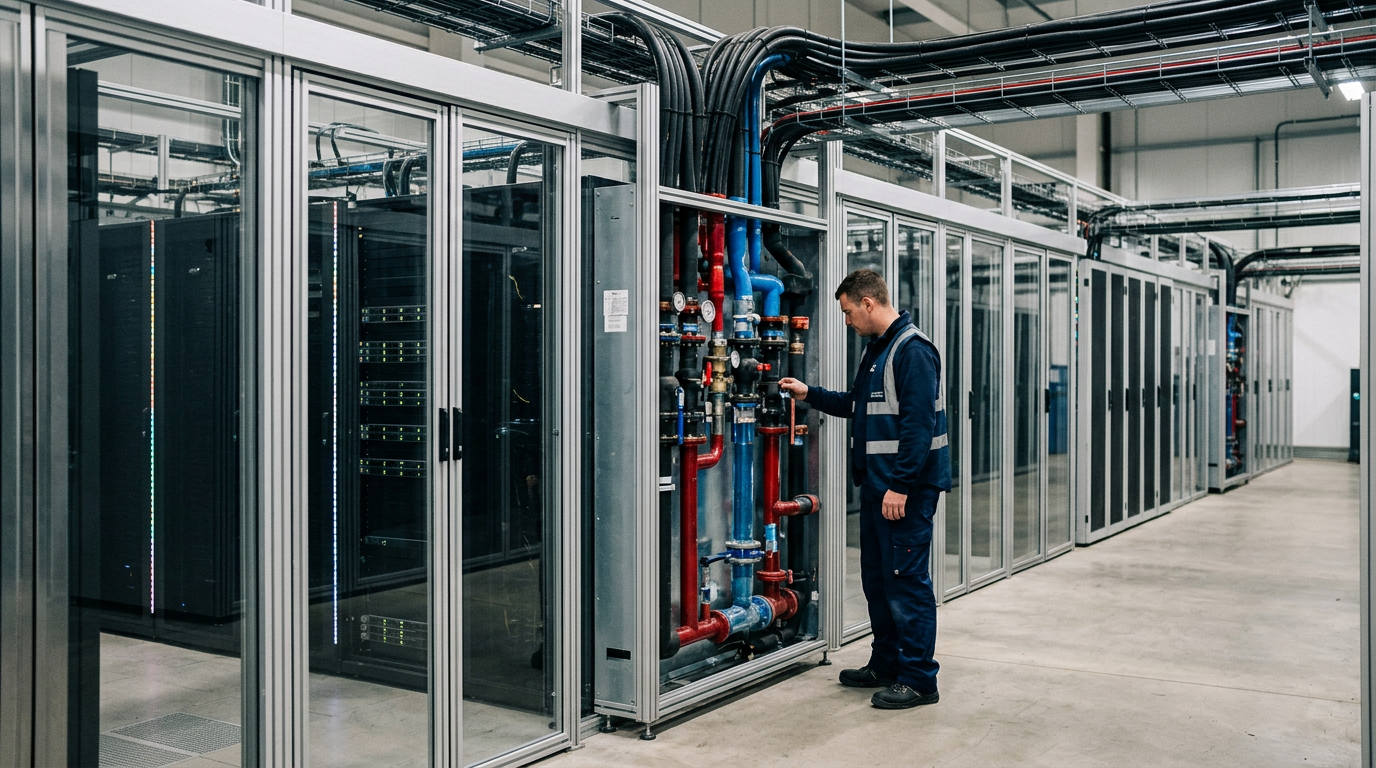
Vertiv Holdings (VRT) manufactures the critical data center infrastructure that keeps AI compute running – power distribution units, liquid cooling systems, uninterruptible power supplies, and thermal management solutions. Not a flashy business. But an essential one. The company joined the S&P 500 in March 2026 – a formal acknowledgment of what the market had been pricing in for two years.
The Numbers
Full-year 2025 revenue came in at $10.23 billion – approximately 28% year-over-year growth from 2024’s $8.01 billion. Q4 2025 alone was $2.88 billion, up 23% year-over-year on 19% organic sales growth. Americas segment revenue climbed over 50%. Q4 organic orders grew approximately 252% year-over-year. That is not a typo. The company raised full-year guidance after Q1, Q2, and Q3 of 2025 – each time citing stronger-than-anticipated demand.
Backlog hit $15.0 billion by Q4 2025, up 109% year-over-year. The Q4 book-to-bill ratio was 2.9x. Adjusted operating margins reached 23.2% in Q4 2025 and 22.3% in Q3 – well past the “above 16%” figure that was being cited earlier this year. Q1 2026 came in at 20.8%, up 430 basis points year-over-year. Long-term margin target remains 25% by 2029.
2026 guidance, updated after Q1 results: net sales of $13.5 billion to $14.0 billion, adjusted diluted EPS of $6.30–$6.40 – up approximately 51% at the midpoint versus full-year 2025. Q1 2026 EPS of $1.17 came in $0.19 above prior guidance and was up 83% year-over-year. Free cash flow for the quarter was $653 million, up 147% from Q1 2025. Net leverage: approximately 0.2x.
The $100 Trillion Shock Poised to “Relaunch” the Stalled AI Boom
The AI boom has been stalled for months. But according to legendary tech investor Louis Navellier, that’s about to change.
How? A $100 trillion breakthrough is about to reset the AI markets in 2026… potentially sending some AI stocks to zero, and one off-the-radar stock soaring.
What the Options Market Is Saying
This is where it gets interesting. VRT’s implied volatility rank is currently sitting in the mid-50s – elevated relative to its post-S&P 500 inclusion baseline, but not at the kind of panic-level readings that would suggest the market is pricing in a genuine breakdown. That mid-range IV environment is worth paying attention to. It means options are not cheap, but they are not pricing in a binary event either. For traders who have a directional view, that is a workable setup.
Put/call skew on VRT has been leaning modestly toward puts in recent weeks – consistent with broader market hedging rather than stock-specific bearish flow. The 30-day expected move on VRT is approximately 8–10% in either direction, which reflects both the stock’s beta to AI sentiment and its sensitivity to macro data center capex headlines. Any major hyperscaler capex revision – up or down – will move this stock faster than the fundamentals alone would justify.
Three Ways to Structure Exposure
These are not trade recommendations. They are defined-risk frameworks for traders who have already formed a view on the underlying thesis.
- Bull case – Bull Call Spread: For traders expecting continued guidance raises and backlog conversion through 2026. A defined-risk call spread 30–45 days out captures upside while limiting premium exposure in a mid-IV environment. The long leg absorbs directional movement; the short leg offsets cost. Max loss is the debit paid.
- Bear case – Put Debit Spread: If EMEA weakness deepens, tariff exposure re-accelerates margin compression, or a major hyperscaler announces a capex pullback, a put spread with 45–60 days to expiration defines the risk while positioning for a corrective move. The stock has shown it can reprice sharply on macro sentiment shifts.
- Neutral case – Short Iron Condor: For traders who believe the fundamental story is intact but the stock is range-bound near current levels while the broader market finds direction. Selling an iron condor collects premium from both sides with defined max loss on the wings. Works best if IV contracts after a period of elevated uncertainty.
Stop Overcomplicating Your Trades
Stop staring at charts until your eyes melt. I found one repeatable morning setup that works so well, I’m usually done trading by 10 AM. No drama, no 14-hour sessions. Just real income.
The Part People Skip
Vertiv trades at a premium to traditional industrials. That premium is not arbitrary – it reflects a backlog that doubled in twelve months, a margin profile that keeps beating estimates, and a customer base that is locked into multi-year capacity commitments. The risk is real: hyperscaler concentration, EMEA headwinds with no recovery expected before H2 2026, and a stock that moves on AI sentiment as much as its own earnings. Those variables belong in any honest risk framework.
But the question worth sitting with is this: at what point does a company with 28% revenue growth, a 2.9x book-to-bill, 51% guided EPS growth, and a $15 billion backlog stop being a “hidden” infrastructure play and start being one of the more obvious compounders in the sector? The market may still be working that out.