
May 5, 2026
The Market Is Pricing Stellantis Like It’s Dying. It Isn’t.
Ram up 20%. €44B in liquidity. A CEO with a plan. The stock is still near $7.
First a message from American Alternative Assets
We printed 1,000 copies of this report.
688 are gone.
When the last one goes out, we’re pulling it offline – the information inside is too sensitive to leave up indefinitely.
Here’s what’s inside the remaining copies:
The executive order Trump can sign tomorrow – the same legal authority FDR used in 1934 to move billions in wealth overnight – and exactly how to position before it happens.
This isn’t a newsletter. It’s not evergreen content.
It’s a window. And 688 people already jumped through it.
Claim one of the 312 remaining copies →
We won’t reopen this once it’s closed.
| GET MY COPY NOW → |
Featured Read
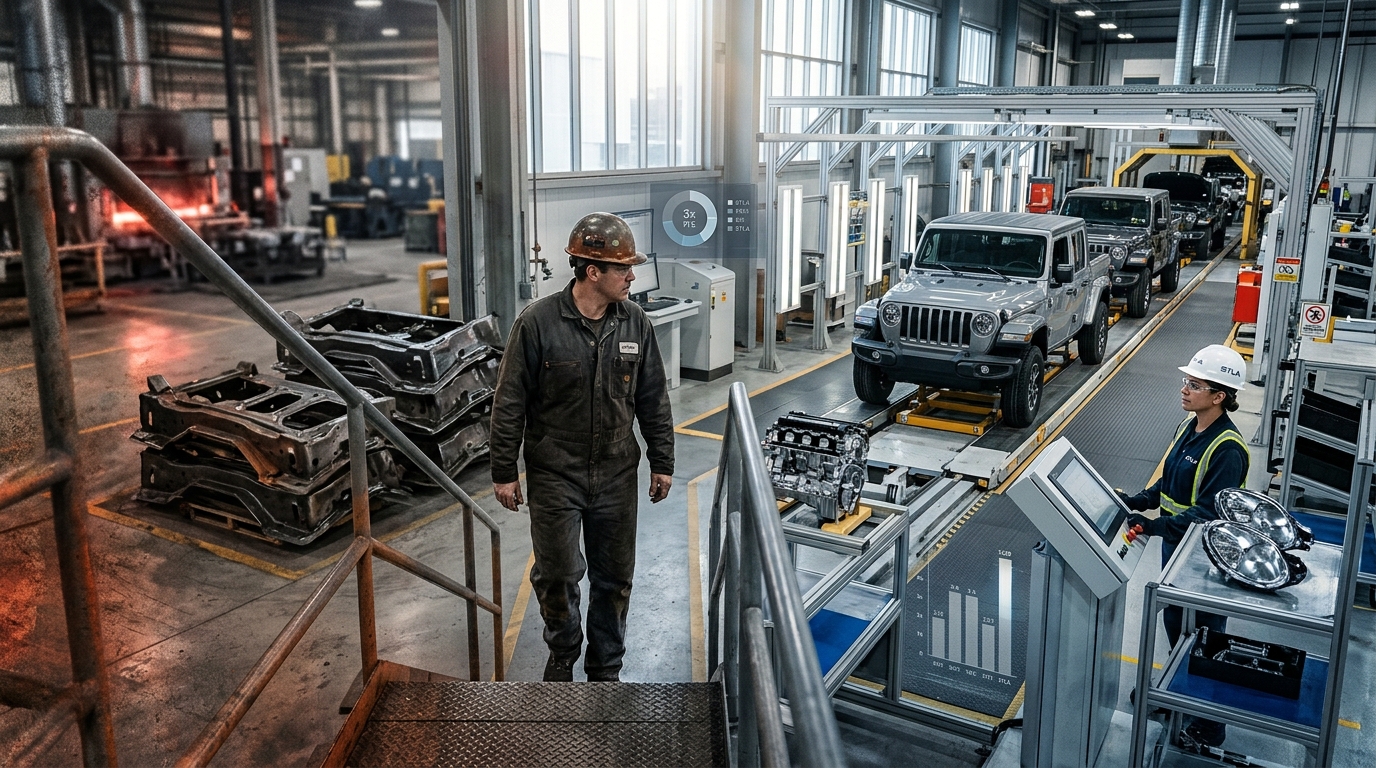
Here’s the thing about Stellantis right now: the story the stock is telling and the story the actual business is telling are starting to diverge. Not by a little. By a lot.
STLA trades near $7 as of early May 2026. That’s off more than 70% from its 2023 highs above $25. The 52-week range alone – $6.28 to $12.22 – tells you the market has been all over the place trying to figure out what this company actually is. At current prices, Stellantis is valued at roughly 0.1x sales. The peer average for global automakers sits near 1.7x. That’s not a discount. That’s a different category entirely.
The question is whether that gap reflects genuine terminal risk or a market that has given up on a business that hasn’t given up on itself.
What Happened
The 2025 collapse was real and the company earned most of it. North American dealer inventories got wildly out of hand. Ram and Jeep volumes fell off a cliff. The prior CEO – Carlos Tavares – departed abruptly in December 2024 after a breakdown in trust with the board. And then on February 6, 2026, management did something almost no major automaker has ever done: it announced a strategic reset that wiped €25.4 billion in EV platform investments from the books in a single sweep. Full-year 2025 net loss came in at €22.3 billion. The company’s first-ever annual loss. Revenue was €153.5 billion – down about 2% year-over-year, mostly FX-related – but the operating business posted an adjusted operating loss of €842 million for the full year. The market’s reaction was predictable. The stock went lower.
What’s easy to miss in that headline number is that €22.2 billion of it was non-cash. The operating infrastructure – the factories, the platforms, the dealer network, the brand equity in Jeep and Ram – is still there. It didn’t evaporate with the write-down. The EV bets failed. The core business didn’t.
IPOs are a bad deal for you…
You’re not going to make any money on the SpaceX IPO.
At least not in the first few months.
See, when a company goes public, the only winners are the rich insiders…
The bigwig elites with special access…
But you can invest in Elon’s other new company – today. Without waiting.
It’s a secret, $25 trillion project that’s 14 times bigger than SpaceX.
Q1 2026 Changed the Tone
The Q1 2026 numbers were the first real signal that something is actually turning. Revenue came in at €38.1 billion, up 6% year-over-year. North American sales rose 6%. Ram specifically – the brand that was in freefall eighteen months ago – posted U.S. sales growth of approximately 20% year-over-year in Q1, the best quarterly performance since 2023. Stellantis outgrew a U.S. auto market that was down 6% overall. That’s not a dead company. That’s a company clawing back.
Adjusted operating income margin recovered to 2.5% in Q1 – up from 0.9% in the same quarter a year ago. Industrial free cash flow was still negative at €1.9 billion for the quarter, but improved 37% year-over-year even with €0.7 billion in cash outflows tied to prior-year charges still clearing the system. Management is guiding for positive industrial FCF in 2027. That’s not imminent, but it’s a concrete target.
The product pipeline is real too. Jeep Cherokee relaunched. Dodge Charger SIXPACK in showrooms. Ram 1500 HEMI V8 and Express trims entered the market in late 2025. Ten new vehicle launches planned across 2026. This isn’t a company rationing its way to survival – it’s running a product offensive while managing a balance sheet reset.
The Balance Sheet Doesn’t Get Enough Credit
Industrial available liquidity sits at €44.1 billion – roughly 28% of trailing twelve-month net revenues. Industrial net financial position is €9.5 billion net positive. For a company trading at $7 a share with a market cap that implies near-bankruptcy, the financial position is almost absurdly strong. No near-term debt crisis. No covenant pressure. The dividend was suspended, which was the right call, not a distress signal.
A brief tangent worth sitting with: most investors who avoided STLA in 2025 did so because of the narrative, not the balance sheet. The narrative was – and still is – that Tavares destroyed the company, the brands are weak, and there’s no EV strategy worth believing in. Some of that is fair. But narratives don’t always track solvency, and right now the solvency argument is much stronger than the stock price suggests.
The Risks Worth Taking Seriously
This is not a clean story. The tariff situation is genuinely complicated – management is guiding for approximately €1.6 billion in net tariff costs in 2026, and any escalation in U.S.–EU trade tensions hits Stellantis harder than Ford or GM because of its European import exposure. Class action lawsuits filed in April and May 2026 over EV strategy disclosures are an active legal overhang. Q1 EPS came in at €0.21 – above revised expectations, but analysts flagged questions about earnings quality and tariff-adjusted line items. And if the U.S. consumer weakens materially in the back half of 2026, truck and SUV demand – the highest-margin segment – takes the first hit.
None of these risks are trivial. The FCF timeline is still extended. There’s execution risk in the product launch cadence. And the 2026 guidance – mid-single-digit revenue growth, low-single-digit AOI margin – is not inspiring on its face. It just happens to be meaningfully better than what the stock is pricing in.
J.P. Morgan Is Building on This Under-$1 Crypto
While fear hits levels not seen since 2022, major institutions aren’t backing off – they’re building. One little-known crypto is being used for real infrastructure tied to moving traditional assets on-chain. With supply tightening and activity expected to rise, this setup is getting harder to ignore.
Get the full breakdown on this under-$1 crypto before attention grows
May 21
CEO Antonio Filosa has Investor Day scheduled for May 21 in Auburn Hills. This is the event where he’s expected to outline which four of the 14 brands receive the bulk of future capital – and which ones get managed for cash or wound down. That decision will define the investment case for the next several years. It could reset the narrative upward. It could also disappoint. Either way, it’s a binary moment for a stock that has been drifting without a clear story to anchor to.
At 0.1x sales, with Ram taking share in a declining market and €44 billion sitting on the balance sheet, the downside from here requires things to get dramatically worse than Q1 2026 suggested they would. The upside, if execution holds, is not modest.
That asymmetry is the whole argument. Whether it’s enough depends on what Filosa says in three weeks – and whether the U.S. consumer keeps buying trucks.
This is not financial advice. Do your own due diligence before making any investment decisions.