
April 30, 2026
The Robotaxi Reckoning: Waymo Is Printing Rides While Tesla’s FSD Is Still Printing Promises
Autonomous vehicles hit an inflection point in Q1 2026 – and the winner is not who Wall Street spent five years betting on.
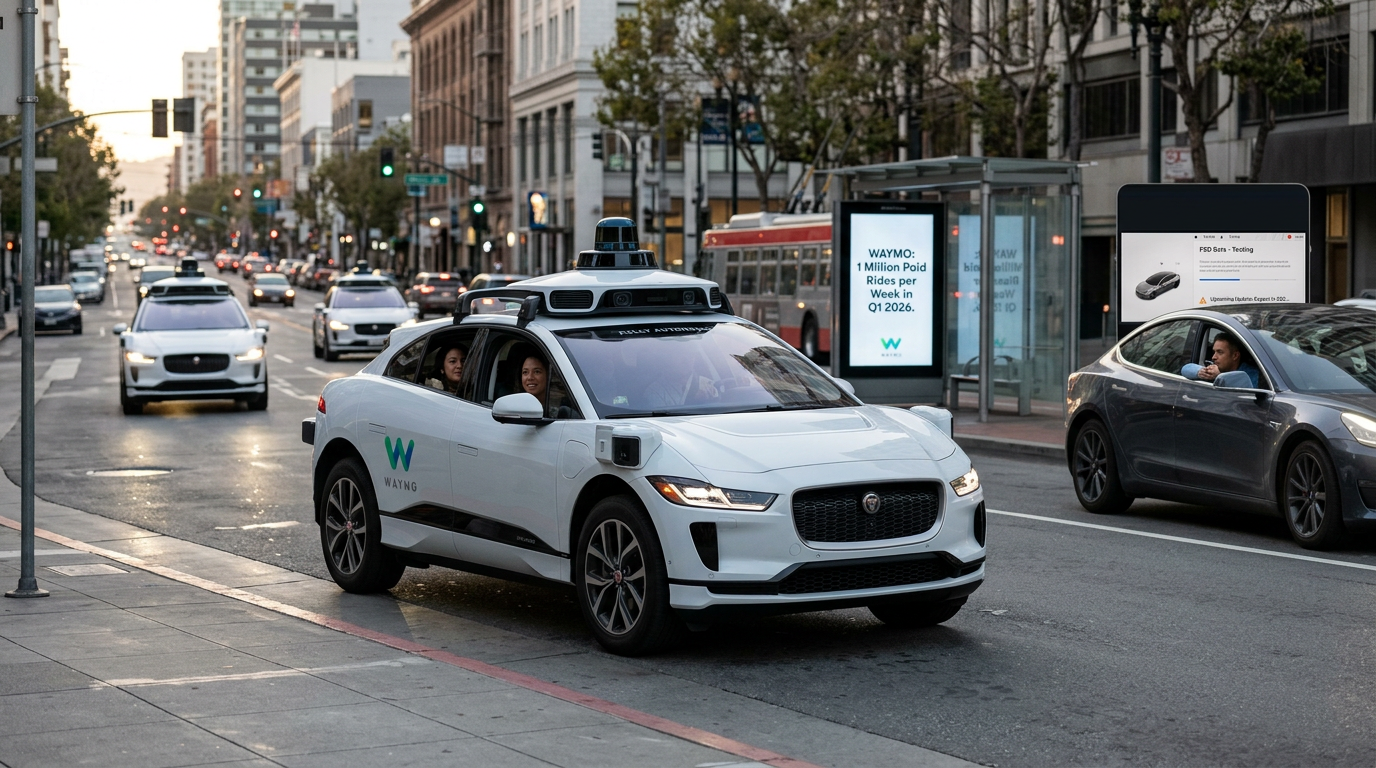
While the financial press was busy obsessing over tariff spreadsheets and Fed dot plots, something quietly historic happened in the autonomous vehicle space: Waymo surpassed 500,000 fully autonomous paid rides per week in Q1 2026 – confirmed by Alphabet on its earnings call on April 29th. Not test rides. Not employee shuttles. Paid. Commercial. Revenue-generating trips. And that number doubled in less than a year.
Slight tangent before we get into the numbers: the framing in most financial media has been almost comically backward. Half the coverage treated Waymo’s milestone as a footnote to Alphabet’s cloud beat. But if you’re looking at this business five years out, the 500K-rides-a-week data point may matter more than Google Cloud crossing $20 billion in quarterly revenue for the first time. Both are real. One is a new business. The other is a potential category-defining one.
Scoreboard
- Waymo: 500,000+ weekly fully autonomous paid rides (Q1 2026, confirmed by Alphabet earnings call); ride volume doubled in under a year
- Waymo valuation: $126 billion following a $16 billion Series D round closed in February 2026, led by Dragoneer, DST Global, and Sequoia
- Alphabet (GOOGL): Q1 revenue of $109.9 billion, up 20% year-over-year – largest growth rate since 2022; Google Cloud up 63% with a $460 billion backlog
- Tesla (TSLA): Cybercab production technically started at Giga Texas in April 2026 – but on AI4 hardware, with AI5 volume not expected until mid-2027; unsupervised FSD pushed to Q4 2026 at the earliest
- Tesla’s supervised robotaxi fleet: currently crashing at roughly four times the rate of human drivers – one incident per 57,000 miles versus a human benchmark of one per 229,000 miles
- Uber (UBER): up 22% YTD as autonomous partnership expansions with both Waymo and Aurora continue to compound
- GM’s Cruise unit: still dark, no confirmed relaunch date
Hidden in Tesla’s Filing: A $12 Billion “Super Startup”
Pull up Tesla’s most recent SEC filing. Page 5.
And you’ll see a single line showing $12 billion in revenue from a brand-new “super startup” Elon Musk has been quietly incubating inside Tesla.
This new “super startup” has nothing to do with cars or robots or space or AI…
But it sits at the center of what Blackstone calls “a $23 trillion investment opportunity.”
And on July 22, Elon is expected to pull back the curtain and reveal exactly what he’s building.
But Adam O’Dell already knows… and he reveals it all in this urgent video.
What Actually Happened
The market spent 2021 through 2024 pricing Tesla as the inevitable robotaxi monopoly. Elon Musk’s repeated timelines – full autonomy by 2020, then 2021, then 2023, then 2025 – trained investors to discount delay risk entirely. That discount is now getting repriced in real time, and the repricing is not a gentle correction.
Waymo, meanwhile, did the boring thing: it kept scaling in Phoenix, San Francisco, and Los Angeles without a product launch event, without a viral demo, and without a CEO tweet. It just drove. Millions of times. The result is a dataset and a safety record that competitors cannot replicate overnight. The 6th-generation Waymo Driver uses 13 cameras, 4 lidar sensors, and 6 radar units for 360-degree coverage up to 500 meters – and the company says it has trained on over 200 million fully driverless miles plus billions of simulated scenarios. That is not a moat you close in eighteen months.
Tesla’s situation is more complicated than the bear case suggests, but not by much. Cybercab production did officially begin – the first unit rolled off the Giga Texas line in February, with continuous production starting in April. The good news ends there. The Cybercab is launching on AI4 hardware, the same chip currently in Model Y and Cybertruck. AI5, which Tesla has spent over a year hyping as the key to the next autonomy phase, just reached tape-out – meaning volume production is still roughly 12 to 18 months away. Musk himself said on the Q1 call that large-scale robotaxi rollout will wait for FSD Version 15, with v14.3 serving as a bridge for limited markets. Three senior Cybercab program leaders have departed since February. The head of vehicle programs, the OTA and ride-hailing infrastructure director, and the assembly leader are all gone.
That is the real story. Waymo is running a mature, repeatable commercial operation. Tesla is running a very expensive beta test on outdated compute hardware, staffed by a program team that no longer includes its original managers.
Is There a Trade Here?
Alphabet trades at roughly 19x forward earnings as of late April 2026. Waymo is not yet broken out as a standalone segment – it sits inside “Other Bets,” which lost $2.1 billion in Q1 and generated only $411 million in revenue. That sounds bad until you realize what you are actually buying. At a $126 billion standalone valuation confirmed by outside institutional investors in February, you are getting one of the most commercially advanced AV platforms on earth essentially embedded inside a business that also owns Google Search, YouTube, and the fastest-growing major cloud division in the world. Sacra estimates Waymo hit approximately $355 million in annualized revenue in February 2026, up from $125 million at the end of 2024. That is a nearly 3x revenue run-rate in roughly fourteen months. Management targets 1 million weekly rides by year-end, which would translate to an annualized revenue run rate approaching $1.6 billion at current pricing.
Uber is the infrastructure play. It does not need to win the AV race outright; it just needs to be the network those cars ride on. Atlanta’s Waymo partnership runs exclusively through the Uber app. That is not an accident – it is a toll booth. At 28x forward earnings with 18% revenue growth, Uber is not dirt cheap. But the optionality embedded in being the distribution layer for multiple competing AV fleets is not fully priced.
What’s interesting is that Alphabet’s CapEx situation complicates the story slightly. The company spent $35.7 billion on capital expenditures in Q1 alone – a 107% year-over-year increase – and free cash flow dropped 47% year-over-year to $10.1 billion as a result. The CFO flagged that 2027 CapEx will “significantly increase” from 2026 levels. That is a real tension. You are buying a company that is simultaneously printing cash and burning it at an accelerating pace. The bet is that the infrastructure being built – cloud, AI, and Waymo – justifies the spend. So far, the results support that case.
J.P. Morgan Is Building on This Under-$1 Crypto
While fear hits levels not seen since 2022, major institutions aren’t backing off – they’re building. One little-known crypto is being used for real infrastructure tied to moving traditional assets on-chain. With supply tightening and activity expected to rise, this setup is getting harder to ignore.
Get the full breakdown on this under-$1 crypto before attention grows
Investor Checklist
- Watch for Waymo to file for a standalone valuation disclosure or partial IPO process in H2 2026 – the $126B Series D sets the floor
- Track weekly ride volume as the primary commercial indicator; the target of 1 million weekly rides by year-end is the next inflection
- Monitor Tesla FSD v15 release timeline – this is the gating factor for large-scale Cybercab rollout, and any further delay is a sentiment catalyst for GOOGL and UBER
- Watch Tesla’s supervised crash rate data; at one incident per 57,000 miles versus the human benchmark of one per 229,000 miles, the software gap with Waymo is not closing fast
- Aurora (AUR) remains the long-shot trucking angle; position sizing should reflect that binary risk
- Alphabet CapEx trajectory: if free cash flow continues compressing while Waymo scales revenue, the sum-of-the-parts math starts doing the heavy lifting on valuation
Bottom line: If Waymo hits 1 million weekly rides before year-end – which management is publicly targeting – Alphabet’s sum-of-the-parts story forces a rerating that the current 19x multiple does not reflect. The trade is long GOOGL as the value anchor, long UBER as the network toll collector, and short complacency on Tesla’s AV timeline. The Cybercab is real hardware. The software that makes it work commercially is not.