
April 28, 2026
The Humanoid Robot Race Is No Longer Theoretical
Tesla, Optimus V3, and the supply chain plays investors are quietly loading up on as physical AI moves from factory floor to mainstream.
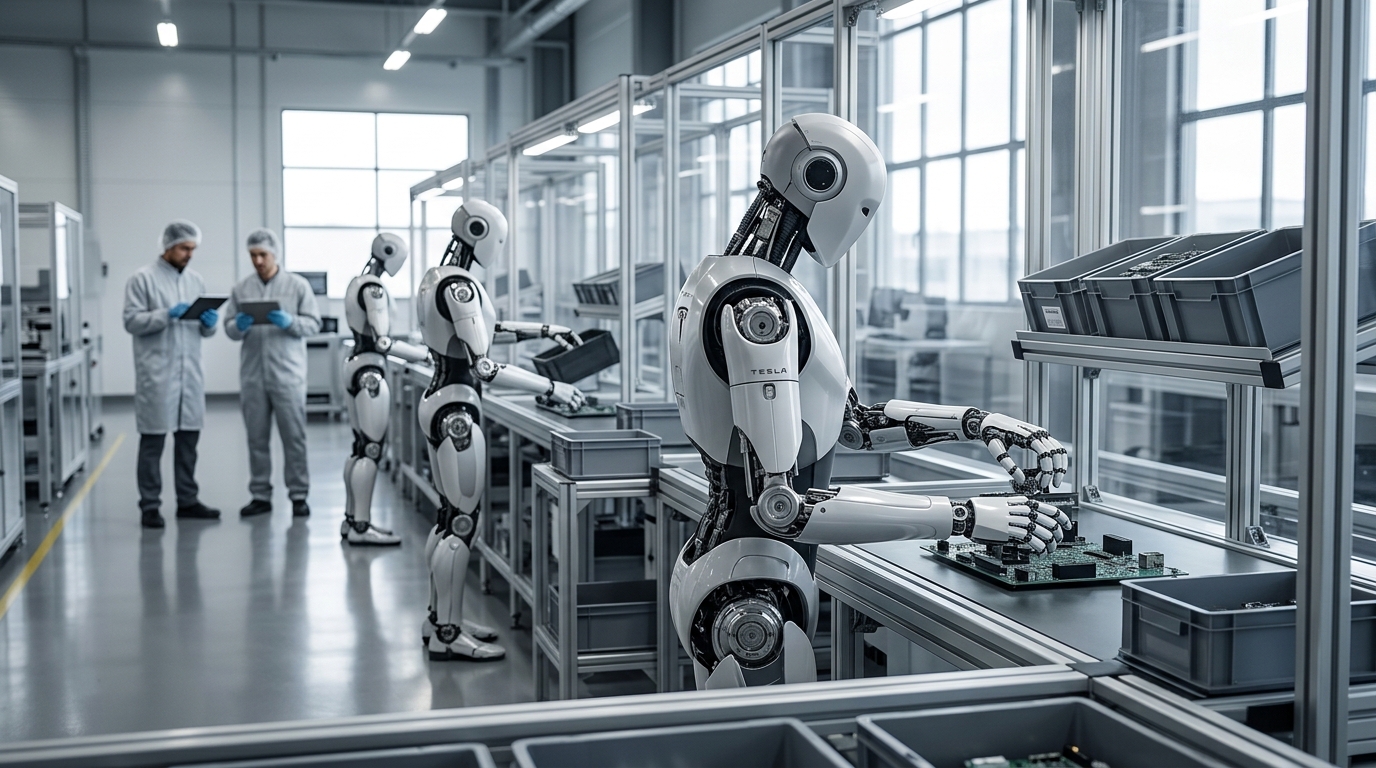
For years, humanoid robots were a punchline wrapped in a press release. Not anymore. As of right now — April 2026 — the machines are working. And the investment thesis has shifted from “if” to “when” and, more importantly, “who profits.”
Tesla made it official on April 23. Optimus V3 is slated for a mid-year debut, with large-scale production targeted for July–August 2026. The V3 features 37 joints — nine more than the previous generation — improved dexterity, and a walking speed of 1.2 m/s. It can also walk stably on 15-degree slopes and quickly recover its balance, which sounds minor until you realize prior generations struggled with uneven floors. Tesla has already converted its Model S/X production lines at Fremont to accommodate Optimus manufacturing. That’s not a prototype announcement. That’s a company physically rearranging its factory footprint.
Worth mentioning: Musk confirmed during Q1 earnings that Tesla is deliberately limiting public demos of V3’s most advanced capabilities. The reasoning — rival companies are studying every reveal in detail. So what’s already been shown may not reflect what the robot can actually do.
Intel spiked. Smart money is looking upstream
Intel just surged 23.6% after earnings, one of its biggest moves in decades. Investors are flooding into AI infrastructure. But chips aren’t the full story.
AI runs on data. And real, human data is becoming scarce. Mode Mobile is building directly into that gap with a 490M+ user ecosystem generating consented,< real-world behavior.
They’ve already driven $115M+ in revenue and helped users earn over $1B. As AI scales, data suppliers may capture outsized value. Mode is still private, with shares at $0.50.
Get in before the next wave of AI value is priced in.
Please read the offering circular at invest.modemobile.com. This is a paid advertisement for Mode Mobile’s Regulation A Offering.
The Spending Behind the Vision
In its Q1 2026 earnings call, Tesla revealed a $25 billion capex plan for the year — a nearly threefold increase from the prior year. It covers six new factories, Optimus production, Cybercab manufacturing, and AI infrastructure. Tesla reported $0.41 non-GAAP EPS and $22.38 billion in revenue for Q1, beating expectations. The stock initially surged 4% in after-hours. Then the $25B capex number hit, and shares reversed — a sign of real investor tension between the long-term vision and near-term execution risk.
That tension is the trade.
Elon Musk has stated Optimus could account for 80% of Tesla’s long-term valuation. Wedbush’s Dan Ives calls Tesla the best physical AI company in the world. Goldman Sachs estimates the humanoid robotics market could hit $38 billion by 2035. Morgan Stanley’s global robotics model goes further — projecting annual humanoid robot market revenue of $7.5 trillion by 2050. The range of outcomes here is genuinely extreme — which is exactly what makes this sector so interesting right now.
Slight tangent, but it matters: Tesla’s AI training advantage isn’t just about hardware. All of Optimus V3’s AI is being trained on Tesla’s Cortex 2.0 supercomputer at Giga Texas — with its first 250 MW phase expected online in April 2026 and full 500 MW capacity by mid-2026. The timing is deliberate. Cortex comes online just as V3 production begins, creating a closed loop where factory robots continuously feed real manipulation data back into the training system. No other robotics company has anything close to that flywheel.
The Part People Skip — Supply Chain Plays
Tesla gets the headlines. But the smarter money is quietly accumulating the picks-and-shovels layer. Every humanoid robot needs vision chips, actuators, edge AI compute, and rare earth materials. None of those are Tesla’s to own exclusively.
- Qualcomm (QCOM) — Its Dragonwing IQ10 chips are designed specifically for robots requiring 5G connectivity and on-device AI; already working with Figure, Kuka, and others to power humanoid platforms
- NVIDIA (NVDA) — Every robot trains in NVIDIA’s Isaac Sim virtual environment before deploying in the real world; Boston Dynamics and Agility Robotics are both running on NVIDIA’s Jetson Thor platform
- Harmonic Drive Systems — Precision actuators that are a direct supply chain bottleneck for humanoid joints; fewer than 10 global suppliers can produce the torque precision these robots require
- MP Materials — Rare earth magnets; you can’t build these robots without them, and the Western supply chain for rare earths is severely constrained
- Ambarella (AMBA) — Low-power vision AI chips that process sensor data on the edge instantly; when a robot needs to react in real time, cloud round-trips aren’t an option
UBS estimates the chip market tied specifically to humanoid robots will grow from $21 million in 2025 to $177 billion by 2050 — nearly 28% of today’s entire semiconductor industry. That number alone reframes how to think about NVDA and QCOM exposure.
Boston Dynamics, Agility Robotics, and Figure AI are all advancing competing platforms. Figure AI — backed by Intel, NVIDIA, Qualcomm, and Brookfield Asset Management among others — hit a $39 billion valuation after its September 2025 Series C. XPeng’s IRON humanoid, featuring 82 degrees of freedom and powered by three Turing AI chips, is targeting large-scale mass production by year-end. This is not a one-company story. And China’s manufacturers — Unitree, UBTECH, Fourier Intelligence — benefit from government subsidies and established domestic supply chains that let them undercut Western pricing significantly.
Your Free Options Book Is About to Vanish
In case you missed it… make sure you get your free “Simple Options Trading For Beginners” book before your link expires.
I eventually plan to charge money for this training, so do yourself a favor and download it now…
That way, no matter what it costs in the future, you’ll have a free copy.
Sound good?
What Investors Should Watch
Production milestones matter more than announcements right now. Watch for Tesla’s actual unit count out of Fremont in Q3 — Musk has targeted 50,000–100,000 units by year-end, though that range should be read as a ceiling, not a floor. The ramp is described internally as starting “very slow.” Watch Bill of Materials compression: the sub-$20,000 price target is the key to mass market adoption, and Tesla’s cost-reduction thesis rests entirely on vertical integration — building its own actuators, chips, and sensors rather than sourcing from third parties. And watch whether any non-Tesla robotics company announces meaningful commercial contracts — that’s the signal that the market is genuinely opening up beyond one player.
One more thing worth tracking: Morgan Stanley flagged the gap between “dancing robots” and robots with scalable practical value. Current humanoid robots require maintenance every 200–500 operating hours. Industrial robotic arms run 50,000+ hours between major services. That gap is real, and it’s not showing up in most bull cases.
The robots aren’t coming. They’re already clocking in. The question left on the table: which companies own the supply chain when this scales to millions of units?
For informational purposes only.