By Isla Binnie and Sophie Kiderlin
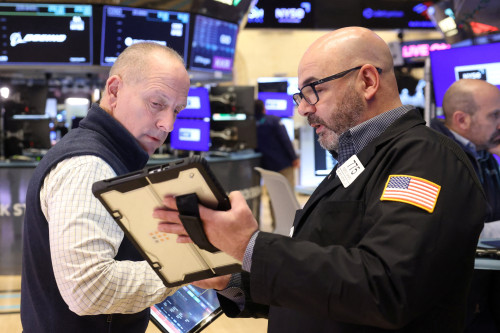
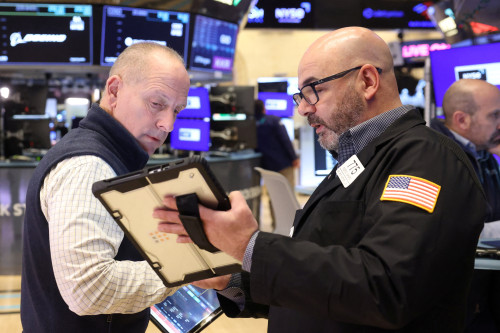
Jan 16 (Reuters) – Major Wall Street indexes nudged higher in volatile trading on Friday, helped by a return to AI-driven enthusiasm for chip stocks, while gold fell and the dollar paused near a six-week high as traders bet the Federal Reserve would wait before cutting interest rates.
Gold slowed going into the weekend after a roaring ride on safe haven demand. Oil prices, however, rose as the market continued to fret about supply risks, even after U.S. President Donald Trump dialed down talk of intervening to address a government crackdown on protests in Iran.
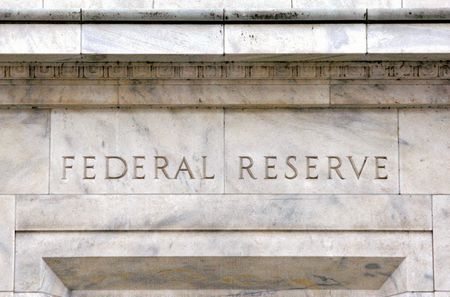
Just two full trading weeks into 2026, investors have been presented with a global maelstrom, including Trump’s intervention in Venezuela, stated desire to take over Greenland, and threat to indict Fed chair Jerome Powell, which raised worries about central bank independence.
U.S. indexes turned lower for a time while Treasury yields ticked up after President Donald Trump said he may want to keep economic adviser Kevin Hassett in his current role, eroding expectations that Hassett would succeed Fed Chair Jerome Powell.
Hassett, who had been seen as the front-runner for the chair, has echoed Trump’s calls for lower interest rates and analysts have questioned whether his appointment to the Fed would undercut the independence that shields it from short-term political pressures.
Betters on Polymarket pushed the odds of former Fed Governor Kevin Warsh becoming the next Fed chair to 57% from 44%.
U.S. Treasury yields moved higher after Trump’s remarks. The yield on benchmark U.S. 10-year notes was last seen up 5.9 basis points at 4.219%, from 4.16% late on Thursday.
SHOT IN THE ARM FOR AI
Stock traders rediscovered their enthusiasm for AI after strong results from chipmaker TSMC, even as some buyers switched out of heavyweight tech names into smaller cap stocks on the hunt for value.
The Dow Jones Industrial Average rose 0.03%, to 49,458.62, the S&P 500 rose 0.10%, to 6,951.62 and the Nasdaq Composite rose 0.12%, to 23,558.38
The indexes were heading towards modest weekly losses, even though the Dow and S&P 500 clocked record closes on Monday.
A trade deal clinched by the U.S. and Taiwan on Thursday cuts tariffs on many of the semiconductor powerhouse’s exports, and direct investments towards the U.S. technology industry. This risks infuriating China, but could bode well for businesses in the supply chain.
“I guess with the TSMC report yesterday being pretty solid and sounding optimistic, it certainly provided a much-needed shot in the arm for those AI names which have been struggling on Wall Street in recent months,” Tony Sycamore, a market analyst at IG, said.
The Martin Luther King Jr. Day holiday will keep U.S. markets shut on Monday, but the earnings season romps along next week with results due from Netflix, Johnson & Johnson and Intel.
The financials sector was headed for its worst week since October, partly due to a proposal from Trump to cap credit card interest rates. That jostled with strong quarterly earnings from big U.S. banks which gave some positive signs for the broader economy.
Consumer staples, real estate and utilities – all sectors less susceptible to downturns – were leading weekly gains.
Some money also shifted out of heavyweight tech names into smaller cap stocks.
DOLLAR AT HIGH, TRADERS WATCH YEN
The dollar held below a six-week high hit on Thursday and was poised for a third consecutive weekly gain. Measured against a basket of currencies, including the yen and the euro, the dollar rose 0.05% to 99.39, with the euro down 0.08% at $1.1597.
Some of the dollar enthusiasm came from data showing unexpected strength in the U.S. labor market, which delayed the prospect of further interest rate cuts.
Markets are betting on a 20% chance of a Fed rate cut in March, down from roughly 50% a month ago.
Japanese Finance Minister Satsuki Katayama put traders on alert for currency intervention when she would not rule out any options to counter weakness in the yen. The yen strengthened 0.32% against the dollar to 158.15 per dollar.
LINGERING IRAN RISK
Lingering concerns about risk to oil supply in the wake of unrest in Iran kept oil prices off the week’s peaks but higher on the day, despite receding prospects of U.S. intervention there. [O/R] Traders were also covering themselves ahead of the long weekend.
U.S. crude rose 1.03% to $59.80 a barrel and Brent rose to $64.43 per barrel, up 1.05% on the day.
Analysts expect higher oil supply this year, which could put a cap on price rises.
Gold gave up its spot as the biggest trade in town as investors booked profits and demand waned for safe havens. It fell more than 1% before recovering some ground to be quoted 0.57% lower on the day at $4,588.23 an ounce.
Geopolitical and economic uncertainty are generally positive for gold, as investors seek safe havens. It is also priced in dollars, meaning strength in the U.S. currency makes it more expensive for overseas buyers.
(Reporting by Isla Binnie, Sophie Kiderlin in London and Rae Wee in Singapore; Editing by Dhara Ranasinghe, Andrew Heavens, Susan Fenton and Aurora Ellis)