(Corrects title of Manuel Muñiz to rector and name of the institution to IE University in paragraph 14)
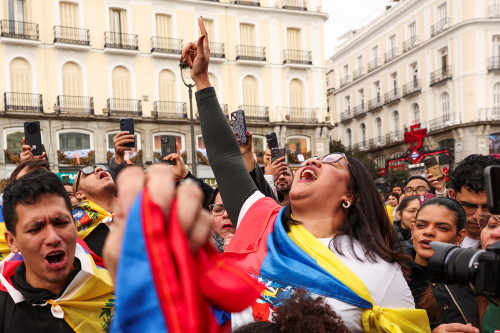
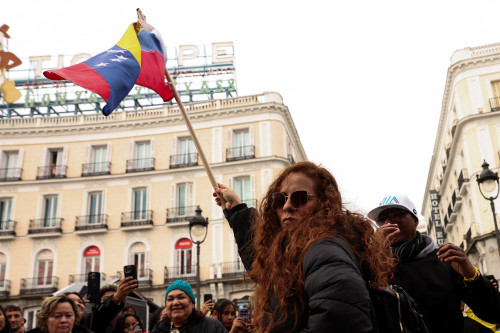
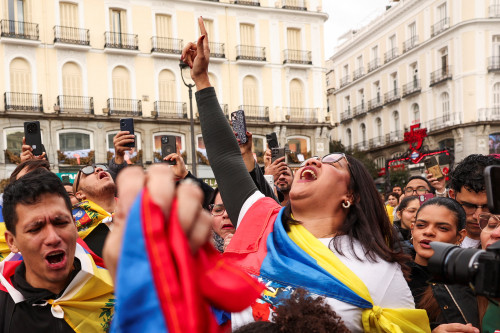
MADRID, Jan 3 (Reuters) – In Madrid, Venezuelan opposition activists and others who follow the situation in their homeland were glued to TV and social media on Saturday, amazed by news of Nicolas Maduro’s capture by U.S. forces.
But they also wondered what comes next.
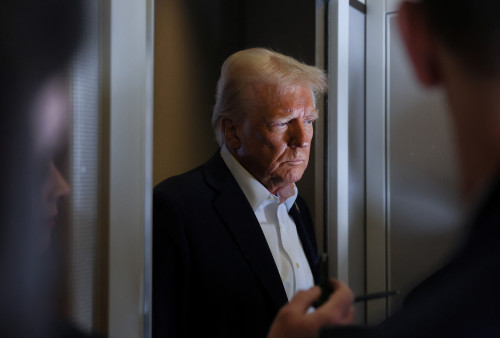
U.S. President Donald Trump, who had been applying intense pressure on Maduro for months, announced that U.S. forces had captured Maduro and flown him out of the country, saying later that the Venezuelan leader and his wife would be taken to New York.
Spain is home to the largest Venezuelan migrant population outside Latin America and the U.S., and they include senior opposition figures including Edmundo Gonzalez and Leopoldo Lopez.
“We are all happy,” one opposition figure told Reuters by WhatsApp. “But we must ensure that the transition is orderly, peaceful and respectful,” said the person, who declined to be named because of the sensitivity of the situation.
This person rejected the idea that Vice President Delcy Rodriguez might now take power, saying that the opposition leaders who won past elections before being blocked by Maduro were the rightful heirs to the Venezuelan presidency.
Venezuela’s opposition, the United States and many other Western countries considered Maduro’s election wins in 2018 and 2024 to be fraudulent.
“The Venezuelan people voted massively for Edmundo (Gonzalez) and Maria Corina Machado. Edmundo is the president-elect with constitutional legitimacy,” the person said, referring to the July 2024 election and adding this ruled out Rodriguez.
‘BEGINNING OF NEW STAGE’
Manuel Garcia, a former opposition leader and lawmaker who left Venezuela after the disputed 2024 election, said the speed of Maduro’s removal demonstrated his government did not have the “military capacity they have been boasting about”.
“Today marks the beginning of a new stage that will culminate in the consolidation of the transition led by María Corina and President Edmundo Gonzalez,” Garcia said.
José Miguel Calvillo, an international affairs and migration professor at Madrid’s Complutense University, said it was “very likely” that the U.S. had already had some back-channel discussions with elements of the Venezuelan government and the military to arrange a transition.
“If it is confirmed that the intervention of the United States has been supported by the internal government, a transitional government will be expected to include major players from the current opposition,” he said.
“What is desirable for both Venezuela and the U.S. is that there will not be a radical break with the current government but rather a moderate transition.”
Manuel Muñiz, rector of Spain’s IE University, said the coming days would test the strength both of the opposition and the Venezuelan government beyond just Maduro.
“The Venezuelan regime is quite granular and present throughout Venezuelan society,” he said. “There are a number of avenues in front of us, and not all of them lead to open, peaceful elections and a transition of power in Venezuela. There are some that lead to violence, disorder and instability.”
DIVERGENT OPPOSITION VIEWS
Jimena Blanco, chief analyst for risk consultancy Verisk Maplecroft, said there were divergent views in the opposition about whether Machado or Gonzalez should take the presidency.
Machado was barred from running in the 2024 presidential election, despite having won the opposition’s primary by a landslide, and her ally Edmundo Gonzalez took her place as the main opposition candidate.
Machado won the 2025 Nobel Peace Prize for her work promoting democracy.
Blanco said that while Gonzalez may be the constitutionally elected president, Machado is credited with unifying the opposition, creating the conditions for his election and risking her life staying in Venezuela to maintain opposition momentum.
“There are others that argue that Edmundo Gonzalez is elected president and he should take office,” she said.
Scenarios discussed in opposition circles included a military junta of second or third tier armed forces leaders overseeing a civilian cabinet of opposition leaders that did not include Machado, for her to then run in elections.
“For her it would be very damaging if she was to be seen as to be placed in power rather than ascending to power through democratic channels she has tried to promote,” Blanco said.
YEARNING FOR HOME
In the Canary Islands, a Spanish archipelago where many Venezuelans live, Agustín Rodríguez, vice president of the Canarian-Venezuelan Union migrant support network, said he had mixed feelings about Saturday’s events.
But he hoped it meant the third of Venezuela’s population that lives in exile – something he described as the country’s “displaced heart” – could return.
Some 7.7 million Venezuelans left the country in recent years.
“No one likes to see these kinds of fireworks, but they may be necessary to find a way out for the country in which there can be a return to power alternation, there can be a future, people can return to their country,” he said.
(Reporting by Corina Pons, Ana Cantero and Aislinn LaingWriting by Aislinn LaingEditing by Frances Kerry)